

Sponsored Content - EU
The optimized dual solid phase extraction (SPE) method was developed to significantly reduce the surfactant background from formulated drug products.
Sponsored Content - EU
The optimized dual solid phase extraction (SPE) method was developed to significantly reduce the surfactant background from formulated drug products.
Sponsored Content - EU
A HILIC solid phase extraction (SPE) and LC method that results in sensitive, effective, and a time savings for the clean-up of N-Glycans.
Sponsored Content - EU
A fast analytical method including both sample preparation and LC–ƒMS/MS analysis of ibuprofen in human plasma.
Sponsored Content - NA
Implementing a peptide screening SPE plate determines the appropriate choice for a wide range of chemically diverse peptides.
Sponsored Content - NA
The optimized dual solid phase extraction (SPE) method was developed to significantly reduce the surfactant background from formulated drug products.
Sponsored Content - NA
A HILIC solid phase extraction (SPE) and LC method that results in sensitive, effective, and a time savings for the clean-up of N-Glycans.
Sponsored Content - EU
The development of a selective and rugged LC–MS/MS method for the quantitation of Amlodipine enantiomers in human plasma.
Sponsored Content - EU
GenX, along with 24 other PFASs, are analyzed simultaneously to achieve sub-ppt reporting limits.
Sponsored Content - EU
A reliable and efficient method was developed to determine the concentration sterols in olive oil by GC-FID.
Sponsored Content - NA
The development of a selective and rugged LC–MS/MS method for the quantitation of Amlodipine enantiomers in human plasma.
Sponsored Content - EU
SPE is used in combination with LC–MS/MS to analyze a panel of opiates from a urine sample.
Sponsored Content - EU
Mycotoxin in grain are extracted using SPE to removes interferences followed by a rapid LC–MS/MS method.
Sponsored Content - NA
Mycotoxin in grain are extracted using SPE to removes interferences followed by a rapid LC–MS/MS method.
Sponsored Content - NA
GenX, along with 24 other PFASs, are analyzed simultaneously to achieve sub-ppt reporting limits.
Sponsored Content - NA
A fast analytical method including both sample preparation and LC–ƒMS/MS analysis of ibuprofen in human plasma.
Sponsored Content - NA
SPE is used in combination with LC–MS/MS to analyze a panel of opiates from a urine sample.
Sponsored Content - EU
Optimize the LC–MS/MS workflow by using a SPE solution that provides in-well urine hydrolysis to save time.
Sponsored Content - NA
Optimize the LC–MS/MS workflow by using a SPE solution that provides in-well urine hydrolysis to save time.
Sponsored Content - NA
A reliable and efficient method was developed to determine the concentration sterols in olive oil by GC-FID.
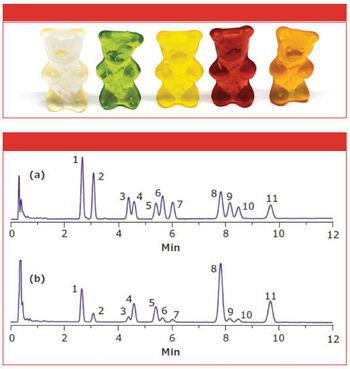
Potency testing in marijuana-infused edibles is a problematic task due to the complexity of the matrices. The concentration of active ingredients in edibles can range from a few ppm to 3.5% (1). In this application, active cannabinoid compounds were extracted from gummy bears (and also brownies, results not shown), followed by HPLC analysis.

LCGC North America

LCGC North America

This method showed excellent precision and accuracy for the 12 FDA regulated mycotoxins that were evaluated during a validation study that covered a variety of matrices.

Organic arsenic compounds added to feed stocks of chicken and poultry pose serious environmental and ecological threats. National and worldwide health organizations, such as the U.S. Environmental Protection Agency and the U.S. Food and Drug Administration, have recently implemented more stringent concentration limits for arsenic species in drinking water and foodstuffs.

Living organisms (yeast and bacteria) were not identified as the agents that produced or spoiled common food items until the 19th century. Baking, especially of bread, was among the first industries to be transformed by the emerging scientific understanding of fermentation. The introduction of commercialized yeast in the early 20th century steadily reduced the time needed to bake bread both at home and on the production line, making way for modern packaged breads.
This method showed excellent precision and accuracy for the 12 FDA regulated mycotoxins that were evaluated during a validation study that covered a variety of matrices.

Pickering Laboratories developed an analytical method to comply with all the chromatographic requirements of Commission Regulation (EC) No 152-2009.
Sponsored Content - EU
Sensitive detection of more than 250 pesticide residues in foods using the Agilent Ultivo Triple Quadrupole LC/MS system