Application Notes: Food and Beverage

i8_t-611591-1408645966748.jpg

The United States Food and Drug Administration (U.S. FDA) and the European Union (EU) have published regulations and provided guidance on the use of chemicals in food packaging materials. Tekmar provides method parameters for the HT3â„¢ Automated Headspace Analyzer for the determination of VOCs that may be contained in food contact packaging materials under various conditions. Temperature and mixing parameters were investigated to determine which VOCs may be released when subjected to these conditions.

i4-611597-1408645940814.jpg

Simulated Moving Bed technology (SMB) is a continuous chromatography technique widely used in the pharmaceutical/biotechnology industry. The continuous chromatographic separation of sodium sulphate (Na2 SO4) from a mixture of glucose and mannose was established by using the Orochem Zuccheroâ„¢ columns and the SMB technology. The main advantages of SMB over batch chromatography includes better yields, higher purity, and decreased solvent usage, which together make the SMB technology economically viable and ideal for desalting applications.

i4-611594-1408645950986.jpg

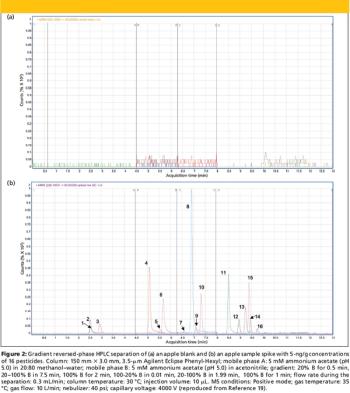
Based on the QuEChERS AOAC Official Method 2007.01, sixteen pesticides were used for evaluating the performance of the Agilent's AOAC Buffered Extraction and SampliQ QuEChERS Dispersive SPE kits for General Fruits and Vegetables. Apple was selected as the fruit matrix. The pesticides are from the "representative pesticides" list (1). A method working well for these representative pesticides should work equally well for the other pesticides that are routinely monitored in multi-class, multi-residue methods. The compounds are from nine different pesticide classes: including acidic, basic, neutral, base-sensitive, and acid-labile pesticides. The selected pesticides are suitable for LC–MS-MS analysis. The MRLs of these pesticides have been set at 10 ng/g or higher (2–4).

i4-627638-1408644906003.jpg

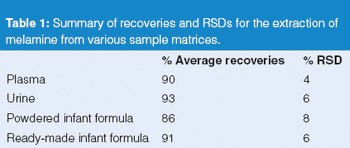
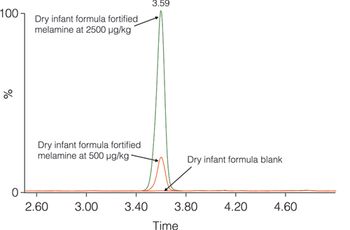
Since September 2008, 294 000 infants and young children suffered urinary problems as a result of the contamination of melamine in infant milk powder and were hospitalized. This hospitalization was required to treat the symptoms caused by the ingestion of melamine contaminated infant formula and related dairy products. Previously in 2007, pet food, animal feed wheat gluten and other protein-based foods were found to contain residues of melamine and its degradation product cyanuric acid.

i1-627642-1417781016914.jpg

Penicillins are regulated substances in food for human consumption. The minimum residue limits range from 1 ng/g to as high as 50 ng/g depending on the compound. Because of the complexity of food matrices measuring the level of contaminants requires a total solution composed of sample extraction, sample clean-up, chromatographic separation and detection. In this paper, a solid-phase extraction method with a high performance liquid chromatography tandem mass spectrometry method (HPLC–MS–MS) is shown for the simultaneous determination of six antibiotic residues.

i1-581394-1417781681959.jpg

Gel Permeation Chromatography (GPC) is widely used for sample clean up in mycotoxin analysis. The most commonly described methods use GPC columns packed with SX-3 BioBeads suitable for cleaning Zearalenone, Aflatoxins, and Trichothesenes from edible oils and fatty matrices. Separation of Fumonisins from the oil fraction are inadequate with this column.

i4-581393-1408661018023.jpg

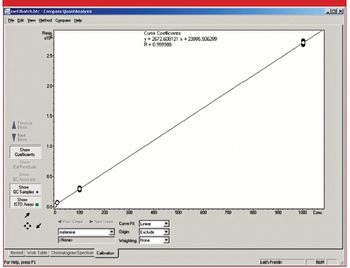
The recent establishment of a 1 μg/g safety threshold for melamine in infant foods has led to an immediate need for more sensitive methods. Here we established GC–MS conditions for highly reproducible analyses and evaluated the effectiveness of both solvent-based and matrix-matched standards. Using this method, melamine and cyanuric acid were reliably detected at and below 1 μg/g in infant formula.

i4-581391-1408661023676.jpg

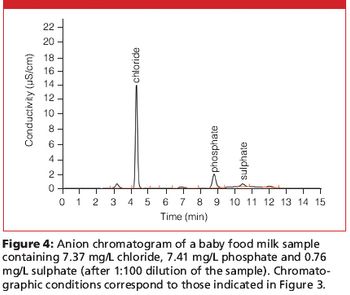
Run a difficult food sample on your IC and you stand a big chance that you will wreck the column. Of course, you can waste a lot of time on tedious sample preparation steps to eliminate undesired matrix components. Or you can go for Metrohm's automated compact stopped-flow dialysis providing optimum separation while protecting your column from detrimental compounds.

i1-581392-1408661021257.jpg

Melamine is an industrial chemical with a high nitrogen content that can cause kidney stones and lead to renal failure. In some instances, melamine has been added to baby formula and dairy products as a substitute for protein. This paper presents an efficient and definitive gas chromatography–mass spectrometry (GC–MS) method to identify melamine and related compounds based on the released US Food and Drug Administration (FDA) method.

i4-581396-1408661005807.gif

Melamine is an organic base and a trimer of cyanamide, with a 1,3,5-triazine skeleton. Melamine can react with formaldehyde to produce melamine resin, a very durable thermosetting plastic, and melamine foam, a polymeric cleaning product. Some end products made from melamine include countertops, dry erase boards, fabrics, glues, housewares, and flame retardants. Melamine is also one of the major components in Pigment Yellow 150, a colorant in inks and plastics.

i4-581389-1408661030618.jpg

LC–MS-MS instruments operating in Multiple Reaction Monitoring (MRM) are widely used for targeted quantitation on triple quadrupole and hybrid triple quadrupole linear ion trap (QTRAP® ) systems because of their well known selectivity and sensitivity. In MRM mode, the first quadrupole (Q1) filters a specific precursor ion; the collision cell (Q2) generates fragments (product ions) which are filtered in the third quadrupole (Q3). Although this double mass filtering greatly reduces noise there is always a chance that elevated background levels or matrix signals interfere with the targeted analyte.

i4-581395-1408661009455.jpg

The global economic downturn, particularly the collapse of the automotive and associated industries, has caused an overall reduction in the demand for acrylonitrile. Since acetonitrile is obtained as a co-product in the production of acrylonitrile, the pharmaceutical, food, environmental, and chemical industries are experiencing an unprecedented acetonitrile shortage. This shortage has resulted in a sharp price increase, in some cases as much as 6-8 times; and the price is projected to remain high even after the production returns to normal.

i4-581390-1408661026266.jpg

Since September 2008, 294,000 infants and young children suffered urinary problems due to the contamination of melamine in infant milk powder and were hospitalized. This hospitalization was required to treat the symptoms caused by the ingestion of melamine contaminated infant formula and related dairy products. Previously in 2007, pet food, animal feed, wheat gluten, and other protein-based foods were found to contain residues of melamine and its degradation product cyanuric acid (2).

i1_t-581397-1416915117604.gif

The analysis of chemical residues in food requires techniques sensitive enough to detect and quantify contaminants at or below the maximum residue limit (MRL) of the compound in a given sample matrix. Because of increased food safety regulations and the growing numbers of samples to be analyzed, it is critical that the analytical techniques provide high sample throughput.

i1-582469-1408659520534.jpg

Melamine is an industrial chemical with a high nitrogen content that can cause kidney stones and lead to renal failure. In some instances, melamine has been added to baby formula and dairy products as a substitute for protein. This paper presents an efficient and definitive gas chromatography–mass spectrometry (GC–MS) method to identify melamine and related compounds based on the released US Food and Drug Administration (FDA) method.

i3-575600-1408667229025.gif

The recent development of ultra-HPLC (UHPLC) has provided a great potential for high throughput analysis achieved using small (sub-2 μm) particle size columns at increased linear velocities. The advantage of UHPLC over conventional HPLC is increased throughput without sacrificing resolution. Despite their popularity, sub-2 μm particle columns impose practical difficulties, such as high backpressure (which often requires a UHPLC system) and susceptibility to column fouling. Thus difficulty can be overcome using 2.0 to 2.5 μm particles. This study describes an example (analysis of vanilla extract) of transferring a conventional LC method to a high-throughput method using newly developed Acclaim® RSLC 2-μm columns that are based on spherical, porous, high-purity silica particles (dp = 2 μm, pore size = 120 Å, surface area = 320 m2/g).

i2-575604-1408667207725.gif

Recent developments in HRes Fast-LC systems have enabled the use of sub-3 μm stationary phases at higher flow rates and elevated pressures. HRes Fast-LC can provide significant improvements in both resolution and throughput.

i4-575599-1408667241709.gif

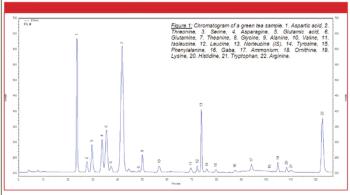
Organic acids are present in many matrices and play crucial roles. Extensive research involving low molecular mass organic acids (LMMOA) has been performed in food chemistry since these acids contribute to the organoleptic properties of food and beverages, including flavor, color, aroma, taste, shelf-life, and health effects. Developing a profiling method to monitor LMMOA levels in raw materials and final products is very desirable. Many reported methods focus on limited numbers of LMMOAs and are incapable of providing a complete LMMOA profile.

i4-575602-1408667216511.gif

Screening for pesticide content is a common analysis that is done in laboratories where many samples need to be analyzed over a short period of time. The desire for a high-speed analysis is due to the need for a fast result from a potentially large volume of samples. A fast analysis is typically achieved through the use of high carrier gas flow rates in combination with temperature programming. A fast detector is needed in order to fully characterize the narrow chromatographic peaks generated from these experiments. TOFMS is ideal for detecting these narrow peaks because of its fast acquisition rate over a full mass range at all times during the experiment. In addition, TOFMS provides for non-skewed mass spectra making peak deconvolution possible.

i3-575601-1408667222086.gif

Mycotoxins, toxic secondary metabolites of several fungal species, represent food safety issues of high concern. Deoxynivalenol, the most abundant trichothecene mycotoxin, can be found worldwide as a contaminant of wheat, barley, maize and other cereals (1,2). The transmission of deoxynivalenol from barley into beer has been reported in several studies (3,4). Therefore, its levels should be controlled.

i4-575603-1408667211448.gif

This article describes a straightforward ion chromatographic method that uses isocratic elution and pulsed amperometric detection (PAD) to sensitively determine water-soluble polyols and sugar alcohols as well as mono-, di- and oligosaccharides in essential and nonessential foodstuffs. While carbohydrate determination of most foodstuffs requires only minimal sample pretreatment such as dilution and filtration, samples with interfering matrices such as protein-containing dairy products have to be dialyzed prior to injection.

i1-547873-1408670637855.jpg

Mycotoxins, toxic secondary metabolites of several fungal species, represent food safety issues of high concern. Deoxynivalenol, the most abundant trichothecene mycotoxin, can be found worldwide as a contaminant of wheat, barley, maize and other cereals (1,2). The transmission of deoxynivalenol from barley into beer has been reported in several studies (3,4). Therefore, its levels should be controlled.