Application Notes: Food and Beverage

i1-762636-1408612829711.jpg

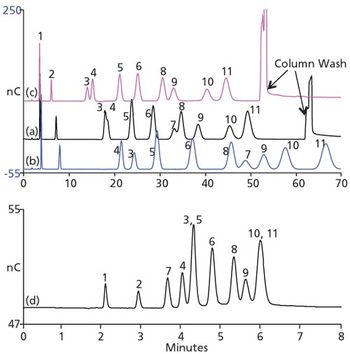
Omega-3 and -6 fatty acids are essential compounds required for normal growth. Omega-3 consumption is purported to have a number of health benefits, e.g., cancer prevention, cardiovascular disease prevention, and improved immune function. Although both omega-3 and -6 fatty acids can give rise to eicosanoid-signaling molecules (prostaglandins, prostacyclins, thromboxanes, and leukotrienes), the omega-6 eicosanoids are generally proinflammatory. A person's diet requires a balance of omega fatty acids at suitable levels.

i1-762626-1408612856295.jpg

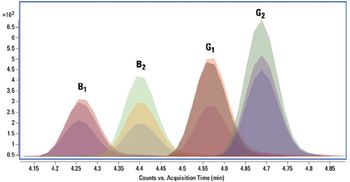
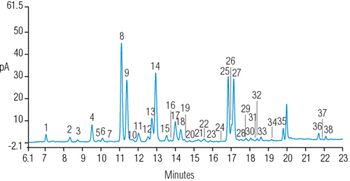
Various triarylmethane and fluorescent dyes are used in aquaculture as antibacterial, antifungal, and anthelmintic agents for the treatment of fish disease. The FDA has banned the importation of certain fish from several countries due to possible contamination of these food products.

i1-762628-1408612850149.jpg

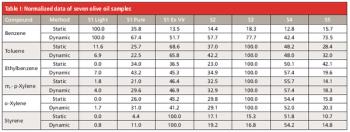
By identifying maturation tracers and molecules commonly responsible for taste defects, gas chromatography–mass spectrometry (GC–MS) augments expert opinion with objective and quantitative information. When using a solid phase micro extraction (SPME) method, GC–MS requires very small sample sizes and a minimum of sample preparation while providing rapid analysis of target molecules. GC–MS can provide an automated technique with repeatable results for detecting all of these compounds.

i4-739803-1417780411667.gif

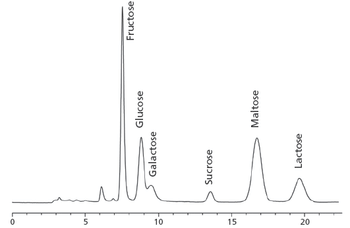
The types and amounts of sugar in animal feeds are as important as the amount of protein, minerals, and fats in the determination of nutritive value. We developed a simple and sensitive HPLC method for analyzing six sugars in animal feeds – sucrose, fructose, glucose, galactose, maltose, and lactose. Post-column derivatization reagents convert reducing and nonreducing sugars into fluorescent derivatives, which greatly improves the sensitivity and selectivity of the detection.

i1_t-739826-1408616962663.gif

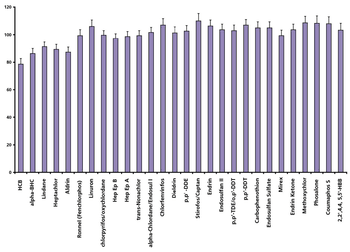
The iDQuant? Standards Kit for pesticide analysis of certified reference material (ISP Guide 34, IOS/IEC 17025, and ISO 9001:2008) includes 204 pesticides in 10 mixes at a concentration of 100 ?g/mL. This kit has been designed to eliminate the need to source pesticides individually, and measure each one manually. This allows users to setup, verify, and validate the performance of pesticide screening methods faster.

i2-739804-1408617006959.gif

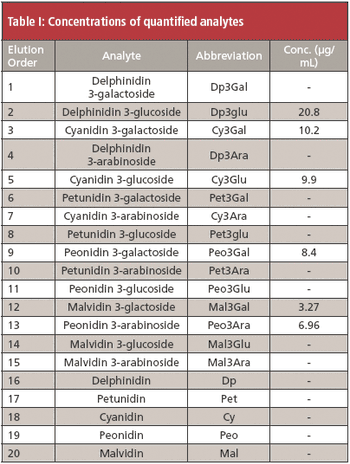
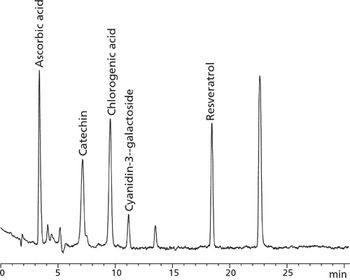
Bilberry (Vaccinium myrtillus L.) extracts are high in anthocyanin content and are widely used in nutritional supplements for improving visual acuity and treating circulatory disorders.

i2-739825-1417780356086.gif

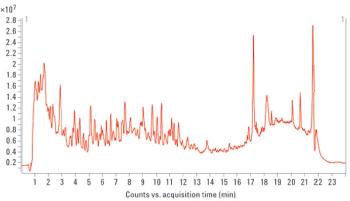
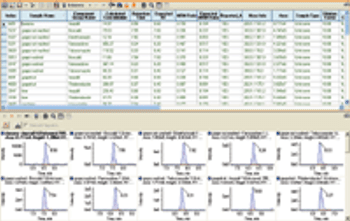
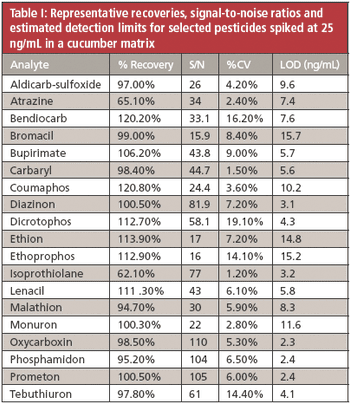
With more than 800 pesticides currently in use there is growing concern by government agencies about the effect of pesticide exposure on human health. While analytical techniques like GC or GC–MS have traditionally been used for pesticide analysis, LC–MS-MS has become the technique of choice due to speed, increased sensitivity, and reduced sample preparation. The following describes an LC–MS-MS method for screening of 534 pesticides in food products.

i1_t-739821-1408616972573.gif

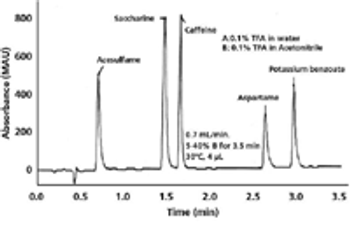
The popularity of diet soft drinks containing aspartame requires the analysis of thousands of samples for quality control purposes each year. These analyses are typically carried out with some fraction of organic modifier in the eluent, leading to the generation of thousands of gallons of hazardous organic waste. This note shows the "green" analysis of several commercial diet soft drinks in combination with a 100% water mobile phase.

i1_t-739809-1408616996950.gif

In December 2008, the United States FDA recognized rebaudioside A (reb. A) purified from Stevia rebaudiana (Bertoni) as Generally Recognized as Safe (GRAS) as a sugar substitute in foods. As a result, stevia products have become popular tabletop and beverage sweeteners. Two steviol glycosides, stevioside and reb. A, are largely responsible for the desired sweet flavor, with reb. A preferred for sweeteners (1).

i2-713148-1408622236776.gif

AGPC column and organic solvents are used to selectively pass large macro molecules such as lipids, resins, waxes, and other compounds from sample extracts while retaining the smaller target analyte molecules in the pores of the gel.

i4-701161-1408632379842.jpg

Naringenin, a chiral flavonoid found in several fruit juices, is well known for its beneficial health-related properties, including antioxidant, antimicrobial, anti-inflammatory, and immunomodulating activities. The HPLC and supercritical fluid chromatography (SFC) enantioselective separation of (R,S)-Naringenin has been performed on both analytical and semi-preparative scale using an amylose derived RegisPack CSP.