

Companies can reduce the fallout of a disaster via a business continuity plan with appropriate hardware and software, including Waters Empower BC LAC/E with SecureSync.
Companies can reduce the fallout of a disaster via a business continuity plan with appropriate hardware and software, including Waters Empower BC LAC/E with SecureSync.
This note demonstrates a novel, easy-to-use, intelligent tandem nanoLC-MS setup capable of 100% MS use that is compatible with the Sonation double-barrel nano ESI source.
The launch of CHIRALPAK® IJ gives access to an expanded range of solvents, which yields new separation not previously achievable on the coated CHIRALCEL® OJ.

Biogen and Postnova present data on the analysis of adeno-associated viruses (AAV) using Asymmetrical Flow Field-Flow Fractionation coupled to Multi-Angle Light Scattering detection (AF4-MALS). AAV are promising gene therapy delivery vehicles, whose efficacy may be negatively affected by the presence of viral aggregates. Due to its gentle separation and broad applicable size range, AF4-MALS is able to characterize AAV and their aggregates with high resolution and precision, thereby overcoming the drawbacks that column-based chromatography techniques often face when dealing with samples larger than 50 nm in size.
Sponsored Content - EU
Efficient and reproducible separation of thymidine oligomers is achieved using an ion-pair reversed phase shallow gradient method with the Avantor® ACE® Oligo column.
Sponsored Content
Nine structurally-diverse, strongly basic drug compounds are resolved in less than 2 min using a high pH mobile phase and a fast acetonitrile gradient at 80 °C.
Sponsored Content - EU
This application note shows how to obtain a fast separation of cannabidiol and melatonin in a sleeping aid with excellent peak shapes using a YMC-Triart C18 column.
Sponsored Content - EU
PharmaFluidics’ μPAC capLC is evaluated for different user needs ranging from 12 samples per day in comprehensive mode to 65 samples per day in throughput mode.

Monitoring the size heterogeneity of AAV-based gene therapy therapeutics is potentially important to ensure consistent product quality and efficacy. We demonstrate that the levels of both high-molecular weight (HMW) and low-molecular weight (LMW) impurities in AAV capsid preparations can be separated on a Waters 450 Å Protein BEH SEC column for a series of AAV serotypes.

Pharmaceutical companies worldwide are currently searching for vaccines, therapeutic agents, and prophylactics to combat COVID-19. The focus on biologic drugs during the current pandemic highlights the crucial role amino acids analysis plays in research and production of pharmaceuticals.
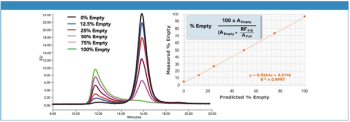
The single-stranded DNA (ssDNA) content of AAV capsids in AAV-based gene therapy preparations impacts the efficacy of this treatment modality. We demonstrate that AAV8 capsids without and with full length ssDNA can be separated and their relative abundances determined on a Waters Protein-Pak Hi Res Q strong anion-exchange column.
Sponsored Content - NA
An HCP analysis workflow including the Agilent AssayMAP Bravo platform for automated sample preparation, 6545XT AdvanceBio LC/Q‑TOF for LC-MS/MS analysis
Sponsored Content
A method describing the detection of 12 potentially mutagenic nitrosamine impurities found in sartan drugs using the Ultivo LC/TQ
Sponsored Content - NA
Use interactive calculators included in this whitepaper to determine the incremental economic value of the Agilent 1260 Infinity II Prime LC and InfinityLab LC/MSD iQ.
Sponsored Content
In this application, we look at the determination of residual solvents and terpenes in cannabis by GC–FID using the Zebron™ ZB-624plus™ GC column.
Sponsored Content - NA
This application note details improved HPLC assay methods for chlorhexidine gluconate on hybrid-silica and core-shell C18 stationary phases.
Sponsored Content
Learn how Janssen cut method-development time by 80% while improving quality 25-fold by upgrading their hardware and using method-development software.
Sponsored Content
• Special considerations when updating software • Data integrity challenges in the cloud environment • Implications of moving to the cloud with respect to audits
Sponsored Content
• Validating custom calculations • The importance of a second-person review and locking data • How to compile a data-integrity plan · · ·
Sponsored Content - NA
Sponsored Content - NA
This note describes how SEC-MALS-UV-RI analysis quantifies multiple critical quality attributes of AAV viral vectors, including concentration/titer, aggregation and empty:full ratio.

The oligonucleotide therapeutics field has seen remarkable progress over the last few years and oligonucleotides are increasingly recognized as potential therapeutic agents for a variety of diseases. Here we describe the ability of ultra-high pressure size exclusion chromatography (SEC) to distinguish N and N-1 oligonucleotide species.
Sponsored Content
-Overview of international guidances for data integrity -Insight into PIC/S guidances -Challenges of managing documentation
Sponsored Content
A fast and reliable method for comparison of related impurities in a brand and a generic over-the-counter (OTC) acetaminophen drug.
Sponsored Content
Learn about aggregate and charge-variant analysis using native-mode MS Understand the fundamentals in SEC and IEX for biotherapeutic characterization Learn the effect of mobile-phase conditions and chromatographic parameters in aggregate analysis by native SEC
Sponsored Content
• Solutions to laboratory-weighing challenges require the latest technology. • New balances offer custom hardware, software, and connectivity solutions.
Sponsored Content
• What constitutes data integrity? • Selecting the right applications and training for GxP environments • Audit preparedness