

An overview of different approaches for the qualitative and quantitative analysis of polysorbates.
Frank David is a principal scientist at RIC group.
An overview of different approaches for the qualitative and quantitative analysis of polysorbates.

An overview of different approaches for the qualitative and quantitative analysis of polysorbates.

In this extended special feature to celebrate the 35th anniversary edition of LCGC Europe, key opinion leaders from the separation science community explore contemporary trends in separation science and identify possible future developments.

The importance of accurate analysis methods for EtO and 2-CE in food is essential and the demand for robust methods that are able to deliver high sample throughput with minimal instrumental downtime is high.

This article looks at the benefits of combining dynamic headspace sampling (DHS) with capillary GC–TOF-MS as a tool for untargeted analysis of aroma compounds in food and beverages. Applications for the analysis of strawberry yoghurt, chocolate, and red wine are described.

LCGC Europe
In this extended special feature to celebrate the 30th anniversary edition of LCGC Europe, leading figures from the separation science community explore contemporary trends in separation science and identify possible future developments. We asked key opinion leaders in the field to discuss the current state of the art in gas chromatography instruments.

LCGC Europe
On-line two-dimensional liquid chromatography (2D-LC) embracing mainly comprehensive LC (LC×LC) and multiple heart-cutting LC (mLC–LC) offers new opportunities for in-depth characterization of pharmaceuticals. Reversed-phase LC × reversed-phase LC using different column chemistries and mobile phases provides good orthogonality for a wide range of applications related to small molecule drugs. Moreover, hardware configurations and software are now commercially available to perform LC×LC and mLC–LC measurements in a reproducible manner.

LCGC Europe
Analysis of additives such as sweeteners, preservatives, and caffeine in various food products, beverages, and consumer toothpaste using the Agilent 1290 Infinity II LC.
LCGC North America
Analysis of additives such as sweeteners, preservatives, and caffeine in various food products, beverages, and consumer toothpaste using the Agilent 1290 Infinity II LC.
LCGC North America
PAHs were determined in a petroleum vacuum distillation residue using the Agilent 1290 Infinity Multiple Heart-Cutting 2D-LC solution with normal-phase in the first dimension and reversed-phase in the second dimension.
LCGC Europe
PAHs were determined in a petroleum vacuum distillation residue using the Agilent 1290 Infinity Multiple Heart-Cutting 2D-LC solution with normal-phase in the first dimension and reversed-phase in the second dimension.
LCGC Europe
In this application the Agilent 1290 Infinity II LC was used to determine the bitter compounds iso-alpha-acids and reduced iso-alpha-acids, and the clove-like phenolic flavor 4-vinylguaiacol in bottled beer.
LCGC North America
In this application the Agilent 1290 Infinity II LC was used to determine the bitter compounds iso-alpha-acids and reduced iso-alpha-acids, and the clove-like phenolic flavor 4-vinylguaiacol in bottled beer.
LCGC Europe
This Application Note describes the method transfer of a USP HPLC method for amlodipine besylate tablets to a UHPLC method using the Agilent 1290 Infinity II LC.
LCGC North America
This Application Note describes the method transfer of a USP HPLC method for amlodipine besylate tablets to a UHPLC method using the Agilent 1290 Infinity II LC.
LCGC Europe
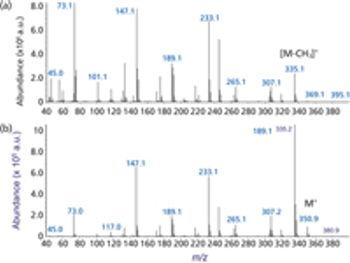
The application of gas chromatography (GC) combined with atmospheric pressure chemical ionization mass spectrometry (GC–APCI-MS) and with supersonic molecular beam ionization mass spectrometry (GC–SMB-MS).

Special Issues
An introduction from the guest editors of this special supplement from LCGC Europe focusing on some recent developments in pharmaceutical analysis.

Special Issues
The determination of genotoxic impurities (GIs) in drug substances and pharmaceutical products is an emerging topic in pharmaceutical quality control. GIs are intermediates or reactants in the synthetic pathway of a drug substance and should be monitored at ppm (?g/g drug substance) or even ppb (ng/g) levels. This is several orders of magnitude lower than in classical impurity analysis (0.05% or 500 ppm level) or in residual solvent analysis. Analytical methods for the determination of GIs include gas chromatography (GC) and liquid chromatography (LC), both often combined with mass spectrometry (MS) detection. Some typical examples of GIs trace analysis using GC and LC are presented. The potential of on-line reaction monitoring is also discussed.

Special Issues
Soft ionization MS using GC–APCI-MS and GC–SMB-MS offers complementary identification power for the characterization of natural products, as illustrated by the identification of alkanes, sterols, long chain alcohols, and derivatized polar compounds in tobacco leaf extracts described here.

LCGC North America
A simple experimental setup applied in a drug discovery laboratory illustrates some anomalies and misconceptions about supercritical fluid chromatography for drug discovery.

Special Issues
Gas chromatography combined with atmospheric-pressure chemical ionization (APCI) was used to analyze high-molecular-weight phthalates.

LCGC Europe
Discussing the latest developments in sample preparation techniques that reduce environmental impact.

LCGC Europe
A novel and sensitive approach for analysing high-molecular-weight phthalates is described.
LCGC Europe
The second part of this series on green chromatography describes characteristics of GC and SFC
Special Issues
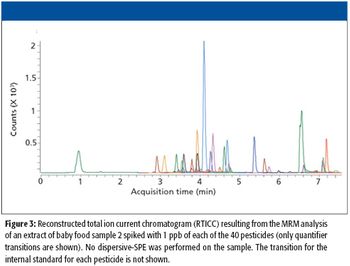
The safety of the food that our children eat is a global concern. Regulations are in place that limit the maximum level of pesticides that can be present in food meant for children, and methods to detect levels well below those limits are needed to ensure the safety of the food supply. Combining the speed and separation efficiency of ultrahigh-pressure liquid hromatography (UHPLC) with the sensitivity and selectivity of triple-quadrupole mass spectrometry (MS)-MS results in a method that can deliver ultralow quantification of pesticides in baby food, with limits of detection more than an order of magnitude below the allowed maximum levels.

LCGC Europe
Part one focusses on ways of reducing and replacing solvents commonly used as mobile phases

LCGC Europe
This article describes methods to quantitatively analyse genotoxic and potentially genotoxic impurities in pharmaceutical ingredients
LCGC Europe
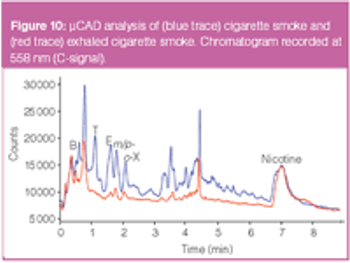
A miniature gas chromatograph incorporating a miniaturized chemical trap for enrichment, rapid thermal desorption of the trap, a resistively heated capillary column for programmed GC analysis and a micro-chip-based plasma emission detector (PED) is described. The sampling and chromatographic conditions for the analysis of volatile compounds in air are presented. The performance of the µCAD is illustrated in the universal (carbon) mode and for the selective detection of chlorinated and organo-mercury compounds. Detection limits (DLs) are at the sub-μg/L level in the carbon mode and 10 ng/L for organo-mercury compounds.

LCGC Europe
An overview is presented of possible pathways to enhance peak capacity in liquid chromatography (LC). The peak capacity in a chromatographic separation is directly related to the plate number and thus to column length and particle size. Serial coupled columns can be used to obtain long effective column lengths, reaching over 100000 theoretical plates and peak capacities up to 900. Some theoretical considerations are made on column dimensions and particle size and examples are given of high resolution "GC-like" separations in LC using state-of-the-art LC hardware. Recent developments in LC hardware have also enhanced the applicability of two-dimensional LC–LC and comprehensive LCÃ-LC. Both techniques are extremely powerful to unravel complex samples.

LCGC Europe
When possible, GC analysis is performed under retention time locked conditions, meaning that allergen elucidation and quantification is based on mass spectral data (scan mode or specific ion detection mode) and on retention time.

May 2nd 2013


