

The Column
Preview of the International Symposium on GPC/SEC and Related Techniques.
The Column
Preview of the International Symposium on GPC/SEC and Related Techniques.

The Column
Raquel Garcia and Maria João Cabrita reveal the theory and practical applications of molecularly imprinted polymers (MIPs).


The Column
Click the title above to open The Column July 22, 2016 Europe & Asia issue, Volume 12, Number 13, in an interactive PDF format.
The Column
Click the title above to open The Column July 22, 2016 North American issue, Volume 12, Number 13, in an interactive PDF format.
Reservoir sensor monitors HPLC solvent levels during unattended operations over long periods of time. Understand how sensing mechanism ensures HPLC system efficiency.
A group of researchers has studied the migration of monomers and plastic additives from plastic food packaging in microwave heated homemade food and packed liquid food using QuEChERS and gas chromatography coupled to mass spectrometry (GC–MS).
André de Kok, a senior analytical chemist at the at the Netherlands Food and Consumer Product Safety Authority (NVWA), was presented with the Excellence Award at the annual North American Chemical Residue Workshop (NACRW) Conference on July 18, 2016.
While conventional calibration for gel permeation (GPC) and size-exclusion chromatography (SEC) are useful for polymer characterization, there are inherent disadvantages in these analyses. Adding multi-angle light scattering (MALS) detection can help overcome the challenges faced with single-detector chromatography. For more complex polymers, asymmetric flow field-flow fractionation (AF4) offers additional capabilities. This e-book explains what you need to know about using MALS in polymer analysis.

The LCGC Blog
The title of this piece may have put you off reading it – in which case you won’t be insulted when I say that even the most experienced gas chromatographers often fail to install columns in the best way possible.

The Column
This instalment of Tips & Tricks shows the influence of analytical parameters on gel permeation chromatography/size-exclusion chromatography (GPC/SEC)–light scattering results when artificially wrong parameters reflecting typical experimental errors are used.

The LCGC Blog
Matrix-assisted laser desorption–ionization time-of-flight mass spectrometry (MALDI-TOF-MS) is actually one of the most versatile tools for fingerprinting mixtures.
Traditionally mass detection instruments have been for the mass spec experts and not played a major role in the majority of chromatography labs. With the advent of smaller, more accessible mass detectors, the potential of mass data is coming more and more within the reach of the chromatographer. With this webcast we look to see how the landscape of the chromatography lab is changing and how the value of mass data can be realized by the chromatographer.
The Column
Click the title above to open The Column July 08, 2016 Europe & Asia issue, Volume 12, Number 12, in an interactive PDF format.
The Column
Click the title above to open The Column July 08, 2016 North American issue, Volume 12, Number 12, in an interactive PDF format.
LCGC North America
How to optimize the key variables in GC analysis–GC columns and detectors

LCGC North America
Microflow LC–MS-MS has seen a surge of attention, development, and popularity among research scientists and bioanalysts over the last few years. The potential of this technology to provide better sensitivity, less solvent waste, near-zero dead volume, and high through-put are a big part of this renewed interest. However, microflow LC techniques are hardly a new idea. More than 40 years ago, in 1974, a group at Nagoya University in Japan first developed a microcolumn liquid chromatography system, elements of which can be found in today’s commercial products. With the advances in technology over the last several years, development and implementation of this technique have been kicked into high gear. In this article, we discuss the history of microflow LC–MS-MS, the current state of the art, and where the future might lead for this rapidly growing technology.

The Column
Incognito debates the pros and cons of onshore support.
The Column
Eurofins Lancaster Laboratories, a part of Eurofins Scientific, has announced the expansion of its Dungarvan campus. The expansion includes a new building and an expansion of existing facilities.
The Column
The winners of the 2016 Thermo Scientific Tandem Mass Tag (TMT) Research Award were celebrated at a ceremony held at the 64th American Society of Mass Spectrometry (ASMS) Conference on Mass Spectrometry and Allied Topics in San Antonio, Texas, USA.
The Column
Postnova Analytics has opened a dedicated office to enhance local support for its UK customers.

The Column
The quantitative performance of the latest generation of high-resolution instruments is comparable to that of a triple quadrupole MS, even though different scanning modes are used. Higher-resolution instrumentation also allows flexibility concerning compound identification because the experiment can be set up for targeted quantitation, screening, or both. In an Orbitrap-based instrument, the parallel reaction monitoring (PRM) mode performs most closely to a triple quadrupole mass analyzer using selected reaction monitoring (SRM) mode. This study looks at the performance of an Orbitrap-based LC–MS method for EPA Method 539.

The Column
A preview of the upcoming 31st International Symposium on Chromatography (ISC 2016), which will be held 28 August–1 September at University College Cork, Ireland.

LCGC Europe
The use of antibodies in “bottom-up” LC–MS workflows to determine low abundant biological active proteins in complex human samples has increased in recent years: immuno-capture analysis combines the workflow of conventional immunological assays with LC–MS analysis. This paper describes typical challenges, such as cross reactivity and the mass spectrometer’s dynamic range, as well as the advantages of isoform differentiation and multiplexing. Additionally, some experimental formats of immuno-capture bottom-up LC–MS analysis of biological active proteins in complex human samples will be discussed.
LCGC Europe
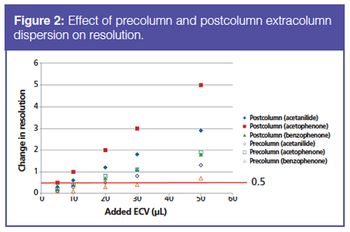
Ultrahigh-pressure liquid chromatography (UHPLC) instruments from different manufacturers and instruments with different configurations can produce significant variations in chromatographic separation. The variety in instrument configuration increases the complexity of the method development process, which now requires a more thorough evaluation of the effect of instrument variations on the method. The studies presented here determined the typical interinstrument variations in dwell volume, extracolumn dispersion, and mixing efficiency as measured by mobile-phase compositional accuracy. Additionally, the dwell volume and extracolumn dispersion were independently and systematically varied to evaluate the resulting impact on resolution for a small-molecule test mixture during gradient elution. To account for these interinstrument variations, dwell volume and wash-out volume method translation and adjustment techniques were evaluated.

LCGC Europe
A reliable autosampler is one key requirement for unattended operation of a liquid chromatograph.
LCGC Europe
While gas chromatographers may take their septa for granted, in fact these small and seemingly unremarkable polymer disks keep air out of the carrier-gas stream when used in an inlet and keep samples intact and uncontaminated when used in sample vials. Choosing the wrong septa can compromise method accuracy and repeatability as well as reduce column life in extreme cases. This instalment addresses septa for inlets and sample vials.