



LCGC North America
To meet system suitability requirements, chromatographers might need to make adjustments to the high performance liquid chromatography (HPLC) operating conditions.
LCGC North America
To meet system suitability requirements, chromatographers might need to make adjustments to the high performance liquid chromatography (HPLC) operating conditions.

LECO Corporation (St. Joseph, Michigan) has introduced a series of Separation Science e-Seminars for fall 2009 designed to give scientists information on several new chromatographic techniques.

LCGC Asia Pacific
The causes and cures for peak tailing are discussed, along with the various ways that chromatographers measure tailing peaks.

LCGC North America
John Hinshaw takes a break from the technical and visits a number of chromatography forums and discussion groups.
LCGC North America
Ron Majors provides first-hand coverage of some of the technology and application advances reported at HPLC 2009.

LCGC North America
The former "Milestones in Chromatography" editor returns to give readers the story of his time in the field.
LCGC Europe eNews
Two of the 2009 R&D 100 awards have been awarded to Phenomenex for the company?s gas chromatography products.
LCGC North America
Guest columnists explore how ionic liquids can be tweaked to mimic the popular stationary phases of today.
The Application Notebook
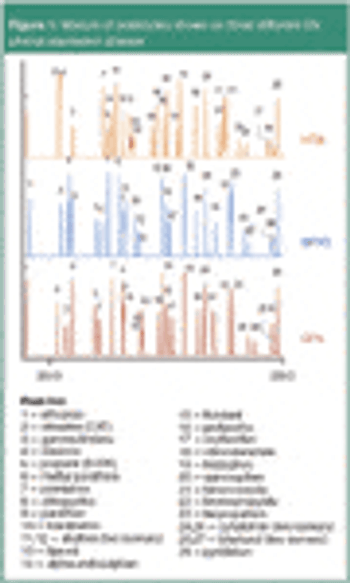
The separation of structurally diverse analytes is often complicated by chance coelutions with other analytes or with matrix related compounds. Often the column is blamed, but while such coelutions make analysis difficult they do not necessarily indicate a faulty column, poor chromatography or method design.
LCGC North America
John Hinshaw discusses the effects that peak tailing has on quantitative measurement of peak height and area.

LCGC Europe
Doug Kitson looks at some of Poland's leading separation science groups.
Malvern Instruments (Westborough, Massachusetts) has more than doubled the size of its web seminar program.
The Pittsburgh Conference released the call for papers for Pittcon 2010, which will be held February 28 to March 5, 2010, at the Orange County Convention Center in Orlando, Florida.
ACD/Labs (Toronto, Canada) announced the release of new software for target analysis of complicated LC?MS and GC?MS datasets, without the tedious and difficult manual interpretation.
French scientists have developed a GC?MS method, combined with a triple partition extraction step to reduce the amounts of co-extracted fats, for the determination of pesticides in meat-based baby foods.
Thermo Fisher Scientific (San Jose, California) announced that it has been presented with the ACHEMA 2009 Innovation Award for the category of Laboratory and Analytical Techniques.

LCGC Europe
In this month's "GC Connections", John Hinshaw addresses the causes and effects of peak tailing, as well as ways in which chromatographers can measure and report their misshapen peaks.

LCGC North America
John Hinshaw presents his review of all that was new and innovative at Pittcon 2009 in the field of gas chromatography.
The Chemical Heritage Foundation announced that David and Alice Schwartz, founders of Bio-Rad Laboratories (Hercules, California) will receive the organization?s fourth annual Richard J. Bolte Sr. Award for Supporting Industries.
Researchers from the University of Thessaly (Volos, Greece) used a single-drop microextraction technique with gas chromatography (GC) and nitrogen?phosphorus and electron-capture detection to analyze pesticides in vegetables.

LCGC North America
Ron Majors brings readers the second part of his yearly review of all that was new and innovative at the annual Pittsburgh Conference.
Special Issues
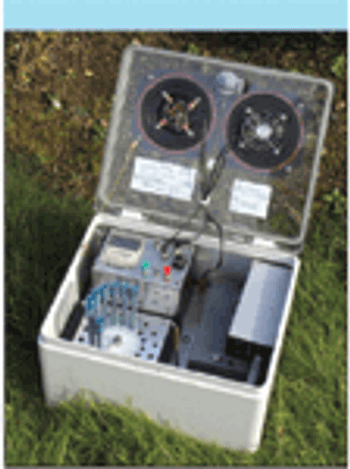
This article discusses the analysis of a wide range of CWAs at current exposure limits and describes a number of recent beneficial developments in TD and associated analytical technologies for the identification and quantification of CWAs at these levels.

Special Issues
In this article, methods developed for rapid, automated detection of CWAs and TICs using a low thermal mass capillary gas chromatograph coupled to a toroidal ion trap mass spectrometer (TMS) are presented.
Phenomenex Inc. (Torrance, California) raised raised $5,150 for Cheer for Children, a Redondo Beach based non-profit that raises donations to help acutely ill children and their siblings at County-Harbor UCLA Medical Center and for children with orthopedic disabilities at local schools, through a combination of sporting challenges, raffles, and refreshment sales.

LCGC Europe
An overview of contemporary techniques in environmental analysis.