






The Column
Incognito turns his attention in the second part of this series to looking at ways of decreasing analysis time in capillary GC.
The Column
Incognito turns his attention in the second part of this series to looking at ways of decreasing analysis time in capillary GC.

E-Separation Solutions
Joining us for a discussion on gas chromatography this month are Eric Phillips of Thermo Fisher Scientific and Ngoc Nguyen of Phenomenex.

The Column
The increasing need for even more sensitive analyses of harmful substances brings new pressure on gas chromatography (GC) analytical methods.

The Column
Speaking to Konik-Tech about the development of a new system combining LC and GC technology.

LCGC Europe
Using narrow-bore column fast GC combined with rapid scanning qMS to analyse flavours and fragrances is described.

LCGC North America
The authors explain the operational considerations for switching from helium to hydrogen in the separations lab, as well as discussing options.

LCGC North America
GC expert Jaap de Zeeuw explores the historical development of PLOT columns, covers details of the most popular stationary phases, and provides practical hints.

LCGC Europe
Part 2 of the series looks at the effects of peak tailing on resolution and peak overlap.

LCGC North America
In Part II of this series, John Hinshaw covers the effect on tailing peak measurements when the peaks start to merge, following on from Part I, which discussed nontailing peaks.

The Column
In this study, comprehensive 2D gas chromatography-mass spectrometry with electron impact and chemical ionization was used to characterize silylated fatty alcohol alkoxylates.
LCGC Europe
The second part of this series on green chromatography describes characteristics of GC and SFC

LCGC Europe
Exploring the use of GCxGC-FID as a technique for qualitative and quantitative analysis of perfumes
LCGC Asia Pacific
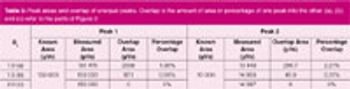
A look at the effect of two overlapping peaks on peak quantificiation and resolution

LCGC Asia Pacific
An overview of current chromatography-based food toxicant screening is presented.

The Column
Incognito concludes by looking at column contamination (and regeneration) and how to select the most appropriate inlet liners for specific applications.
The Column
The GC×GC-7 symposium ran concurrently with this year?s ISCC in Riva del Garda, Italy. Speaking with The Column, Philip Marriott of the Australian Centre for Research on Separation Science, RMIT, Melbourne, Australia, said it ?offered the most comprehensive and thorough GCxGC programme yet assembled.?

LCGC North America
The author examines the process of validating a CDS and describes the trials along the way such as speed of validation, risk management, and so forth.

LCGC North America
Well-known industry veteran and LCGC EAB member Peter Carr looks back at the early days of the chromatography field and reflects on his own experiences.

The Column
This summer the National Gallery in London will host an exhibition demonstrating some of the ways that science has been able to shed new light on the history behind some of the Gallery's priceless works of art.

The Column
Continuing this series, Incognito shares his wisdom on properly selecting and optimizing GC column dimensions.

The Column
When wheat becomes infested with Hessian fly larvae the plant is forced to undergo a variety of physical and biochemical changes. The larvae?s saliva thins the surface of the leaf to allow the larvae to get to the liquid in the plant?s cells. A study funded by the US Department of Agriculture and published in The Plant Journal has investigated how this happens, which researchers hope will allow them to make plants more resistant.

LCGC North America
An HS-GC-FID method for the determination of ethanol and methanol content in biological fluids is presented.
LCGC North America
This month's "GC Connections" addresses the effects of two overlapping tailing peaks on peak resolution and quantitation.
LCGC Europe
This instalment addreses the effects on peak resolution and quantification of two overlapping peaks.

The Column
The introduction of a new range of capillary GC columns substantially reduces column bleed, increases inertness and offers unparalleled injection-to-injection and batch-to-batch reproducibility.