LC–MS

Latest News


Researchers from the University of Barcelona (Barcelona, Spain) analyzed heterocyclic amines in meat samples using pressurized liquid extraction followed by liquid chromatography with tandem mass spectrometry detection (LC?MS-MS).

Researchers at the University of Utah's (Salt Lake City) Sports Medicine Research and Testing Laboratory developed a test for testosterone and epitestosterone in urine that uses liquid chromatography with tandem mass spectrometry detection (LC-MS-MS).

Researchers at the Universit? di Camerino in Camerino, Italy have developed a new GC-MS and LC-MS technique for the determination of five ink photoinitiator residues: 2-isopropylthioxanthone (ITX), benzophenone, 2-ethylhexyl-4-dimethylaminobenzoate (EHDAB), 1-hydroxycyclohexyl-1-phenyl ketone (IRGACURE 184) and ethyl-4-dimethylaminobenzoate (EDAB) in packaged beverages.

This month Chromatography Online's Technology Forum looks at the topic of LC-MS and the trends and issues surrounding it. Joining us for this discussion is Scott Berger of Waters Corporation, Graham McGibbon of Advanced Chemistry Development, Inc. (ACD/Labs), Bob Classon of Shimadzu Scientific Instruments, Inc., and Alexander Shaw, Ph.D of Hitachi High Technologies America, Inc.

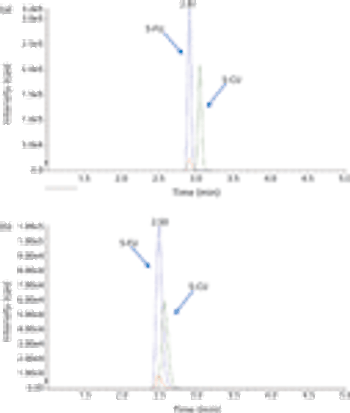
Vitamin D is a group of fat-soluble prohormones that helps the body absorb calcium and maintain proper levels of calcium and phosphorus in the blood. A vitamin D deficiency results in impaired bone mineralization and leads to bone-softening diseases, such as rickets in children and osteomalacia and osteoporosis in adults, as well as autoimmune and nervous system diseases. A vitamin D overdose can raise blood levels of calcium and cause gastrointestinal symptoms and kidney disease. High blood levels of calcium also can cause heart rhythm abnormalities and calcinosis, the deposition of calcium and phosphate in the body's soft tissues.

This article aims to demonstrate the unique capability of resin-based mixed-mode solid-phase extraction (SPE) to achieve efficient extraction of basic drugs from plasma. Optimized pore size of the method minimizes retention of high molecular weight matrix components present in the biological fluid samples. The interferences are removed, ensuring extremely clean extracts for subsequent liquid chromatography?mass spectrometry-mass spectrometry (LC-MS-MS) analysis.

The unique features of silica hydride-based columns are described with a focus on how these columns can expand a laboratory's capabilites in HPLC and LC-MS. Of particular interest is the ability to retain both polar and nonpolar compounds and provide an orthogonal method of analysis for currently existing procedures.

A fast quantitation method for the analysis of N-Methyl Carbamate pesticide residues in vegetables and grains has been developed. High recoveries were obtained for most carbamates screened in all matrices tested at 1 ppb levels. Good linearity of the calibration curves was observed for all analytes, over the range from 1 ppb to 200 ppb levels, with r2 greater than 0.99.

LC-MS-MS has become a widely used technique for the fast and sensitive quantitation of small molecules. In this article, this approach has been extended to high-throughput quantitative LC-MS-MS analysis under GLP applications for a drug candidate in development from preclinical animal studies through clinical development.

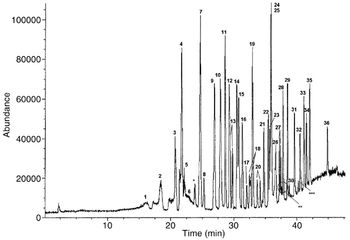
Ultrahigh performance liquid chromatography (LC)–time-of-flight mass spectrometry –(TOF-MS) and gas chromatography (GC)–TOF-MS are powerful approaches for screening target compounds and identifying or characterizing nontarget compounds in complex mixtures. The combination of accurate mass data and newly developed software enables truly generic screening methods with TOF-MS, and the confident detection, identification, and confirmation of small molecules in a range of application areas.