



The Column
This article describes a LC-MS method for the analysis of biodiesels, particularly the characterization of FAMES.
The Column
This article describes a LC-MS method for the analysis of biodiesels, particularly the characterization of FAMES.
The Column
This article aims to demonstrate the unique capability of resin-based mixed-mode solid-phase extraction (SPE) to achieve efficient extraction of basic drugs from plasma. Optimized pore size of the method minimizes retention of high molecular weight matrix components present in the biological fluid samples. The interferences are removed, ensuring extremely clean extracts for subsequent liquid chromatography?mass spectrometry-mass spectrometry (LC-MS-MS) analysis.
LCGC Europe
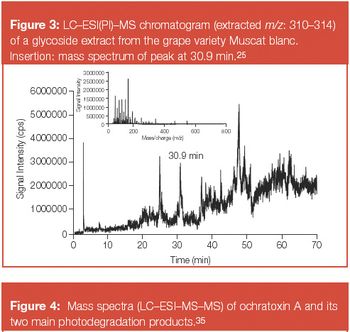
Liquid chromatography–mass spectrometry (LC–MS) is a popular technique for the analysis of wine. This article gives an overview of wine analysis and new insights this technique has revealed regarding the composition of wine, possible health benefits, customer safety and the understanding of winemaking processes.
The Column
The unique features of silica hydride-based columns are described with a focus on how these columns can expand a laboratory's capabilites in HPLC and LC-MS. Of particular interest is the ability to retain both polar and nonpolar compounds and provide an orthogonal method of analysis for currently existing procedures.
The Column
A fast quantitation method for the analysis of N-Methyl Carbamate pesticide residues in vegetables and grains has been developed. High recoveries were obtained for most carbamates screened in all matrices tested at 1 ppb levels. Good linearity of the calibration curves was observed for all analytes, over the range from 1 ppb to 200 ppb levels, with r2 greater than 0.99.

LCGC North America
This month's column brings much of the previous discussion on how to interpret mass spectra to a practical examination of detecting substitutions in counterfeit pharmaceuticals.

LCGC North America
LC-MS-MS has become a widely used technique for the fast and sensitive quantitation of small molecules. In this article, this approach has been extended to high-throughput quantitative LC-MS-MS analysis under GLP applications for a drug candidate in development from preclinical animal studies through clinical development.
LCGC North America
In this month's "MS-The Practical Art," Michael Balogh takes a closer look at insight provided by Chuck McEwen regarding obstacles while using solvents.
LCGC North America
LCGC North America

LCGC North America
Emerging as a complementary analytical tool to LC-MS, LC-ICP-MS brings added value to the determination of inorganic element containing molecules of biological importance.

Special Issues
Ultrahigh performance liquid chromatography (LC)–time-of-flight mass spectrometry –(TOF-MS) and gas chromatography (GC)–TOF-MS are powerful approaches for screening target compounds and identifying or characterizing nontarget compounds in complex mixtures. The combination of accurate mass data and newly developed software enables truly generic screening methods with TOF-MS, and the confident detection, identification, and confirmation of small molecules in a range of application areas.

Special Issues
Enabling targeted quantitative proteomics applications and hypothesis-driven inquiries will help researchers to understand how proteins function in living systems. The discovery and validation of small molecule and protein-based biomarkers, and the eventual translation of these discoveries from the research lab to the clinic, involves robust mass spectrometry (MS) systems and software that make it easier for technicians to perform routine sample analyses on liquid chromatography (LC)–MS-MS systems, which continue to be used in an increasing number of both protein and small molecule analysis applications.

Special Issues
Serum protein profiling using mass spectrometry (MS) is one of the most promising approaches for biomarker identification.
Special Issues
Mass spectrometry has long been a preferred tool for protein identification and biomarker discovery, but preparation of biological samples remains a challenge. Hindrances include the wide range of protein concentrations, sample complexity, and loss or alteration of important proteins due to sample handling. This article describes recent developments in sample fractionation technologies that are overcoming these challenges in interesting ways and are enabling in-depth proteomic studies that were not possible in the past.

The Column
Doping testing is now an accepted fact of sporting life - whether in major international competitions, such as the Olympics, or in regular events at the national level. Athletes who cheat by taking banned substances risk harming their careers and their health. They also bring their country and their sport into disrepute. A reliable and reproducible scientific system for doping testing, backed up by sanctions, helps fight the culture of drugs in sport so that athletes can participate on a level playing field.
LCGC North America

LCGC North America
September 2006. Top-down and bottom-up are alternative strategies for protein identification and characterization by mass spectrometry. How do they fit into the world of proteomics? What are their implications for separation technology? These questions are addressed in this installment of "Directions in Discovery."

LCGC North America
In Part I of this two-part look at spectral interpretation, Michael Balogh examined the ability to see and appreciate the product of our analytical devices. In Part II, he takes a closer look at the tools of the trade.

The Column
Midazolam is a central nervous system depressant that is commonly used as a sedative before surgical or other medical procedures.
LCGC North America
In this column, Michael Balogh proposes some practices that you can adopt to enhance your prospects of being right when converting data to knowable information and applying it to solving problems.

LCGC North America
In this tutorial, the mechanism and origin of ion suppression will be investigated, as well as ways to validate the presence, and circumvent or compensate for, the effects in LC-MS.
LCGC North America
This is the second installment of a two-part series on the practical aspects of configuring and operating a nano liquid chromatography-mass spectrometry (LC-MS) system.

LCGC North America
This month's column explores the idea that despite the well-considered physics and engineering involved in mass spectrometer technology, it nonetheless seems that the uality of one's results are as much the product of art as they are of science.

LCGC North America
Definitions, however meticulously crafted, can give the meaning of terms with scrupulous clarity, but often fail to tell us how to apply them. Such definitions are descriptions that dictate usage but stop well short of the sense and purpose that many of us turn to them for.