When pyrolyzed, macromolecules will decompose into smaller fragments that can have the appropriate volatility for gas chromatography (GC) separation and analysis.

When pyrolyzed, macromolecules will decompose into smaller fragments that can have the appropriate volatility for gas chromatography (GC) separation and analysis.

In this installment of "Sample Prep Perspectives," we cover some of the basic scientific principles behind solid-phase extraction (SPE) to allow the correct mode of extraction to be selected through an understanding of how analytes interact with and are separated by the sorbent.

Make your column last forever? Not quite, but you can help prevent its early demise.

Why should you be concerned about mobile-phase degassing - it's all done automatically, isn't it?

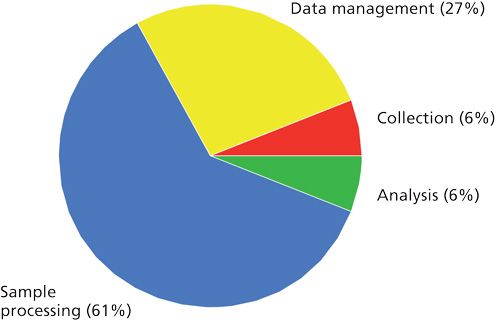
In sample preparation, what does "high-throughput" really mean?

This article discusses the benef ts of using automated dispersive solid-phase extraction (dSPE) rather than standard SPE in urine analysis.

The selective removal of a fat substitute in food products is discussed to demonstrate options for obtaining selectivity during extraction.

In this column, the selective removal of a fat-substitute in food products is discussed to demonstrate options for obtaining selectivity during extraction.

A look at five sample preparation methods where the application of a charge across barriers provides enhanced selectivity

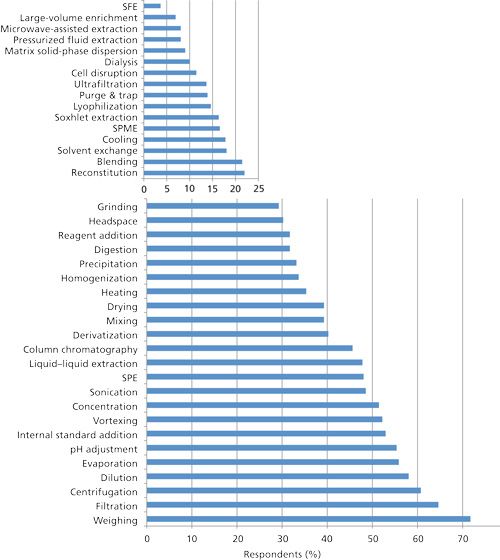
To keep readers informed of the latest developments and trends in sample preparation, LCGC North America occasionally runs reader- and expert-surveys that provide information on overall technology and usage patterns.

The past and future development of analytical supercritical fluid extraction (SFE) is traced in terms of experimental strategies, applications, vendor support, and timely acceptance of the existing technology.

Pressurized high temperature or superheated water is a green extraction solvent used in food, environmental, and traditional medicine studies for the extraction of non-polar and polar analytes including essential oils and spices, agrochemicals, pharmaceuticals, and petrochemicals.

Pressurized fluid extraction (PFE) is an automated extraction technique that uses elevated temperature and pressure to increase the rate and efficiency of the extraction process.

Some sample preparation techniques that were introduced in the past are now being used for new applications.

Microwave accelerated extraction (MAE) was evaluated by the authors of this review in 1999 (1). Since this time, the United States Environmental Protection Agency (USEPA) has promoted the use of SW-846 Method 3546 using MAE for the extraction of organic compounds from solid matrices.

The growing interest in green chemistry requires fresh perspectives on analytical extractions. Reduced solvent consumption, alternative safer solvents, and reasonable energy demands must be balanced with traditional analytical considerations such as extraction yield and selectively.

Modern autosamplers and workstations possess a range of capabilities, in addition to simple liquid handling, that allow automation of sample preparation steps traditionally performed manually.

A review article that summarizes the successful sample preparation strategies that have led to some of the highest peptide and protein identification rates reported in the literature

In contrast to isocratic separations, gradient elution can sometimes seem to be counter-intuitive. Yet with the proper perspective, the things we intuitively understand about isocratic methods apply in a similar manner to gradients.

The authors present the most common and fundamental techniques that address common matrix issues and discuss the critical chemistry considerations.

This article gives an overview of research into carbon nanotubules and their potential applications in chromatography and sample preparation.

The results from a reader survey on sample preparation techniques

This short review covers the use of ionic liquids (ILs) and polymeric ionic liquids (PILs) in solid-phase microextraction (SPME) and dispersive microextraction (DLLME)

Ionic liquids have tunable selectivity for specific classes of analytes, giving them distinct advantages over organic solvents.

Howard G. Barth and Ronald E. Majors Liquid–solid extraction is the most popular method, but sometimes modern approaches such as PLE/ASE and MAE are possible.