

LCGC North America
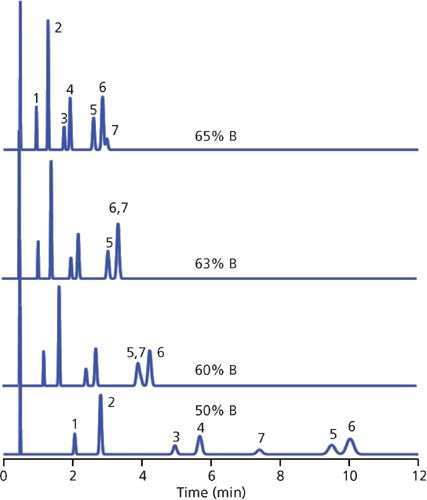
Ionic liquids have tunable selectivity for specific classes of analytes, giving them distinct advantages over organic solvents.
LCGC North America
Ionic liquids have tunable selectivity for specific classes of analytes, giving them distinct advantages over organic solvents.
LCGC North America
Howard G. Barth and Ronald E. Majors Liquid–solid extraction is the most popular method, but sometimes modern approaches such as PLE/ASE and MAE are possible.

LCGC Europe
This instalment focuses on approaches and techniques for extracting and concentrating small molecules of interest present in polymeric materials.
LCGC Europe
This article discusses the details of how the newer techniques of sample preparation are simplified by the use of LC–MS-MS and GC–MS-MS technology.

The Column
Well, the vacation is over and I've certainly come back down to earth with a bump!

LCGC North America
Congratulations, LCGC, on 30 successful years of reporting on the current trends in chromatography. Certainly, this is an accomplishment that we in the separations community have enjoyed and benefited from, and we wish you many more happy years of success.

Purification of Monoclonal Antibodies Using Various Modes of Analytical Chromatography

Special Issues
Sample preparation is a crucial part of the analysis of foodstuffs. Current sample preparation techniques used in food analysis are reviewed and the advantages and drawbacks of each one are discussed.

The Column
LC method development for new drug candidates or screening methods for new active structures in botanicals present the same type of challenges: How do I know that I have separated all main components, as well as important, sometimes hidden, impurities? Is my resolution good enough? Am I missing small, co-eluting peaks?

The Column
The current state of economic affairs is tumultous; as the economy struggles to bounce back, companies across all industries are becoming more creative in finding ways to reduce costs without sacrificing the quality of their goods or services. According to a recent survey conducted by the Society of Forensic Toxicologists (SOFT), 64.5% of forensic labs surveyed are implementing changes, or plan to implement changes, as a result of limited resources.

LCGC North America
Turbulent flow chromatography is often used for on-line sample cleanup of biological matrices in liquid chromatography–mass spectrometry applications.

LCGC North America
Part I of this series explains how lipids analysis has evolved.

LCGC Europe
Examples of a wide variety of sample preparation techniques for the analysis of trace-level contaminants in food and the advantages and disadvantages of each are discussed in this article.

The Column
Gathering information about the chemical and physical properties of target analytes is an essential step to effective solid-phase extraction (SPE) method development.

E-Separation Solutions
Sample preparation is the basis for all separations-related research.
LCGC Europe
Describes practical aspects of hollow-fibre liquid-phase microextraction in the three phase mode (HF3LPME) and also electromembrane extraction (EME).

LCGC North America
A presentation of the overall trends in liquid-phase chromatography observed at the symposium, as well as the awards presented and the opening plenary session

The Column
Polymers are sensitive molecules. Depending on the polymer architecture or copolymer composition, it is possible to have bonds present along the polymer chain that can easily be broken.

The Column
Flash chromatography is a type of preparative liquid chromatography commonly used in the separation of organic compounds.

LCGC Europe
Aggregated singletons for automated purification workflow delivers 30 mM DMS solutions for biological screening.

LCGC Europe
Microextraction by packed sorbent is a sample preparation technique that can be connected on-line with LC or GC systems.
LCGC North America
A review of the gas chromatography columns, sample preparation, and chromatographic and sample preparation accessories that were presented at Pittcon 2011.
The 2011 Dal Nogare award has been presented to Janusz Pawliszyn at Pittcon 2011.

LCGC Europe
Discussing the latest developments in sample preparation techniques that reduce environmental impact.
LCGC North America
A review of the liquid chromatography columns and accessories for analytical and preparative chromatography to be unveiled at Pittcon 2011