

LCGC (Chromatographyonline.com) has developed a pilot program with EARL (EARL2learn.com), the most extensive online library of interactive web-based learning material for analytical chemistry.
LCGC (Chromatographyonline.com) has developed a pilot program with EARL (EARL2learn.com), the most extensive online library of interactive web-based learning material for analytical chemistry.

LCGC North America
Ron Majors brings readers his yearly review of all that was new and innovative at the annual Pittsburgh Conference.
LCGC Europe
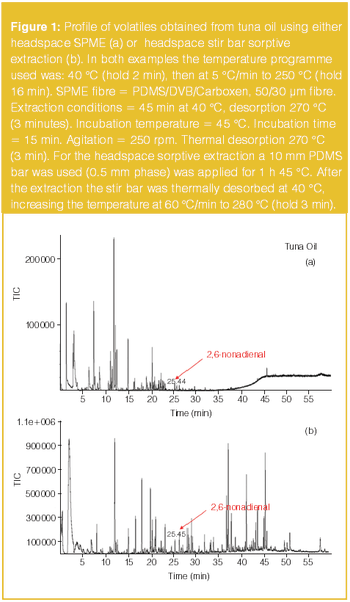
A review of the role of Solid-phase Microextraction (SPME) in quality control (QC) in the fish oil industry.
A research group from the Mendel University of Agriculture and Forestry (Brno, Czech Republic) and the Academy of Sciences of the Czech Republic (Trebon, Czech Republic) combined solid-phase exraction (SPE) and supercritical fluid extraction (SFE) using an SPE cartridge incorporated in an SFE cell to extract benzoic acid and cinnamic acid derivatives from microalgae and cyanobacteria samples.
The American Filtration and Separations Society will be holding its 22nd Annual Technical Conference and Exhibition on May 4-7, 2009, at the Sheraton Hotel in Bloomington, Minnesota.
Researchers from the Chinese Academy of Sciences (Beijing, China) and the University of Science and Technology of China (Hefei, China) used a two- and three-phase hollow-fiber liquid-phase microextraction method to determine aromatic amines in environmental water samples.
Researchers from Universita ?La Sapienza? (Rome, Italy) used a matrix solid-phase dispersion technique with hot water as the extracting solvent to extract seven quinolone antibacterial agents from egg samples.
LCGC North America
Guest authors from South Africa review the application of membranes in the extraction, preconcentration, and separation of various contaminants in food.
Researchers from Sun Yat-sen University and South China Normal University (both in Guangzhou, China) developed a sample preparation method for extracting the beta-blockers propranolol, atenolol, pindolol, and alprenolol from human plasma and urine samples.
Researchers from Stockholm University (Stockholm, Sweden) and Nankai University (Tianjin, China) used a serial mixed-mode cation-exchange and anion-exchange solid-phase extraction (SPE) method to extract 15 basic, neutral, and acidic pharmaceutical compounds from wastewater.
A research group from the University of Tehran (Tehran, Iran) used dispersive liquid?liquid microextraction coupled with gas chromatography to determine compounds in rose water, which is the hydrosol portion of the distillate of rose petals.
Scientists from the Swedish University of Agricultural Sciences (Uppsala, Sweden) and the University of Tabriz (Tabriz, Iran) developed a single-step solid-phase extraction (SPE) method to completely separate sterol oxidation products in food lipids.
Researchers from Universidad de Santiago de Compostela (Santiago de Compostela, Spain) developed a dispersive liquid-liquid microextraction sample preparation method to determine the antibacterial agent triclosan and its environmental transformation product methyl triclosan in water samples.
A research group from the South China University of Technology (Guangzhou, Guangdong, China) and the Georgia Institute of Technology (Atlanta, Georgia) used a full evaporation headspace gas chromatography method to determine ethanol in fermentation liquor.
Researchers from the University of the Basque Country (Bilbao, Spain) have compared two extraction techniques as preparation methods for analyzing organic pollutants polycyclic aromatic hydrocarbons, polychlorinated biphenyls, phthalate esters, nonylphenols, polybrominated biphenyls, and polybrominated diphenyl ethers in water samples.
Researchers from the Swedish University of Agricultural Sciences (Uppsala, Sweden) and the University of Tabriz (Tabriz, Iran) developed a solid-phase extraction method to separate sterol oxidation products in food lipids for analysis by gas chromatography (GC) and GC?mass spectrometry.
Pressure Biosciences, Inc. (South Easton, Massachusetts) has entered into an exclusive patent license agreement with the Battelle Memorial Institute (Columbus, Ohio.

LCGC Europe
Hypercrosslinked polystyrene-type (solid-phase extraction) SPE materials exhibit a unique ability to enter p-interactions with aromatic, heterocyclic and unsaturated compounds. This property permits selective extraction and pre-concentration of the above classes of species from non-polar media and fatty matrices. The principle has been exploited for developing analytical protocols to determine polar furan derivatives in mineral transformer oil, polyaromatic hydrocarbons (PAHs) in smoked fish and for the fractionation of polychlorinated aromatic compounds in environmental matrices.
Researchers at Universidade Federal de Santa Maria (Santa Maria, Brazil) and Centro de Pesquisas e Desenvolvimento Leopold Americo Miguez de Mello-CENPES/PETROBAS (Rio de Janeiro, Brazil) analyzed chloride in petroleum coke samples using microwave-induced combustion followed by ion chromatography.
Researchers from National Chung Hsing University (Taichung, Taiwan) analyzed four chlorophenols in aqueous samples using purge-assisted headspace solid-phase microextraction (SPME) followed by gas chromatography?mass spectrometry (GC?MS).
A research group from LMTAI (La Rochelle, France) and LVMH Recherche (St. Jean de Braye Cedex, France) analyzed the oligosaccharides ciceritol and stachyose extracted from Tephrosia purpurea seeds using an instant controlled pressure drop pretreatment before solvent extraction.
A researcher from Shagrao Normal University (Shangrao, Jiangxi Province, China) used solid-phase microextraction (SPME) followed by gas chromatography?mass spectrometry (GC?MS) to analyze volatile organic compounds (VOCs) in cigarette smoke.
Scientists from INIA (Madrid, Spain) used ultrasonic-assisted extraction followed by liquid chromatography with triple-quadrupole mass spectrometry detection (LC?MS) to analyze paraben compounds in environmental solid samples.
The Application Notebook
A highly sensitive analytical method for the analysis of tamsulosin in human plasma has been developed for use in bioanalytical studies. The solid-phase extraction (SPE) and UPLC–MS–MS methodologies are described, as well as performance against validation parameters.
LCGC North America
Columnist Ron Majors discusses some of the practical considerations in the successful application of the popular yet age-old technique of solvent extraction (also known as liquid–liquid extraction, or LLE).