The Application Notebook-09-01-2008

i1-575612-1408667185836.jpg

The Application Notebook

The separation and quantitation of drug substances and counterions are two important determinations in the pharmaceutical industry (1). Drug substances and counterions are determined by HPLC (often on reversed-phase columns) and by ion chromatography (IC), respectively. IC is the preferred method for selective and sensitive screening of both cationic and anionic pharmaceutical counterions (2). To increase the analysis throughput, it is desirable that for analysis of drug formulation both drug substance and counterions can be determined within a single run. Naproxen is a non-steroidal anti-inflammatory drug commonly used for treating moderate to severe pain, fever, inflammation, and stiffness. Naproxen sodium was approved by the U.S. Food and Drug Administration (FDA) as an over-the-counter drug. No reports were found describing one technique for the simultaneous determinations of both naproxen and the counterion (Na+).

i3-575605-1408667204315.gif

The Application Notebook

In March 2007, several North American manufacturers of pet food voluntarily issued nationwide recall notices for some of their products that were reportedly associated with renal failure in pets. The raw material wheat gluten, used to manufacture the pet food, was imported from China and was identified as the source of contamination.

i4-575584-1408667320652.jpg

The Application Notebook

Additional studies were undertaken to better understand the chromatographic behavior of PEGylated proteins in an effort to improve purification and characterization techniques of such proteins. Proteins were PEGylated using larger (20 KDa and 40 KDa) PEGylation reagents that are commonly used in pharmaceutical drug development. Generated PEGylated proteins were separated from unmodified proteins using different reversed phase medias (Jupiter® C4 and Jupiter® C18). In these studies it was found that the Jupiter C18 media provided the best separation of PEGylated proteins from their unmodified counterparts. Such results further clarify good method starting points for developing analytical and preparative separations of PEGylated proteins.

i1-575583-1408667323910.jpg

The Application Notebook

They say that timing is everything, and though this saying may have originally been applied to Broadway and Vaudeville in the early twentieth century, it is just as true when it comes to the field of modern-day separation science. For this September issue of The Application Notebook should be reaching our audience of analytical chemists, lab managers, and other industry professionals just as the busiest time of the year ramps up in the world of chromatography.

i1-575618-1408667170575.jpg

The Application Notebook

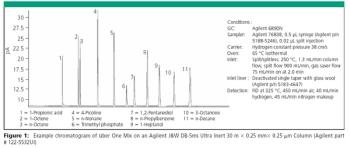
QC test probes serve a vital function in ensuring the reproducibility of modern GC columns. These probes ensure that the columns have been properly deactivated, contain the correct amount of stationary phase, and have the same relative retention as the last column purchased. The choice of individual compounds in these test mixes varies widely and can have profound consequences on the performance of a column in the users' applications.

i4-575598-1408667244956.gif

The Application Notebook

A new technique, QuEChERS, standing for Quick, Easy, Cheap, Effective, Rugged, and Safe, is readily accepted by both the AOAC International and the Committee of European Normalization (CEN) for the pesticide residues in foods and agriculture products. Waters DisQuEâ„¢ Dispersive Sample Preparation Kit contains conveniently-packaged centrifuge tubes with pre-weighed sorbents and buffers designed for use with the AOAC official QuEChERS methods.

i2-575594-1408667270648.gif

The Application Notebook

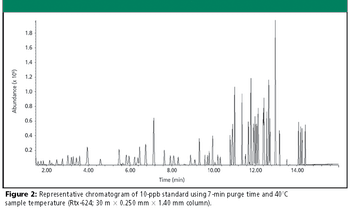
The purge-and-trap (P&T) technique for analysis of volatile organic compounds (VOCs) was pioneered in the 1970s at the United States Environmental Protection Agency (USEPA) research laboratory in Cincinnati. Many of the operational parameters developed during this time period are still included in USEPA methods. While these parameters still produce good analytical results, they do not take advantage of advances in instrumentation that enable analysis of emerging contaminants such as fuel oxygenates, and increased sample throughput.

i1-575609-1408667193558.jpg

The Application Notebook

Sample preparation is an essential technique to remove unwanted matrix components prior to LC–MS-MS analysis of drugs in biological fluids. Plasma matrix components whether endogenous (salts, proteins, and phospholipids) or exogenous (dosing vehicles, e.g. PEG 400), can interfere with compounds of interest leading to regions of ion suppression or enhancement. This can lead to inaccurate quantitation and have adverse effects on sensitivity. Mixed-mode SPE provides cleaner extracts as a result of rigorous interference wash steps, afforded by the dual retention mechanism of the sorbents.

i3-575600-1408667229025.gif

The Application Notebook

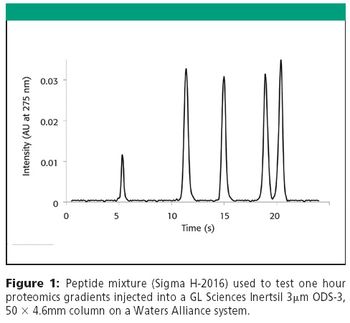
The recent development of ultra-HPLC (UHPLC) has provided a great potential for high throughput analysis achieved using small (sub-2 μm) particle size columns at increased linear velocities. The advantage of UHPLC over conventional HPLC is increased throughput without sacrificing resolution. Despite their popularity, sub-2 μm particle columns impose practical difficulties, such as high backpressure (which often requires a UHPLC system) and susceptibility to column fouling. Thus difficulty can be overcome using 2.0 to 2.5 μm particles. This study describes an example (analysis of vanilla extract) of transferring a conventional LC method to a high-throughput method using newly developed Acclaim® RSLC 2-μm columns that are based on spherical, porous, high-purity silica particles (dp = 2 μm, pore size = 120 Å, surface area = 320 m2/g).

i1-575611-1408667188103.jpg

The Application Notebook

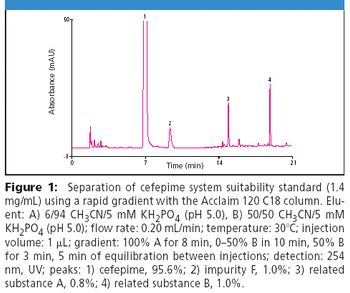
Cephalosporins contain a four-member β-lactam ring that is inherently strained and prone to hydrolysis and photolysis, limiting stability and leading to degradation products that may be toxic (1). In addition, synthetic byproducts are generated and persist during production of these antibiotics including cefepime. Analysis of cefepime purity is particularly challenging due to the presence of such isomeric synthetic impurities. The Acclaim® 120 C18, 3 μm can be used to meet and exceed the criteria set by the USP for determining related substances and assaying the purity of cefepime.

i1-575623-1408667158070.jpg

The Application Notebook

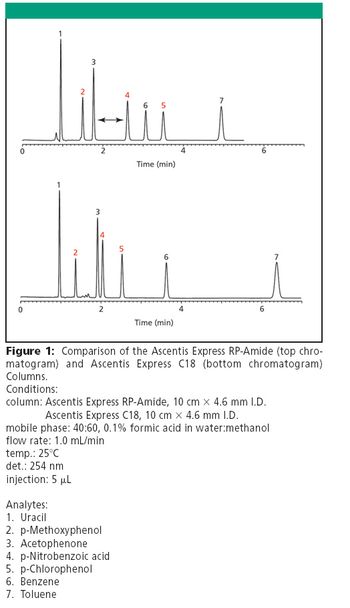
The Fused-Core particle consists of a 1.7 micron solid core and a 0.5 micron porous shell yielding a 2.7 micron diameter. One of the benefits of the Fused-Core particle is the small diffusion path (0.5 microns) compared to conventional fully porous particles. The shorter diffusion path minimizes peak broadening. In fact, there have been many reports on the vast improvements in efficiency provided by Fused-Core particles versus conventional particles. These improvements provide sub-2 micron like performance at half of the backpressure allowing Ascentis Express columns to be used in conventional HPLC as well as UHPLC systems.

i2-575604-1408667207725.gif

The Application Notebook

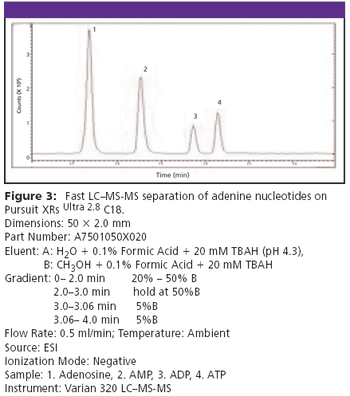
Recent developments in HRes Fast-LC systems have enabled the use of sub-3 μm stationary phases at higher flow rates and elevated pressures. HRes Fast-LC can provide significant improvements in both resolution and throughput.

i4-575626-1408667151067.jpg

The Application Notebook

In size exclusion chromatography, obtaining calibration curves over a wide range of molecular weights is a difficulty investigators often encounter when analyzing polymers with a broad molar mass distribution. To overcome this problem two procedures are typically used. One option is to use multiple columns of different pore sizes linked together in series. A second is to use a column packed with a mixed bed resin of different pore sizes at an optimized mix ratio. However, problems can occur with both of these methods, which include distortion of the chromatogram or deviations between the actual calibration curve and the calibration curve approximated from data obtained from the molecular weight standards.

i4-575627-1408667148261.jpg

The Application Notebook

Our work focuses on the synthesis of branched (functionalized) polydienes via a facile two-step synthesis. Despite the numerous strategies developed for the preparation of branched polymers in recent years, there is still a limited number of simple synthetic strategies based on common vinyl monomers.

i2-575607-1408667197579.gif

The Application Notebook

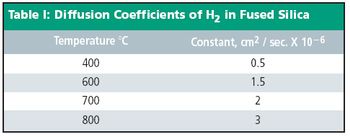
Escalating costs and increasing demands for helium, coupled with diminishing helium supply, have given rise to the investigation and use of hydrogen as an alternate choice of carrier gas for use in gas chromatography (GC) applications. This application note illustrates that the use of hydrogen as a carrier gas as an alternative to helium in refinery gas applications is not only possible, but also results in improved performance and higher sample throughput.

i4-575599-1408667241709.gif

The Application Notebook

Organic acids are present in many matrices and play crucial roles. Extensive research involving low molecular mass organic acids (LMMOA) has been performed in food chemistry since these acids contribute to the organoleptic properties of food and beverages, including flavor, color, aroma, taste, shelf-life, and health effects. Developing a profiling method to monitor LMMOA levels in raw materials and final products is very desirable. Many reported methods focus on limited numbers of LMMOAs and are incapable of providing a complete LMMOA profile.

i2-575585-1408667317127.gif

The Application Notebook

This application note describes a rapid U-HPLC method for the separation of sulphorhodamine 101 (Texas Red®) and its three water-soluble derivatives using a Hypersil GOLD™ column packed with 1.9 μm particles.

i1_t-575595-1408667265796.gif

The Application Notebook

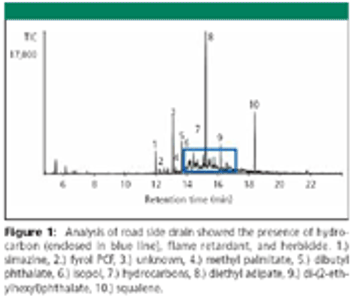
MEPS uses a barrel insert and needle (BIN) device to reduce Solid-Phase Extraction (SPE) to a micro-scale suitable for small volume samples and for the online adaptation of conventional SPE techniques. Because the SPE cartridge (BIN) is incorporated into the needle assembly of a gas-tight syringe, MEPS is also a simple field-portable SPE device that may be operated manually without need for sampling pumps or, alternatively, may be incorporated into robotic samplers. MEPS devices are of glass and stainless steel construction allowing them to be fully immersed for sampling at depth or, alternatively, used at needle depth to avoid perturbing the stream from which the sample was drawn. An extension pole allowed MEPS to be used to sample back along pipes or down inspection vents. When sampling from drainage pits and open sumps, there was minimal requirement to remove grates to gain access. An extension pole also allowed sampling from outflows that were offensive and could be readily adapted for safe sampling of..

i2-575596-1408667260592.gif

The Application Notebook

The CUSTODION™ SPME Syringes are a series of novel solid phase micro extraction syringes that incorporate Supelco Analytical's® (Bellefonte, Pennsylvania) SPME fiber technology. The SPME syringes are fabricated with injection-molded components and the device resembles a ball-point pen. The Supelco Analytical® SPME fiber assembly is housed inside the syringe.

i4-575602-1408667216511.gif

The Application Notebook

Screening for pesticide content is a common analysis that is done in laboratories where many samples need to be analyzed over a short period of time. The desire for a high-speed analysis is due to the need for a fast result from a potentially large volume of samples. A fast analysis is typically achieved through the use of high carrier gas flow rates in combination with temperature programming. A fast detector is needed in order to fully characterize the narrow chromatographic peaks generated from these experiments. TOFMS is ideal for detecting these narrow peaks because of its fast acquisition rate over a full mass range at all times during the experiment. In addition, TOFMS provides for non-skewed mass spectra making peak deconvolution possible.