The Application Notebook-09-01-2008

i3-575601-1408667222086.gif

The Application Notebook

Mycotoxins, toxic secondary metabolites of several fungal species, represent food safety issues of high concern. Deoxynivalenol, the most abundant trichothecene mycotoxin, can be found worldwide as a contaminant of wheat, barley, maize and other cereals (1,2). The transmission of deoxynivalenol from barley into beer has been reported in several studies (3,4). Therefore, its levels should be controlled.

i4-575603-1408667211448.gif

The Application Notebook

This article describes a straightforward ion chromatographic method that uses isocratic elution and pulsed amperometric detection (PAD) to sensitively determine water-soluble polyols and sugar alcohols as well as mono-, di- and oligosaccharides in essential and nonessential foodstuffs. While carbohydrate determination of most foodstuffs requires only minimal sample pretreatment such as dilution and filtration, samples with interfering matrices such as protein-containing dairy products have to be dialyzed prior to injection.

i4-575617-1408667172824.jpg

The Application Notebook

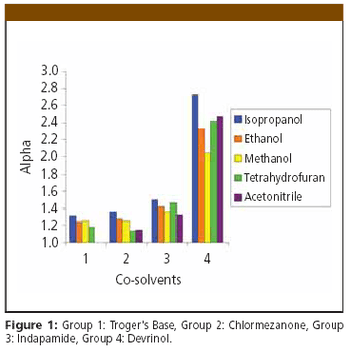
In the past decade, supercritical fluid chromatography (SFC) has experienced a striking resurgence and exponential growth in acceptance, particularly in pharmaceutical and chemical laboratories. In SFC, "supercritical" CO2, in combination with one or more polar organic solvents, most commonly alcohols, are used as mobile phase. The polarity of CO2 is similar to that of hexane, and thereby making SFC a normal phase chromatographic technique. SFC has readily lent itself as an attractive complement to reversed phase HPLC (RPLC). For instance, in separating polar compounds that have little retention, and/or selectivity, even with special polar group embedded columns, SFC holds a unique advantage over RPLC due to its normal phase separation mechanism.

i2-575592-1416914095215.gif

The Application Notebook

Semivolatile analyses using methods similar to US EPA method 8270 (1) are important in environmental laboratories worldwide. A number of acidic compounds such as benzoic acid or 2,4-dinitrophenol and strong bases such as pyridine or benzidine are active species found in the semivolatile sample set. These highly polar species are particularly susceptible to adsorption into active surfaces in the sample flow path, including the column itself. System and column inertness are critical for effective analysis of these active chemical species.

i1-575610-1408667190495.jpg

The Application Notebook

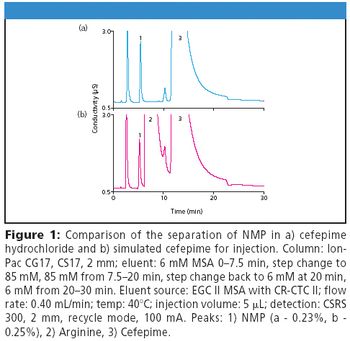
Cefepime is a fourth generation cephalosporin (1). During preparation and storage, cefepime degrades by release of the N-methylpyrrolidine (NMP) side chain and opening of the beta-lactam ring. An NMP concentration increase will directly affect the potency of the active component of the drug. Therefore, it is critical to determine the amount of NMP in cefepime. The US Pharmacopeia (USP) monograph specifies the limit of NMP to <0.3% in cefepime hydrochloride and <1% in cefepime for injection (2,3). The latter is a dry mixture of cefepime hydrochloride and L-arginine. The current USP method uses cation-exchange chromatography with non-suppressed conductivity detection to determine the limit of NMP in cefepime. There are several disadvantages to this method, such as the ~3-4 h time required per injection, a lack of retention time stability for NMP in standard and sample solutions, and a lack of sensitivity. In this paper, we describe an improved method using a hydrophilic, carboxylate-functionalized cation..

i4-575621-1408667162946.jpg

The Application Notebook

In general, polymer-based columns have a broad pH range (pH 2 to 13), and some have high temperature tolerance (up to 150°C or higher). Considerably large selectivity changes can be obtained by varying analysis temperature and mobile phase pH. Having control on these two parameters over wide ranges can be especially useful in method development.

i4-575606-1408667199830.gif

The Application Notebook

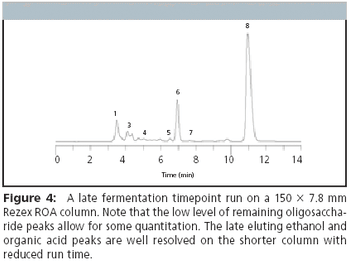
Political priorities as well as economic interests have fueled a dramatic growth in the biofuel industry, due much in part to research funding and tax incentives. Currently the world's ethanol production is estimated to be over 16 billion gallons a year. This number is expected to increase in the next few years, reaching an estimated yearly production of 20 billion gallons by 2012. Today, many ethanol producers add fermentors to expand their production capacity. In order to continue using existing HPLC equipment for the increased monitoring, increased analytical throughput is needed.

i2-575608-1408667195767.gif

The Application Notebook

Viscotek has been a strong advocate of good chromatography as a prerequisite for GPC (Gel Permeation Chromatography) data accuracy. Our recent work in application development has been driven by extremely difficult samples from industrial, biopharmaceutical, and academic sources. These samples present challenges ranging from sample solubility, column adsorption, as well as detection issues. This report will attempt to highlight a new approach that could be very helpful in certain advanced GPC applications.

i2-575597-1408667253095.gif

The Application Notebook

Use of a modified QuEChERS sample preparation procedure was fully evaluated for identification and quantitation of pesticides in lettuce using gas chromatography and ion trap mass spectrometry. Final results compared favorably to the reporting and detection limits offered by several worldwide agencies, demonstrating a robust and reliable solution for analyzing pesticide residues in lettuce.

i2-575593-1408667276928.gif

The Application Notebook

The second unregulated contaminant monitoring regulation (UCMR2) program was developed to monitor US drinking water sources for currently unregulated compounds. EPA Method 527 is categorized under List 1; Assessment Monitoring in the UCMR2 program. EPA Method 527 focuses on a wide range of semi volatile organic contaminants, including pesticides that were deferred during the first UCMR, flame retardants, and pyrethroid pesticides. This application for EPA Method 527 employs SPE with analysis by gas chromatography–mass spectrometry (GC–MS).

i4-575614-1417780563080.jpg

The Application Notebook

Paracetamol is a major ingredient in numerous medications due to its analgesic and antipyretic properties. During its synthesis (Figure 1), a total of ten process-related impurities are observed. Several HPLC applications have been developed for the monitoring of these impurities (1, 2), including the European Pharmacopoeia which has adopted an isocratic HPLC method using a silica-based C8 column with 5 μm particle size, requiring a run time of 45 min (3). By using a gradient method and standard HPLC instrumentation, the analysis can be reduced to 7 min (4).

i1_t-575590-1408667292279.gif

The Application Notebook

A large percentage of commercial and investigational pharmaceutical compounds are enantiomers and many of them show significant enantioselective differences in their pharmacokinetics and pharmacodynamics. The importance of chirality of drugs has been increasingly recognized, and the consequences of using them as racemates or as enantiomers have been frequently discussed in the pharmaceutical literature during recent years. With increasing evidence of problems related to stereoselectivity in drug action, enantioselective analysis by chromatographic methods has become the focus of intensive research of separation scientists. Most of the pharmaceutical and pharmacological studies of stereoselectivity of chiral drugs before the mid eighties involved pre-column derivatization of the enantiomers with chiral reagents forming diastereomers.

i2-575586-1408667313143.gif

The Application Notebook

Amylose is an occasionally-branched biopolymer and, together with amylopectin, the hyper-branched component, a constituent of starch. Determination of branching in amylopectin on the basis of amyloses may be performed with the help of synthetic amyloses. Synthetic amyloses from enzymatic (phosphorolytic) reaction were checked for their linearity.