

LCGC E-Books
LCGC E-Books

LCGC Europe
The United States Pharmacopeia general chapter on Analytical Instrument Qualification has been updated and became effective 1 August 2017. So, what has changed?
LCGC Europe
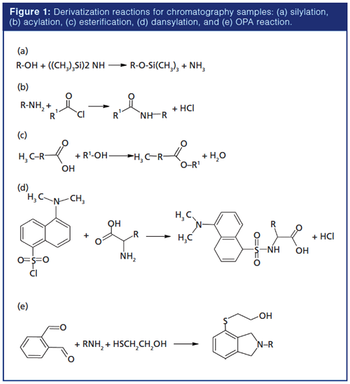
During the developmental stages of chromatography, the use of sample derivatization was prevalent either to render difficult-to-separate analytes ready for chromatography or to improve analyte detectability. As chromatography techniques advanced, including detection, the need for derivatization was less pronounced. Today, there is a resurgence of interest in derivatization schemes; however, the new generation of separation scientists is not as well-versed in these reactions. Some of this resurgence is for newer purposes, such as combining two or more derivatizations for the analysis of multiple compound classes, or to develop greener approaches. In this month’s instalment, we explain the use of chemical derivatization in the separation sciences, generally, and in sample preparation specifically.

LCGC Europe
A look at what’s in store for chromatographers at Pittcon 2018, which takes place in Orlando, Florida, USA, from 26 February to 1 March 2018.

LCGC Europe
The 34th International Symposium on Microscale Separations and Bioanalysis (MSB 2018) will be held at the conference centre of the Windsor Barra Hotel (Barra da Tijuca) in Rio de Janeiro, Brazil, from 18–21 February 2018.

LCGC North America
There is a resurgence of interest in chemical derivatization schemes in separation science, particularly in sample preparation. Here’s why.

LCGC North America
Paying attention to the details of mobile-phase preparation can have a big impact on the reproducibility of HILIC separations.

LCGC North America
A look at techniques for charge-variant analysis of monoclonal antibodies and the question of whether pH gradients are really better than salt gradients

LCGC North America
The fundamental principles of ion-exchange solid-phase extraction

LCGC North America
Three main points summarize the best ways to be successful in GC:capillary GC is clean GC; practice, practice, practice; and be a student of GC.
LCGC Europe
Click the title above to open the LCGC Europe January 2018 regular issue, Vol 31, No 1, in an interactive PDF format.
LCGC North America
Click the title above to open the LCGC North America January 2018 regular issue, Vol 36 No 1, in an interactive PDF format.
The Column
The LCGC Europe/HTC-15 Innovation Award was launched to celebrate the work of scientists who are innovatively evolving the field of hyphenated techniques.
The Column
The newly appointed Chromatographic Society Lecturer, Mel Euerby, visited the University of Sunderland in early November in the first official outing of the role.

The Column
Researchers from University College London have developed a novel method of characterizing the mechanical strength of agarose-based chromatography resins used in the manufacturing of biopharmaceuticals.
The Column
Avantor Inc. has completed the acquisition of VWR Corporation for an approximate amount of $6.5 billion.
The Column
Click the title above to open The Column December 12, 2017 Europe & Asia issue, Volume 13, Number 18, in an interactive PDF format.
The Column
Click the title above to open The Column December 12, 2017 North American issue, Volume 13, Number 18, in an interactive PDF format.

The LCGC Blog
It’s very easy to be comfortable with what you have. It’s only when we realize what could be, that we become interested in changing things.
The Column
Peak Scientific has created a new online calculation tool to help laboratories that use gas chromatography (GC) to quickly identify the ideal gas solution for their specific GC instrument.
The Column
The American Chemical Society has awarded Kevin Schug with the J. Calvin Giddings Award for Excellence in Education in recognition of his efforts to improve the educational experience of students in the field of analytical chemistry.

The Column
Dwight Stoll has been awarded the EAS Young Investigator Award at the recent Eastern Analytical Symposium held in Plainsboro, New Jersey on 15th November.

The Column
Sciex Diagnostics, the in vitro diagnostics (IVD) division of Sciex, has announced a joint venture with Zhejiang Dian Diagnostics (Dian).

The Column
A preview of HTC-15, which will be held at Cardiff City Hall, Cardiff, United Kingdom, from 24–26 January 2018.
The Column
Click the title above to open The Column December 05, 2017 Europe & Asia issue, Volume 13, Number 17, in an interactive PDF format.
The Column
Click the title above to open The Column December 05, 2017 North American issue, Volume 13, Number 17, in an interactive PDF format.

When I want to hear some humorous stories, there are few friends in the instrument manufacturing and sales business I can contact. If I ask them about their recent experiences with the cannabis industry, their stories will cover topics ranging from instruments purchased using duffel bags of cash (cue images of large men in suits and sunglasses packing heat) to recent college graduates who cleared $25 million in their first year of business selling cannabis butter (cue images of large men at breakfast laughing uncontrollably).
LCGC North America
Click the title above to open the LCGC North America December 2017 Corporate Capabilities, Vol 35 No s12, in an interactive PDF format.