

LCGC Asia Pacific
How do non-alkylsilica columns provide us an additional dimension of column selectivity?
LCGC Asia Pacific
How do non-alkylsilica columns provide us an additional dimension of column selectivity?
LCGC Asia Pacific
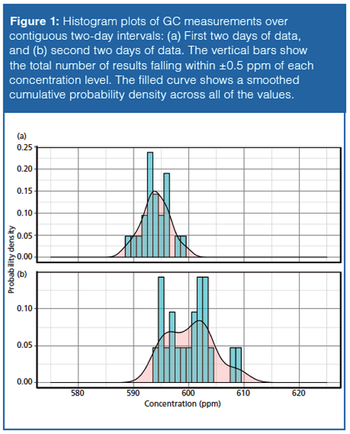
Small differences in process gas chromatography (GC) results from the same sample stream over time can indicate corresponding changes in target analyte concentrations, or the fluctuations might be due to external influences on the instrument. This instalment of ”GC Connections” explores ways to examine such results and better understand their significance.

LCGC Asia Pacific
Using a liquid chromatography–mass spectrometry (LC–MS) method in conjunction with two complementary types of chromatographic retention modes-reversed phase and aqueous normal phase-various compounds present in mesquite flour extracts were identified. Because of the diverse types of chemical constituents found in such natural product extracts, a single chromatographic mode may not be sufficient for a comprehensive characterization. However, the combination of reversed-phase and aqueous normal phase LC can encompass a wide range of analyte polarity. This characterization of the composition of mesquite flour could be used in future studies to elucidate the beneficial health effects of its consumption.
LCGC Europe
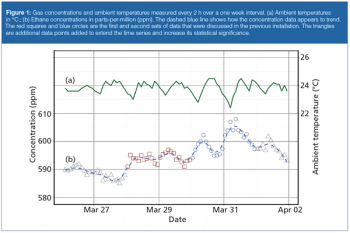
In the previous instalment, we presented a case of periodically fluctuating data that did not lend itself well to trend analysis with conventional statistical methods. The data did appear to have a strong regular fluctuation, but its relationship to other observations was not clear. This instalment addresses methods for teasing out external influences on trending data.

LCGC Europe
The 45th International Symposium on High Perfomance Liquid Phase Separations and Related Techniques (HPLC 2017), cochaired by Michal Holc€apek and František Foret, was held 18–22 June in Prague, Czech Republic. This instalment covers some of the highlights observed at the symposium, including advances in large-molecule separations, multidimensional chromatography, and areas of growing application of high performance liquid chromatography (HPLC). In addition, trends and perspectives on future developments in HPLC noted from the conference are presented.
The Application Notebook
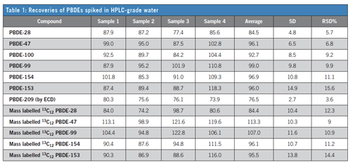
Polybrominated diphenyl ethers (PBDEs) are a worldwide contamination problem. Structurally similar to polychlorinated biphenyl (PCBs), these compounds are long-lived in the environment and can bioaccumulate throughout the food chain. The health hazards of these chemicals have attracted increasing scrutiny and, as such, a great deal of research and regulations have been implemented to manage and control them.
The Application Notebook
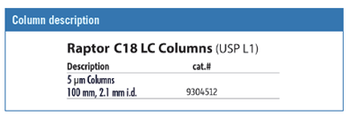
Perfluorinated alkyl acids are man-made fluorochemicals used as surface-active agents in the manufacture of a variety of products, such as firefighting foams, coating additives, textiles, and cleaning products. They have been detected in the environment globally and are used in very large quantities around the world. These fluorochemicals are extremely persistent and resistant to typical environmental degradation processes. As a result, they are widely distributed across the higher trophic levels and are found in soil, air, groundwater, municipal refuse, and landfill leachates. The toxicity, mobility, and bioaccumulation potential of perfluorooctanesulfonic acid (PFOS) and perfluorooctanoic acid (PFOA), in particular, pose potential adverse effects for the environment and human health.
The Application Notebook
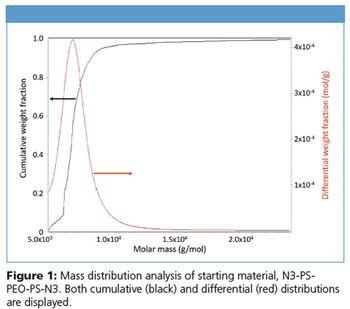
“Click” chemistry is a class of efficient and selective reactions that is characterized by quantitative yields, tolerance to a broad range of functional groups, facile experimental setup, and minimal synthetic workup. This class of reactions combines particularly well with controlled radical polymerization methods, such as atom transfer radical polymerization (ATRP), and the two techniques have been prolifically employed for the synthesis of a wide variety of novel polymeric materials, including (multi) block copolymers, stars, brushes, and gels. This note describes the analysis of multisegmented block copolymers prepared by click-coupling of block copolymers synthesized by ATRP.

LCGC North America
Identifying Post-Translational Modifications in Monoclonal Antibodies Analyzing post-translational modifications-such as glycosylation, oxidation, and deamidation-at different levels can reveal different types of information.
The Application Notebook
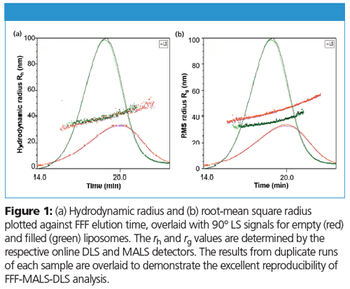
Liposomes are often used as nanocarriers to encapsulate in their cores hydrophobic or highly toxic drugs, and deliver these drugs safely to target tissue. During drug nanocarrier research and development as well as production quality control, it is of great importance to monitor liposome size distributions accurately while also verifying drug encapsulation. FFF-MALS-DLS, consisting of field-flow fractionation (FFF) combined with multi-angle light scattering (MALS) and dynamic light scattering (DLS), is a powerful tool for characterizing the size, concentration, and structure of large nanoparticle ensembles.

The Application Notebook
This application note describes a combined approach of analytical method development and method transfer by direct emulation of different target HPLC systems.
The Application Notebook
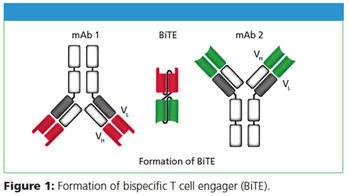
Modern therapeutic antibody formats, such as bispecific antibodies (bsAbs), are on the rise. Bispecific antibodies are artificial proteins that recognize two different epitopes and can simultaneously bind to two different types of antigen. They can be used to redirect T cells to tumour cells, block two different signalling pathways simultaneously, dually target different disease mediators, and deliver payloads to targeted sites.

LCGC Europe
The 15th International Symposium on Hyphenated Techniques in Chromatography and Separation Technology (HTC-15) will be held at Cardiff City Hall, Cardiff, United Kingdom, from 24–26 January 2018.

LCGC Europe
ChromSoc’s Advances in Gas Chromatography meeting will take place at The Heath Business and Technical Park, Runcorn, Cheshire, UK, on 18 October 2017.

LCGC Asia Pacific
Click the title above to open the LCGC Asia Pacific September 2018 regular issue, Vol 20, No 3, in an interactive PDF format.
LCGC Europe
Click the title above to open the LCGC Europe September 2017 regular issue, Vol 30, No 9, in an interactive PDF format.
LCGC North America
Click the title above to open the LCGC North America September 2017 regular issue, Vol 35 No 9, in an interactive PDF format.

As the fall semester starts, I begin my 13th year as a chemistry professor. Let me get right to the point-if you do not love this job, you will hate it!

The Column
A method to determine the quality of olive oil has been developed using a novel atmospheric pressure chemical ionization (APCI) source in combination with gas chromatography (GC) coupled to hybrid quadrupole time-of-flight mass spectrometry (QTOF-MS) and a metabolomics strategy.
![IMG_4773[1].jpg](https://cdn.sanity.io/images/0vv8moc6/chroma/6db719ea80519dad8e948ad595b96c3fa3731826-200x207.jpg?w=350&fit=crop&auto=format)
The Column
VUV Analytics has announced Hans-Gerd Janssen and his laboratory at the University of Amsterdam, The Netherlands, as the recipient of their academic grant.
The Column
Gary J. Patti is the recipient of the 2017 Agilent Early Career Professor Award.
The Column
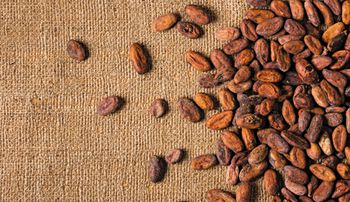
Researchers from the Université de Strasbourg, France, have developed a method to discover cocoa bean origin by analyzing chocolate polyphenols using high performance liquid chromatography–diode array detection–mass spectrometry.

The Column
This proof-of-principle study shows that dynamic headspace sampling with thermal desorption–gas chromatography–time‑of-flight mass spectrometry (TD–GC–TOF-MS) analysis can be used to investigate the complex aroma profiles released from flavoured cookies. Key flavour compounds in chocolate-chip, peanut, and orange-cream cookies are highlighted, and the effect of raising the headspace extraction temperature is examined.

The Column
A rapid and sensitive ultrahigh-pressure liquid chromatography tandem mass spectrometry (UHPLC–MS/MS) method was developed to simultaneously determine six plant growth regulators in bean sprouts with a simple preparation. Analyte extraction from samples was effectively performed using liquid–liquid extraction (LLE) by acetonitrile. Chromatographic separation was conducted on a C18 reversed-phase column with gradient elution. The analytes were detected by tandem quadrupole MS after negative electrospray ionization by multiple reaction monitoring. The developed method was validated by testing method specificity, matrix effect, sensitivity, linearity, accuracy, and precision.

The Column
A preview of RAFA 2017, which will be held 7–10 November 2017 in Prague, Czech Republic.
The Column
Click the title above to open The Column August 22, 2017 Europe & Asia issue, Volume 13, Number 12, in an interactive PDF format.