All News

Not every method is as we would hope it would be. Some methods come to us in imperfect form and we have to live with them, while others are difficult separations and, by necessity, need to be developed using close control of several variables such as eluent pH, eluotropic strength, ionic strength etc.

Waters Corporation has announced the addition of Richard Chang and Xiao Ran Yu to its Asia Pacific leadership team. Chang has been appointed as Vice President of Waters’ Asia Pacific Operations and Yu has been appointed as General Manager of Waters China.

Food and beverage manufacturers who perform simple sugar analysis require methods that provide sensitive, selective, and direct determination of carbohydrates. Minimizing errors associated with sample preparation is of key importance, because samples often require large dilutions that can impact the downstream accuracy of results. In this summary, the benefits of using high-performance anion-exchange chromatography coupled with pulsed amperometric detection (HPAE-PAD), which does not require sample derivatization, will be discussed. We will also cover recent technological advances, including high pressure ion chromatography, which have enabled manufacturers to analyze more samples in less time.

figure 2-2.jpg

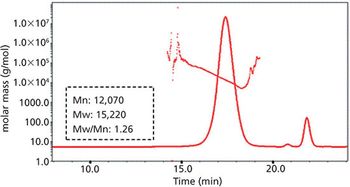
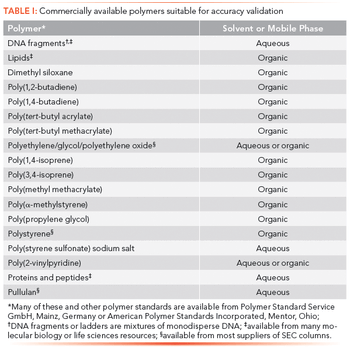
While conventional calibration for gel permeation (GPC) or size-exclusion chromatography (SEC) is useful, there are inherent disadvantages in this type of analysis that introduce experimental error. This uncertainty may cast serious aspersions on the rigour and utility of the results. Multi-angle light scattering (MALS) detection is quite simple to add to an existing chromatography system and can help overcome the challenges faced with single detector chromatography and conventional calibration-based methods. An alternative separation technique called asymmetric flow field-flow fractionation (AF4) offers tunable, column-free fractionation.

table 1 S.jpg

The third instalment in this series provides an overview of modern practices of separation science in small-molecule drug development. It highlights approaches in high performance liquid chromatography (HPLC) method development and physical or chemical characterization to support process chemistry and formulation development, and for assessment or control of clinical trial materials. The roles of separation scientists in analytical development and salient chromatographic methodology trends are also discussed.

LGC Standards has been awarded a Responsible Sourcing status by Sedex for its Standards division in Germany. A non-profit membership organization, Sedex is dedicated to improving responsible and ethical business practices in global supply chains.

fatty acids.jpg

Researchers from the USA have developed a simple and derivatization-free gas chromatography (GC) method for the quantitative analysis of oleic acid and related fatty acids.

meat.jpg

Researchers from Universidade Federal de Minas Gerais, Brazil, have used multiple analytical techniques including IEC and ATR‑FTIR spectroscopy to investigate bovine meat adulteration.