Click the title above to open the LCGC Europe June 2017 supplement, Vol 30, No s6, in an interactive PDF format.

Click the title above to open the LCGC Europe June 2017 supplement, Vol 30, No s6, in an interactive PDF format.

Click the title above to open the LCGC North America June 2017 regular issue, Vol 35 No 6, in an interactive PDF format.

MilliporeSigma (St. Louis, Missouri, USA) is now accepting entries for the Alfred R. Bader Award for Student Innovation.


A novel unit that integrates sampling and analysis for the determination of pest insect sexual pheromones in environmental air using fabric phase sorptive extraction (FPSE) and headspace gas chromatography coupled to mass spectrometry (HSGC–MS) has been developed at the University of Córdoba in Spain.

Markes International has been awarded a European Product Design award for their recently re-designed “xr” series of thermal desorption (TD) products.

3M, the science-based technology company, has commissioned the National Institute for Bioprocessing Research and Training (NIBRT) to conduct in-depth research into their Emphaze AEX Hybrid Purifier, a single use plug and play filter matrix.

Agilent Technologies has awarded Dwight Stoll an Agilent Thought Leader Award in support of his research applying two‑dimensional liquid chromatography (2D‑LC) to biopharmaceutical analysis.

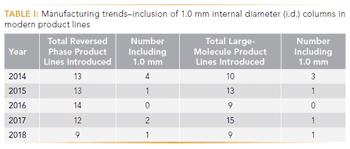
Incognito delves into some statistics on chromatography research, and is unsettled by what he finds.

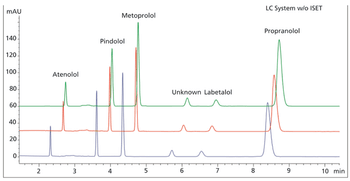
An autosampler for a standard gas chromatography (GC) or GC–mass spectrometry (MS) system was adapted to perform simple static headspace sampling, instead of using a separate, and potentially more complicated, headspace sampling unit.

A preview of HPLC 2017, which will be held from 18 to 22 June 2017 at the Prague Congress Centre, Prague, Czech Republic.

Novel psychoactive substances pose a major challenge for forensic toxicology and drug-seizure laboratories because of the scale and speed at which these new “designer drugs” are entering the market. To keep pace with the threat, laboratories require robust full-scan detection techniques capable of both targeted drug screening and the identification of unexpected compounds too. Here, a full-scan gas chromatography (GC) coupled to high-resolution accurate mass (HRAM) approach for the profiling of known and unknown drugs of abuse is presented.

Click the title above to open The Column May 09, 2017 Europe & Asia issue, Volume 13, Number 7, in an interactive PDF format.

Click the title above to open The Column May 09, 2017 North American issue, Volume 13, Number 7, in an interactive PDF format.

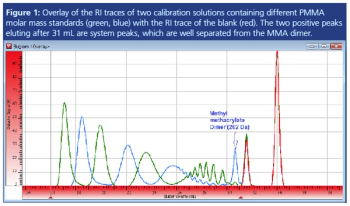
I guess we have all had the issue at some time or other. A blank injection of eluent (or a zero volume dummy injection) gives rise to discreet peaks on the chromatographic baseline which may interfere with analyte peaks or increase the complexity of the chromatogram obtained, especially when performing trace analysis.chromatogram obtained, especially when performing trace analysis. Of course this is an undesirable situation and one which can be difficult to understand or troubleshoot as, if we didn’t inject anything, how on earth do we end up with discrete beaks in the blank chromatogram? The secret to understanding the phenomenon lies in understanding the mechanisms of gradient of HPLC.

This is the fifth article in a series exploring current topics in separation science that will be addressed at the HPLC 2017 conference in Prague, Czech Republic, from 18–22 June.

This is the sixth instalment of a series of articles exploring current topics in separation science that will be addressed at the HPLC 2017 conference in Prague, Czech Republic, from 18–22 June.


As part of the Earth Day celebration in Dallas, Texas, last month, the Collaborative Laboratories for Environmental Analysis and Remediation (CLEAR) at U.T. Arlington hosted the first annual Responsible Shale Energy Extraction (RSEE) symposium (www.shalescience.org). We had an exceptional range of speakers who conveyed all sides of the issue, including U.S. Secretary of Energy Rick Perry and atmospheric scientist Dr. Katherine Hayhoe from Texas Tech University, one of Time’s top 100 most influential people. We had representatives from major oil producers, environmental groups, land management groups, water recycling service companies, and scientists conversant on many key issues related to unconventional oil and gas (UOG) extraction. Even though we have been very involved in this conversation for the past several years, several points stood out.

Click the title above to open the LCGC North America May 2017 Advancing the Analysis of Medical Cannabis Supplement, Vol 35 No s5, in an interactive PDF format.

What is required to optimize a gradient elution HPLC method?


How does the career of a young leader get started?

Reflections on a career blending academia and entrepreneurship