

LCGC North America
Gaining a solid understanding of how HPLC instrumentation works will help you achieve success in the analytical laboratory. This four-part series is here to guide you, starting with pumps.
LCGC North America
Gaining a solid understanding of how HPLC instrumentation works will help you achieve success in the analytical laboratory. This four-part series is here to guide you, starting with pumps.

LCGC North America
What are the roles and responsibilities of quality assurance staff for ensuring data integrity in an organization?
LCGC North America
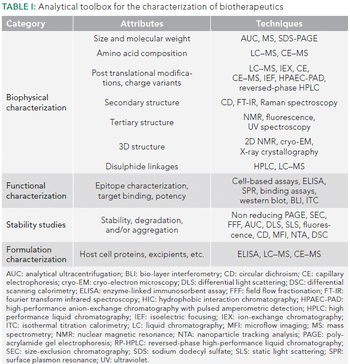
Coupling CE with MS presents some challenges. Here, we discuss the advantages of CE–MS over LC–MS, and the parameters that are important to obtain a stable CE–MS profile.

LCGC North America
Improved practices in chemistry selection and sample processing may resolve recovery issues related to target analytes or internal standards.
LCGC North America
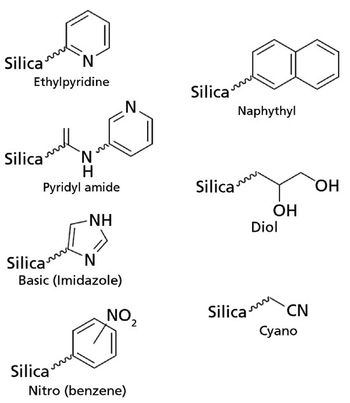
Unlike reversed-phase liquid chromatography, SFC lacks a universal stationary phase. Thus, it is important to re-evaluate the default column screening library used with SFC. In this study, three uncommon achiral SFC columns were investigated and compared to three popular stationary phases.
Nominate a colleague or yourself for the LCGC Europe/HTC-16 Innovation AwardSubmission Deadline: 15 October 2019The LCGC Europe/HTC-16 Innovation Award was launched to celebrate the work of scientists who are innovatively evolving the field of hyphenated techniques.The winner will be selected by the HTC scientific committee who will choose based on the following criteria:

Special Issues
Click the title above to open the LCGC Europe May 2019 supplement, Recent Developments in HPLC and UHPLC, Volume 32, Number s5, in an interactive PDF format.
LCGC Europe
Click the title above to open the LCGC Europe May 2019 regular issue, Vol 32, No 05, in an interactive PDF format.
The Biemann Medal will be awarded to Sarah Trimpin at the American Society for Mass Spectrometry (ASMS) conference on Tuesday, June 4, at the Georgia World Congress Center in Atlanta, Georgia.
Jefferey Shabanowitz, a principal scientist at the Hunt Laboratory at the University of Virginia (Charlottesville, Virginia), will receive the Al Yergey Mass Spectrometry Scientist Award at the American Society for Mass Spectrometry (ASMS) conference on Monday, June 3, at the Georgia World Congress Center in Atlanta, Georgia.
The 2019 Ron Hites Award, to be presented on Wednesday, June 5, at the Georgia World Congress Center in Atlanta, Georgia, will honor Julia Laskin of Purdue University (West Lafayette, Indiana) and her coauthors for their paper, “Towards High-Resolution Tissue Imaging Using Nanospray Desorption Electrospray Ionization Mass Spectrometry Coupled to Shear Force Microscopy.”
The winners of the 2019 Research awards from the American Society for Mass Spectrometry (ASMS) are James F. Davies of the University of California, Riverside; Nicolas L. Young of Baylor College of Medicine (Houston, Texas); and Eleanor Browne, of the University of Colorado, Boulder.
John R. Yates III, a professor in the Department of Molecular Medicine at The Scripps Research Institute (La Jolla, California), will receive the John B. Fenn Award for a Distinguished Contribution in Mass Spectrometry at the American Society for Mass Spectrometry (ASMS) conference on Monday, June 3, at the Georgia World Congress Center in Atlanta, Georgia.

The Column
The 48th International Symposium on High Performance Liquid Phase Separations and Related Techniques (HPLC 2019) will be held 16–20 June 2019 at the Milano-Bicocca University, in Milan, Italy. This is the first time that this symposium will be held in Italy.
The Column
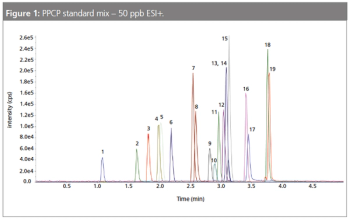
Pharmaceutical and personal care products (PPCPs) are routinely detected in a variety of aquatic environments and these compounds encompass a wide range of chemical and physical properties that contribute to their combined analytical screening challenges. Further examination of their accumulation throughout environmental samples that contain solids, including sediments, adds additional levels of analytical difficulties in their effective extraction and new sample matrix interferences. QuEChERS (Quick, Easy, Cheap, Effective, Rugged, and Safe) has become a very popular extraction and cleanup technique for the analysis of multiresidue pesticides in agricultural and food samples. Applying the same principles to overcome similar challenges in PPCP analysis in solid environmental samples is demonstrated in this article.
The Column
Markes International has been awarded two Queen’s Awards for Enterprise in the categories of “innovation” and “international trade”.

The Column
Following decades of research, evidence of the human microbiome’s importance in maintaining overall health and well-being has become evident, spawning a multimillion-dollar industry. A wide range of products aimed at repairing and maintaining a healthy microbiome are now available, with many focusing on prebiotics.

The Column
Researchers have analyzed sediment core from a lake located in the northern foothills of Alaska’s Brooks Range to investigate the Beringian standstill hypothesis (BSH) of human migration into the Americas.
The Column
Thermo Fisher Scientific has announced the opening of its Customer Solution Center in Delhi, India.
The Column
Click the title above to open The Column May 2019 Europe & Asia issue, Volume 15, Number 5, in an interactive PDF format.
The Column
Click the title above to open The Column May 2019 North American issue, Volume 15, Number 5, in an interactive PDF format.
LCGC E-Books
From ghost peaks to baseline interferences, analytical laboratories deal with several challenges in their everyday work. Tips for Addressing Common Problems with LC Analysis offers laboratories some practical advice for dealing with common analytical problems and suggests using ultrapure water is a key strategy.
LCGC Europe
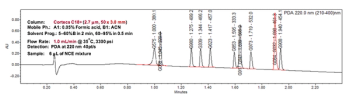
Wouldn’t it be nice if a single generic high performance liquid chromatography (HPLC) method could be used for all small molecule drugs - not only for potency assays but also for ICH-compliant stability-indicating assays?

We have been working to develop the use of liquid chromatography–triple quadrupole–mass spectrometry (LC–MS/MS) for quantification of intact proteins from biological fluids.
From its development in 2016, the liquid-electron ionization (LEI) LC–MS interface has demonstrated a high versatility, offering the identification advantages of library-searchable, electron ionization (EI) spectra from samples in a liquid phase.
Special Issues
Click the title above to open the Current Trends In Mass Spectrometry May 2019 special issue in an interactive PDF format.