All News

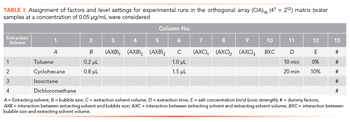
The ability to rapidly screen stationary phases through column-switching capabilities provides significantly greater efficiency in method development than was previously possible. The approach does require some additional hardware and software. And, while such capabilities may limit the ability to expand one’s literary knowledge during excessive months in the laboratory developing separation methods, real progress to key decision points for method optimization can be realized instead.

figure 1.png

Dual flow chromatography (DFC) separations are performed with back and forth flow for rapid method development, design of experiments (DOE), quality-by-design (QbD), or high-throughput chromatographic purification. Although different than conventional unidirectional flow through chromatography, chromatographic principles still control the separations. Selectivity coefficients and Langmuir adsorption isotherms control the separation chemistry properties of the column and dictate the mobile phase conditions needed to achieve separation. However, the kinetic rates of diffusion and interaction of mobile phase molecules with the stationary phase, column channeling, and other column properties are not germane to the practice of DFC. Chromatographic conditions developed with DFC can be scaled to any size, including laboratory and industrial preparative columns.

Mike-Tessalone_web.jpg

This month marks another major milestone for LCGC: 35 years of successfully publishing “solutions for separation scientists.” I would be remiss if I did not thank you, our readers, as well as the tireless staff that work so hard to bring you this publication every month. In kind, I would also like to thank our columnists for their helpful contributions and willingness to share their expertise with our audience. Our advertisers also deserve a round of applause for supporting our business and counting on us to deliver successful products across the industry.

LauraBush_web.jpg

For this 35th anniversary issue of LCGC North America, we asked leading separation scientists what they foresee for the future. Their essays are insightful and thought provoking.

Salary-Survey-Figure-1_web.jpg

We present our analysis of LCGC’s first reader survey on salary, workload, job satisfaction, and the job market in general. The survey shows that workloads and stress levels have increased for many. Nevertheless, most view the employment outlook as good, if not excellent, and indicate a high level of satisfaction with their present jobs.