

The Column
Restek Corporation and LECO have agreed an expanded collaboration that will allow LECO customers access to a core set of Restek consumables.
The Column
Restek Corporation and LECO have agreed an expanded collaboration that will allow LECO customers access to a core set of Restek consumables.

The Column
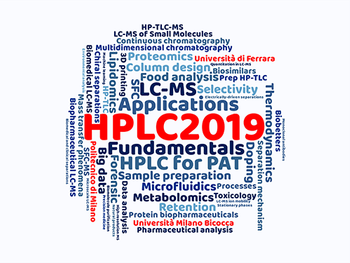
The 48th International Symposium on High Performance Liquid Phase Separations and Related Techniques (HPLC 2019) will be held 16–20 June 2019 at the Milano-Bicocca University, in Milan, Italy. This is the first time that this symposium will be held in Italy.

The Column
This is the first in a series of articles exploring current topics in separation science that will be addressed at the HPLC 2019 conference in Milan, Italy, from 16–20 June.

The Column
The “5th Workshop on Analytical Metabolomics” will be held in Thessaloniki, Greece, from the 13–17 May 2019. Here is a sneak preview of what attendees can look forward to.
LCGC E-Books
Peter Schoenmakers, a professor of analytical chemistry at the University of Amsterdam, received the Chromatography Forum of the Delaware Valley Dal Nogare Award on Monday, March 18, at Pittcon 2019, in Philadelphia Pennsylvania.
LCGC E-Books

As we close in on a little more than a month to go before the 43rd International Symposium on Capillary Chromatography and the 16th GCxGC Symposium (ISCC & GCxGC 2019; www.isccgcxgc.com), May 12 – 17 in Ft. Worth, Texas, my excitement burgeons. All of the groundwork has been laid to provide forums for presenting and discussing the latest advances in capillary and comprehensive separations science.
LCGC E-Books
The most common method of pesticide extraction for food matrices is QuEChERS. But, is there a better way? This LCGC ebook on Improving Extraction Processes and Sample Preparation in Food Analysis talks about the use of extraction technologies in food analysis and explores how Energized Dispersive Extraction (EDGE®) has revolutionized sample extraction.
Special Issues
Click the title above to open the Recent Developments in Sample Preparation 2019 special issue in an interactive PDF format.

In this HPLC 2019 topic preview, Rawi Ramautar discusses capillary electrophoresis–mass spectrometry (CE–MS) for metabolomics and why the technique can help researchers overcome the issues which arise from low amounts of material. HPLC 2019 conference will be held in Milan, Italy, from 16–20 June.
LCGC North America
Click the title above to open the LCGC North America April 2019 issue, Volume 37, Number 4, in an interactive PDF format.

LCGC North America
Our annual review of new liquid chromatography columns and accessories.

LCGC North America
New HPLC and MS systems: A review of instrumentation trends and the current market along with new instruments, modules, chromatography data systems, and related software.

LCGC North America
We provide a succinct explanation of electron ionization for GC–MS and illustrate the fundamentals of ion formation.

LCGC North America
The meaning of the terms raw data and complete data are explored. One term is from EU GMPs and the other is from US GMPs. Do they mean the same thing?

LCGC North America
How well do Gaussian-shaped profiles represent injected solute peaks after they are eluted through a chromatographic column? This question is explored along with a discussion of moment analysis for determining retention time, variance, and shapes of peaks.

Special Issues
The field of sample preparation is undergoing revolutionary change, largely governed by the need for miniaturization while maintaining high selectivity and high analyte enrichment. How up-to-date are you in the advances of sample preparation for chromatographic analysis?
Special Issues
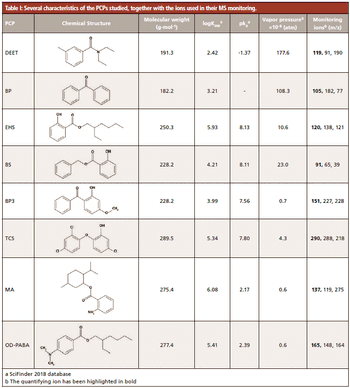
In this study, the analysis of contaminants found in environmental waters and originating from personal care products is addressed using metalorganic frameworks (MOFs) in combination with liquid chromatography (LC). This work expands the use of MOFs from gas chromatography to LC and also meets the requirements of green analytical chemistry.

Special Issues
Nanomaterials are extremely useful as sorbents for sample preparation, because of their varied morphologies, high surface area, surface-tovolume ratio, porosity, and ability to interact with samples in a variety of ways. Here, we review how nanomaterials are being used in a variety of sample preparation techniques, such as dispersive solid-phase extraction (dSPE), solid-phase microextraction, stir-bar sorptive extraction, and matrix solid-phase dispersion.

Special Issues
A simple, fully-automated method is proposed to analyze extractables and leachables-compounds that are released from packing materials into drugs during storage-using SPME-GC×GC–MS. This method avoids the use of sample preparation solvents and reduces sample handling, and is ideal for routine use in quality control.

Special Issues
Crude (4-methylcyclohexyl)methanol (MCHM) is a chemical contaminant that must be monitored in fresh water environments, because of significant health risks to surrounding human populations. A new method for MCHM analysis was developed using solid-phase microextraction (SPME) and thin film microextraction (TFME) combined with GC–MS. Both methods achieved limits of quantitation lower than standard methods using SPE.

Special Issues
A simple, automated, and fast method to quantify complex odorants in foods is described using stir-bar sorptive extraction (SBSE) combined with fast enantioselective GC–MS analysis. The total analytical method takes only 30 minutes and does not require any sample pretreatment.

LCGC Europe
This instalment describes high performance liquid chromatography (HPLC), mass spectrometry (MS), and related products introduced at Pittcon 2019 and during the year prior. It reviews new HPLC and MS systems, modules, chromatography data systems (CDS), and other related software and summarizes their significant features and user benefits. A brief description of instrumentation trends and the current market is also included.

LCGC Europe
Lipidomics is one of the youngest branches of “omics” research. Maria Fedorova from Leipzig University, in Leipzig, Germany, discusses the latest trends and challenges in lipidomics research and highlights how innovative bioinformatics solutions are addressing data handling issues in this evolving field.