
LCGC North America
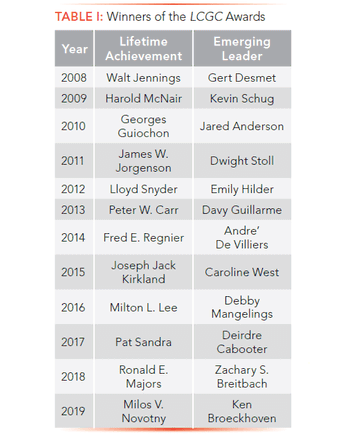
The contributions of Milos V. Novotny and Ken Broeckhoven, the winners of the 2019 LCGC Lifetime Achievement and Emerging Leader in Chromatography Awards, are presented.
LCGC North America
The contributions of Milos V. Novotny and Ken Broeckhoven, the winners of the 2019 LCGC Lifetime Achievement and Emerging Leader in Chromatography Awards, are presented.

LCGC North America
It is often possible to achieve better sensitivity and lower limits of detection and quantitation using standard gas chromatography instrumentation. Paying attention to fundamental variables-like sample solvent, initial oven temperature hold, carrier gas operating mode, and thermal gradients- can lead to much improved method performance.

LCGC Europe
When can we use completely aqueous eluents with reversed-phase stationary phases, and what happens if we make a mistake?

LCGC Europe
This instalment of “GC Connections” begins with a brief introduction to GC×GC, follows with examples of how GC×GC opens additional avenues of analysis, and it concludes with information about how to learn more.

LCGC Europe
Tips to improve signal-to-noise ratio when using standard gas chromatography (GC) equipment.

LCGC Europe
The third meeting in the “Emerging Separations Technologies” series will take place on Thursday 28 March 2019 at RSC Burlington House, Piccadilly, London.

LCGC Asia Pacific
LCGC Asia Pacific spoke to Yong Liu and Adam Socia from MSD about the cost-saving benefits of implementing green chromatography in the pharmaceutical sector, the importance of analytical method volume intensity (AMVI), and effective practices to reduce solvent consumption and replace harmful solvents, including supercritical fluid chromatography (SFC), fast chromatography, and “cocktail chromatography”.
LCGC Asia Pacific
The Column
Click the title above to open The Column January 2019 North American issue, Volume 15, Number 1, in an interactive PDF format.
The Column
Click the title above to open The Column January 2019 Europe & Asia issue, Volume 15, Number 1, in an interactive PDF format.

The Column
I’ve written several times on the operational principles and variables used in UV detection, but I also get asked questions on the basic theory of UV detection, and this time I’m going to address some of those FAQs to give a little more background theory as well as some operational tips and tricks.
The Column
The UK Department of International Trade (DIT) has awarded Markes International with a trade accolade in recognition of its success in exporting scientific instrumentation.

The Column
A novel flow-confinement concept designed to remove the performance sacrifice associated with current comprehensive two-dimensional liquid chromatography techniques has been tested by researchers.
The Column
The EAS Award for Outstanding Achievements in Separation Science was awarded to Christopher Pohl at EAS on 12 November.
The Column
The EAS Award for Outstanding Achievements in the Fields of Analytical Chemistry was presented to Linda B. McGown at EAS on 14 November.

The Column
The 9th SCM symposia (SCM-9) will take place from 30 January to 1 February 2019, in Amsterdam, The Netherlands. Focusing on the separation and characterization of natural and synthetic macromolecules, SCM is the place where academia is challenged by industry to help solve real problems using analytical tools.
The Column
The EAS Young Investigator Award was presented to Kerri Pratt at the EAS, in Princeton, New Jersey, USA, on 12 November.

You may be one of the many analytical scientists who look with envy at those laboratories who are equipped with sophisticated automated HPLC method development systems. These systems are indeed very nice and can be very efficient in narrowing down choices, however, they aren’t a universal panacea and one can achieve a lot with a simple, paired down approach.

In 2009, the founders of VUV Analytics, Inc. approached my group about the potential of coupling a vacuum ultraviolet absorption spectroscopy detector to a gas chromatograph (GC–VUV).
YMC Co., Ltd. (Kyoto, Japan), a supplier of separations resins, services, and systems for the pharmaceutical market, has acquired the pharmaceutical systems business of Lewa -Nikkiso America Inc. (Devens, Massachusetts).
Tosoh Bioscience LLC (King of Prussia, Pennsylvania) has invested in Semba Biosciences (Madison, Wisconsin) with the intention of acquiring full ownership.
LCGC E-Books
LCGC Europe
Click the title above to open the LCGC Europe January 2019 regular issue, Vol 32, No 01, in an interactive PDF format.
LCGC North America
Click the title above to open the LCGC North America January 2019 regular issue in an interactive PDF format.
LCGC Europe
The best troubleshooting is proactive; problems are much more easily prevented then solved. Proactive troubleshooting involves anticipating problems before they start, and stopping them before they disrupt your workflow. It also ensures a long operational lifetime for instruments. Unlike many other instruments, a gas chromatograph (GC) has several components, each of which must be properly maintained and optimized for the full instrument to operate properly. This instalment of “GC Connections” focuses on simple proactive steps that users of a gas chromatograph can take to ensure that instruments will operate correctly over time.

LCGC Europe
This is the final part of a trilogy looking at the impact of the new USP on analytical instrument qualification (AIQ) on data integrity in a regulated chromatography laboratory. This part will focus on the performance qualification (PQ) portion of the 4Qs model and, specifically, monitoring and requalification of chromatographs.

LCGC Europe
Confusion exists on the quantitative nature of headspace sampling, because it is an equilibrium-based technique when done in the static mode, but not necessarily in the dynamic mode. To aggravate matters further, the concentrations of headspace compounds in common applications, like foods, flavours, or petroleum distillates, can easily vary by an order of magnitude or more. Thus, what defines quantitative may depend largely on the goals of the analysis. This month we’ll take a look at headspace sampling and its quantitative nature.

LCGC Europe
LCGC Europe spoke to Alina Muscalu from the Organic Contaminants Section at Ontario Ministry of the Environment, Conservation and Parks (MECP) in Toronto, Canada, about the practical advances in environmental analysis using comprehensive GC×GC for targeted and nontargeted analysis, the role of GC×GC in routine analysis, and the benefits of using a micro-electron capture detector (μECD) for environmental analysis.

LCGC Europe
Challenges that can be encountered when using isocratic high performance liquid chromatography (HPLC) can be overcome by using gradient HPLC.