All News

The Column

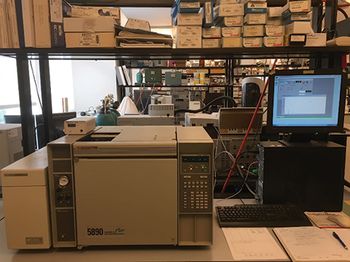
Agilent Technologies Inc. and Imperial College London have signed a strategic scientific collaboration agreement that will see a broad range of Agilent instruments installed in a sponsored measurement suite to be housed within Imperial’s Molecular Sciences Research Hub.

equation 11524063096904.png

The Column

This article introduces the development of an automated and versatile technique for solution viscosity determination of a wide range of polymeric materials in different solvents. Sample preparation is a tedious and error-prone process in viscosity determinations of polymeric materials, especially when elevated temperature or when hazardous solvents are required. This new approach automates sample preparation and injection to the viscometer detector, with benefits in efficiency and safety as well as in analysis precision. The dissolution conditions were studied and optimized to reduce thermal and oxidative degradation, which are detrimental to the accuracy of the observed viscosity.

I do not remember the application, but I remember very clearly Professor McNair telling us that soil is one of the most challenging sample matrices, if not the toughest, from which to perform analytical determinations. Sources indicate the composition of soil ideal for growing plants to be 25% air, 25% water, 45% minerals, and 5% organic matter. That does not seem like a daunting makeup, but the reality is that the relative proportion of the constituents can vary dramatically.

RSC.jpg

LCGC Europe

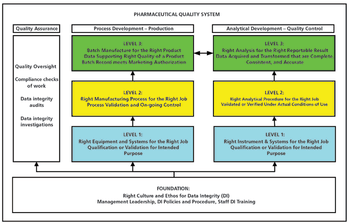
The Chromatographic Society and Joint Pharmaceutical Analysis Group have announced a one‑day meeting titled From Cradle to Grave: The Chromatographic (Analytical) Method Life Cycle. The meeting will be held at Burlington House, London, UK, on Thursday 10 May 2018.

The overriding majority of articles on problems with the technical transfer of HPLC methods ultimately focus on differences between HPLC dwell volumes. However, as the title suggests, there are many more issues which can cause problems in the transfer of HPLC methods, and I wanted to highlight some common issues that come across my desk, in the hope that it will help you avoid these problems in your own practice.

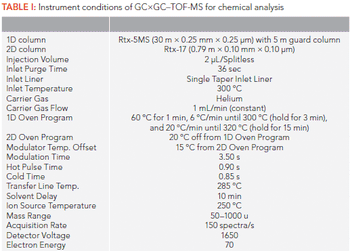
Several years ago, I would have held the stance that environmental analysis was fairly boring. How complicated can water be? I am not ashamed to say that was a naïve view. It is clear from our research and related research by others on similar topics that much more work in these areas is needed. Standard methods cannot solely accommodate the growing list of targets and the multitude of unknowns associated with complex samples taken from the interface between the petroleum industry and the environment.

LCGC2_i1.gif

Special Issues

Novel ionization processes provide gas-phase ions of a wide variety of materials using MS. These simple and sensitive methods operate from solution or a solid matrix. Both manual and automated platforms are described that allow rapid switching between the ionization methods of MAI, SAI, vSAI, and conventional ESI.