The Column
Incognito wonders if chromatographers are happy with their choice of career.
The Column
Incognito wonders if chromatographers are happy with their choice of career.

The Column
The Column spoke to Núria Fontanals, a senior researcher at the Department of Analytical and Organic Chemistry, Universitat Rovira i Virgili, Spain, about her work investigating the impact of artificial sweeteners as environmental pollutants using hydrophilic interaction chromatography (HILIC) and the broader role of HILIC in environmental analysis.

The Column
The goal of metabolite identification groups is to de-risk compounds moving into development by ensuring they have favourable metabolic profiles before clinical trials are initiated. Liquid chromatography–mass spectrometry (LC–MS) is a well-established technology for this purpose, as a result of its ability to selectively and accurately distinguish drugs and their metabolites. Ion mobility spectrometry (IMS) can add another critical dimension of separation by improving spectral clarity and generating collision cross section (CCS) values to track metabolites across multiple analysis conditions. Modern software platforms have now evolved to solidify the value of IMS for the field of metabolite identification.

The Column
The Column spoke to Linda Schreiner and Andrea Buettner of the Fraunhofer Institute for Process Engineering and Packaging IVV and the Friedrich-Alexander-Universität Erlangen-Nürnberg in Germany, about their work investigating Scots pine for odour-active compounds using two‑dimensional gas chromatography (2D-GC).

The Column
In peptide mapping, the enzymes and conditions used in digestion affect not only the number of peptides liberated, but also the stability of associated post-translational modifications (PTMs).

This Wednesday morning session begins at 9:00 am with Leonard Sidisky, Jamie Desorcle, Greg Baney, and Kathy Kiefer of MilliporeSigma presenting “Latest Developments in Ionic Liquid Stationary Phase Technology.”
A Tuesday morning session on Sample Preparation starts at 9:00 am in the Tulip Room with Reynhardt Klopper of Anton Paar discussing how Microwave Digestion replaces 10-h ash methods for metals analysis in petroleum products.
These Wednesday morning and afternoon sessions in Exhibit Hall A4 highlight the advanced applications of Gas Chromatography.
Tuesday morning and afternoon presentations taking place in the Daffodil Room highlight the use of GC–MS for analysis of multiple constituents in hydrocarbons, as well as a workshop for the use of pyrolysis in GC and GC–MS.

In my previous blog, I discussed the possibility of backflash in splitless GC injection and its effect on quantitative reproducibility and carry-over.While much is written in the literature on optimization of splitless injection conditions, little is available on the implementation and optimization of increased head pressure (pressure pulsed) injection, so we will concentrate on this aspect of injection optimization.
The theme of the 2018 Eastern Analytical Symposium and Exposition is “Analytical Solutions to the World’s Problems.” The EAS has always been about problem solving. This year, we focus on problems that affect the world.

For an international conference, highlighting the diversity of research, and the people performing it, is important. Diversity comes in a lot of different flavors: Industrial vs. academic; different cultures, values, needs, and resources; age and gender; among others. Representatives from all different backgrounds and experiences should be given a voice.
LCGC North America
Click the title above to open the LCGC North America October 2018 issue in an interactive PDF format.
Special Issues
Click the title above to open the October 2018 issue of Current Trends in Mass Spectrometry in an interactive PDF format.
LCGC Europe
Click the title above to open the LCGC Europe October 2018 regular issue in an interactive PDF format.
Special Issues
Click the title above to open the LCGC Europe October 2018 Supplement: Advances in Pharmaceutical Analysis in an interactive PDF format.
Special Issues
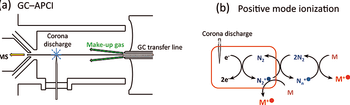
The past decade has witnessed resurgent interest in coupling GC to atmospheric-pressure chemical ionization (APCI), which is suitable for the high column flows required for using flow modulation. This study assesses the use of GP-APCI with flow modulation for sensitive detection of selected trace organics.

Special Issues
The structural complexity of monoclonal antibodies (mAbs) challenges the capabilities of even the most advanced chromatography and mass spectrometry techniques. This study examines the use of micro-pillar array columns in combination with mass spectrometry for peptide mapping of both mAbs and antibody–drug conjugates (ADCs).

LCGC Europe
This instalment provides an overview of the modern trends and best practices in mobile-phase selection for reversed-phase liquid chromatography (LC). In particular, we focus on selection criteria and rationales for enhancing analytical performance and ease of preparation.

LCGC North America
Topics that stood out at HPLC 2018 include advances in large-molecule separations, multidimensional separations, 3D printing, chiral separations, and HILIC. Also, many speakers addressed separation fundamentals, including ways to increase speed, generate higher throughput, and add selectivity.

LCGC North America
Many LC users are unclear what happens when we combine two (or more) flow streams in LC systems, and when mixers are needed to blend the fluids. This discussion explains why mixers are needed, and when and how you might consider using something other than the default mixer setting.
LCGC North America
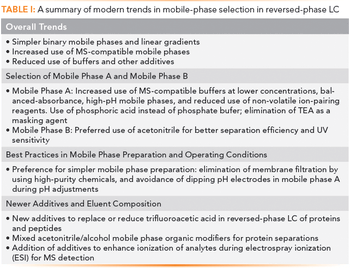
Modern trends in LC mobile-phase selection and preparation include using simpler mobile phases, increased use of MS-compatible mobile phases, and eliminating filtration and certain mobile-phase additives. Here, we discuss those and other trends and best practices, as well as the fundamentals behind them.

LCGC North America
Molecularly imprinted polymers can replace conventional sorbent materials in sample preparation techniques such as solid-phase extraction (SPE), solid-phase microextraction (SMPE), and matrix solid-phase dispersion (MSPD), offering increased selectivity over the target analytes.

LCGC North America
Elena Ibañez is determined to make sample preparation for food analysis not only more environmentally friendly but also more efficient, as she explores approaches that simplify solvent selection, increase solvent selectivity, and lessen the role of chemical solvents.
LCGC North America
Proper tuning and calibration of instruments ensure their peak response and an exact mass-to-charge ratio and ion abundance measurement.

LCGC Europe
What types of mixers are needed with different types of liquid chromatography (LC) pumps? Are different mixers needed for different applications?