
The Column
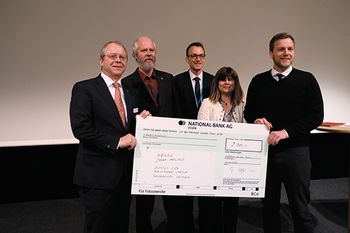
Josef Heiland has been awarded the 2018 Eberhard Gerstel Prize for his publication “Temperature Gradient Elution and Superheated Eluents in Chip-HPLC” (1), which was published in the journal Analytical Chemistry.
The Column
Josef Heiland has been awarded the 2018 Eberhard Gerstel Prize for his publication “Temperature Gradient Elution and Superheated Eluents in Chip-HPLC” (1), which was published in the journal Analytical Chemistry.

The Column
Agilent Technologies has announced an agreement to acquire Genohm, a developer of highly differentiated, on-premise, and cloud-based software solutions for laboratory management.
The Column
LabConnect LLC, a global provider of central laboratory and support services for biopharmaceutical, medical device, and contract research organization, has completed phase one of a 11,000 square foot facility expansion in Johnson City, Tennessee, USA.
The Column
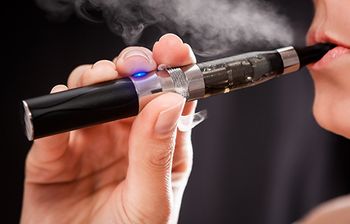
Researchers from Gdansk University of Technology, Poland, have investigated the flavour profiles of e-cigarette refill solutions using GC–MS/MS.
LCGC Asia Pacific
Click the title above to open the LCGC Asia Pacific June 2018 regular issue in an interactive PDF format.
LCGC Europe
Click the title above to open the LCGC Europe June 2018 regular issue in an interactive PDF format.

LCGC North America
What can metal–organic frameworks offer for liquid chromatography?

LCGC North America
Here, we see how 2D-LC can solve coelution problems that are difficult or impossible to address using peak purity tools or curve resolution methods.
LCGC North America
With autosamplers, we need to be extra careful to avoid contamination.

LCGC North America
Comprehensive 2D-LC using HILIC and reversed-phase LC is a robust tool to characterize nonionic ethoxylated surfactants in pharmaceutical formulations.

LCGC North America
We examine the connection between the distribution coefficient and Gibbs free energy, and contributions from enthalpy and entropy.
LCGC North America
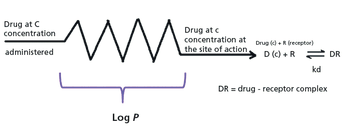
Drug discovery can be accelerated by chromatographic profiling of analogs by measuring their nonspecific binding to proteins and lipids.

Special Issues
An introduction to this special issue from the guest editor.

Special Issues
The packed particle bed format still rules LC columns, but advances continue in monoliths. Meanwhile, newer formats are on the horizon, including microfabricated columns and 3D printed columns. This article provides a critical review of all these technologies and demonstrates how further development of chromatographic columns will be of paramount importance in the future.

Special Issues
Thermal effects in UHPLC and low-density SFC cause peak broadening and distortion. A solution to this problem is to thermally insulate the chromatographic column. Vacuum-jacketed column technology has been developed as a new approach to insulate the column in a practical way.
Special Issues
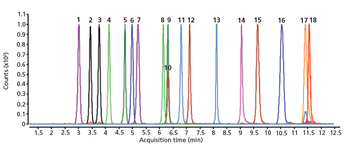
This article highlights the use of a new HILIC zwitterionic phase on superficially porous particles. A study on the use of a novel mobile-phase additive to achieve superior peak shape and isomer separation is also discussed, as well as improved LC–MS detection capabilities for metabolomics analysis.

Special Issues
Liquid chromatography (LC) is proving to be a valuable complementary technique to gas chromatography (GC) in cannabis testing for the analysis of cannabinoids, mycotoxins, and pesticides.
Today, I learned of the passing of a dear friend and a valued collaborator, Walton Caldwell, who founded the company Princeton Chromatography in 1994.

The Column
Postnova Analytics has announced a joint collaboration with the Department of Biosciences at the University of Helsinki in Finland, to use AF4 for the purification of halophilic viruses.

The Column
Restek has partnered with the Girl Scouts in the Heart of Pennsylvania to host three STEM expos with the aim of building basic science skills in girls.

The Column
Peak Scientific has given a guided tour of their manufacturing headquarters in Inchinnan, Scotland, to his Royal Highness The Duke of Gloucester to mark the company’s 20th anniversary

The Column
Researchers from the University of Almería, in Almería, Spain, have developed a nontargeted metabolomic approach to differentiate organic and non-organic tomato crops using HPLC–HRAMS.

The Column
Researchers from the Université de Pau et des Pays de l’Adour, in France, have developed a large volume injection method using a programmed temperature vaporization (PTV) injector for the simultaneous determination of mercury, tin, and lead at ultra-trace levels in natural waters using GC–ICP-MS.
The Column
Click the title above to open The Column May 2018 North American issue, Volume 14, Number 5, in an interactive PDF format.
The Column
Click the title above to open The Column May 2018 Europe & Asia issue, Volume 14, Number 5, in an interactive PDF format.

It’s excellent to see that compendial authorities are considering updating “allowable change” regulations, and the updates to allow changes to gradient profiles certainly open up a whole new world, but there are some reservations around the new restrictions on allowable changes to stationary-phase chemistry.

One of the initiatives that the SCSC oversees is the nomination process and awarding of the Satinder Ahuja Award for Young Investigators in Separation Science. Where are all of the young investigators in separation science? Certainly, those that have been honored to date have been worthy; however, there must be more eligible parties out there.