
Food and Beverage Analysis

Latest News


LCGC6_i1.jpg

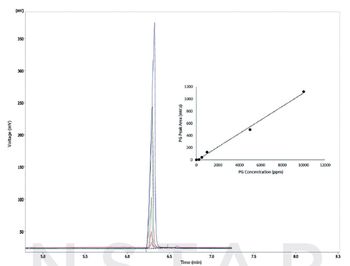
A variety of alcoholic beverages purchased within the UK were analyzed for the presence of Ethylcarbamate. A 1 µL injection of these alcoholic beverages were analyzed on an Ellutia 200 GC followed by detection on an Ellutia 820 TEA working in nitrogen detection mode. This mode of analysis detects nitrogen containing compounds within a sample. The Ellutia 810/820 systems are able to analyse various nitro or nitroso compounds, utilizing the selectivity available through nitrogen or nitroso modes. Nitrogen mode utilizes the catalytic pyrolyzer tube, oxygen reactor, and higher temperatures to detect nitrogen compounds. Results for various alcoholic beverages are shown in Figure 3. The samples were found to have various low levels of ethylcarbamate, the system was optimized through levels of oxygen input and EHT sensitivity. The samples were then analyzed adopting a standard addition approach.

Tania-1.jpg

Gas chromatography–atmospheric pressure chemical ionization (GC–APCI) offers increased limits of sensitivity in food analysis. Carlos Sales Martinez from the Research Institute of Pesticides and Water in the University Jaume I, Castellón, Spain, has been exploring the novelty of this technique for the analysis of food samples. He recently spoke to LCGC about this work.

i11455268539357.jpg

Our modern, ISO 9001-certified research and manufacturing facilities in Muskegon, Michigan and Seelze, Germany benefit from the Honeywell Operating System, a comprehensive, integrated manufacturing approach based on Six Sigma and Lean manufacturing methodologies that is designed to eliminate variation and waste and improve work processes rapidly and continuously.

Food contact materials contain low molecular weight additives and processing aids which can migrate into foods leading to trace levels of contamination. Food safety is ensured through regulations, comprising compositional controls and migration limits, which present a significant analytical challenge to the food industry to ensure compliance and demonstrate due diligence. Of the various analytical approaches, LC-MS/MS has proved to be an essential tool in monitoring migration of target compounds into foods, and more sophisticated approaches such as LC-high resolution MS (Orbitrap) are being increasingly used for untargeted analysis to monitor non-intentionally added substances. This podcast will provide an overview to this area, illustrated with various applications showing current approaches being employed.

Mars, Incorporated (McLean, Virginia, USA) has announced the opening of its Global Food Safety Center, a first-of-its-kind facility for pre-competitive research and training that aims to raise global food safety standards through collaboration.

Mars, Incorporated (McLean, Virginia, USA) has announced the opening of its Global Food Safety Center, a first-of-its-kind facility for pre-competitive research and training that aims to raise global food safety standards through collaboration.

Table 1.jpg

Fundamental Foodomics

Foodomics can help to investigate and solve crucial topics in food science and nutrition from a short- and long-term perspective. LCGC spoke to Alejandro Cifuentes from the Laboratory of Foodomics at the Institute of Food Science Research (CIAL), National Research Council of Spain (CSIC) in Madrid, Spain, about the fundamental importance of foodomics and where the field of food analysis is heading.

Preventing environmental contaminants from getting in to the food chain is of paramount importance to us all. Yelena Sapozhnikova, a Research Chemist at the Agricultural Research Service, United States Department of Agriculture (USDA) in Wyndmoor, PA, USA, spoke to The Column about her research into the development and evaluation of analytical methods for persistent and emerging organic chemical contaminants in food samples.

Figure-2.jpg

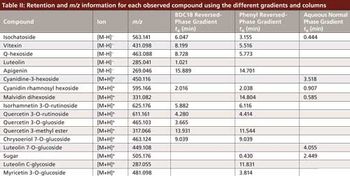
Ginseng has been used worldwide for thousands of years. Thought to possess therapeutic effects, it has been marketed as a natural product for the treatment of disease. This article describes how ultrahigh-performance liquid chromatography (UHPLC) can be coupled with ion mobility mass spectrometry (IMS-MS) to profile phytochemicals contained within ginseng and confirm quality.

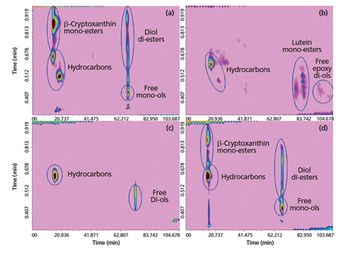
In this video from LCGC TV, Luigi Mondello from the University of Messina in Italy reveals his views on the prospect of mass spectrometry eliminating the need for chromatographic separations in the future.

Yelena Sapozhnikova.jpg

Preventing environmental contaminants from getting in to the food chain is of paramount importance to us all. Yelena Sapozhnikova, a Research Chemist at the Agricultural Research Service, United States Department of Agriculture (USDA) in Wyndmoor, PA, USA, spoke to LCGC about her research into the development and evaluation of analytical methods for persistent and emerging organic chemical contaminants in food samples.

A team of researchers in Spain has examined the use of commercial yeast products in the production of white and rosé sparkling wines. Using a range of analytical techniques, including gas chromatography–mass spectrometry (GC–MS) and high performance liquid chromatography (HPLC), the team examined four yeast autolysates to find out how they affect the chemical composition, foam, and sensory properties of sparkling wines aged on lees for nine months.

Torsten C. Schmidt of the University Duisburg-Essen in Germany recently developed an in-tube extraction (ITEX) method for headspace sampling of beer prior to gas chromatography–mass spectrometry (GC–MS). In this short video, he explains the principles of the technique and its advantages over other methods.

Solid-phase microextraction (SPME) coupled with comprehensive two-dimensional gas chromatography and time-of-flight mass spectrometry (GC×GC–TOF-MS) can be used to detect trace-level fungicides and compounds responsible for undesirable attributes known as “organoleptic faults” in wine. Of particular interest is the analysis of trace-level fungicides, which are difficult to detect using conventional quadrupole GC–MS techniques without resorting to selected ion monitoring mode. 

90546687_Beer.jpg

Beer from a 1840s shipwreck in the Baltic Sea has been analyzed by a team of scientists at the VTT Technical Research Centre in Finland. Using a variety of chromatography techniques - including gas chromatography coupled to mass spectrometry (GC–MS) and high-performance anion-exchange chromatography (HPAEC) coupled to MS - the team compared the beer with modern-day varieties and found they were not too dissimilar.