




A high-speed and simultaneous analysis of common active ingredients used in mouthwashes on a C18 column
A high-speed and simultaneous analysis of common active ingredients used in mouthwashes on a C18 column

QuEChERS has been updated to suit modern instrumentation. Now also “efficient and robust,” QuEChERSER is a “mega-method” that covers a wider polarity range.

A rapid LC–MS method using ESI coupled with SIM-MS for analysis of humulone and isohumulone content in beer is described.

We examine the rapid growth of green microextraction techniques, such as molecular imprinted polymer solid-phase extraction (MISPE), in the field of food quality and safety, and how this technique is used for bisphenol A (BPA) analysis.

Multiple-cumulative trapping headspace extraction coupled with high-concentration-capacity tools, such as SPME, enhances sensitivity of volatiles, as illustrated here in food analysis.

Ionic liquids (IL) are a very versatile tool for natural product and food analysis. When combined with moieties with different functional groups, ILs can be tuned to obtain extraction media with different properties and selectivity.

LCGC Europe spoke to Hans-Gerd Janssen from the Unilever Foods Innovation Centre in The Netherlands, about the advantages of a novel, rapid method to analyze antioxidants that inhibit oxidation, and he explains that the maturity of GC technology is actually an advantage to the analyst.

This 7-minute method enables easy analysis of bitter flavors in beer.

Trace-level pesticides and environmental pollutants in the food supply continue to be a worldwide concern. Here we present a fast-screening workflow for residual pesticides present on the surface of fruits using a GC–MS system with direct heating technology and MS spectral deconvolution.

Mycotoxins are toxic metabolites produced by fungal species often found in agricultural products. An accurate method for analyzing 12 regulated mycotoxins is described using UHPLC–MS/MS. The method demonstrated limits of quantitation (LOQs) for all analytes below stringent regulatory limits, making the method suitable for routine mycotoxin analysis.

Hydrolyzed collagens (collagen peptides) are water-soluble products obtained by hydrolysis of natural proteins and used for dietary supplements. A simple GPC/SEC method is described for molar mass determination of collagen peptides, allowing reliable molar mass determination using ultraviolet (UV) detection.

A fully automated quick, easy, cheap, effective, rugged, and safe (QuEChERS) extraction and extract clean-up method is described for analysis of organophosphate pesticides in orange juice. This method uses GC–MS and LC–MS along with an industry standard robotic x,y,z-sampling system.

This symposium looks at various methods used to detect PFAS in foods, cosmetics, packaging, and commercial products.

An overview of the analytical approaches proposed, from sample preparation to the final chromatographic determination, for the reliable risk assessment of mineral oil hydrocarbon (MOH) contaminants in food. The analysis of these contaminants in food is a challenging task and requires a comprehensive approach to tackle the cumbersome issues related to their determination.

LCGC is seeking contributed manuscripts for an April 2021 supplement on food and beverage analysis.

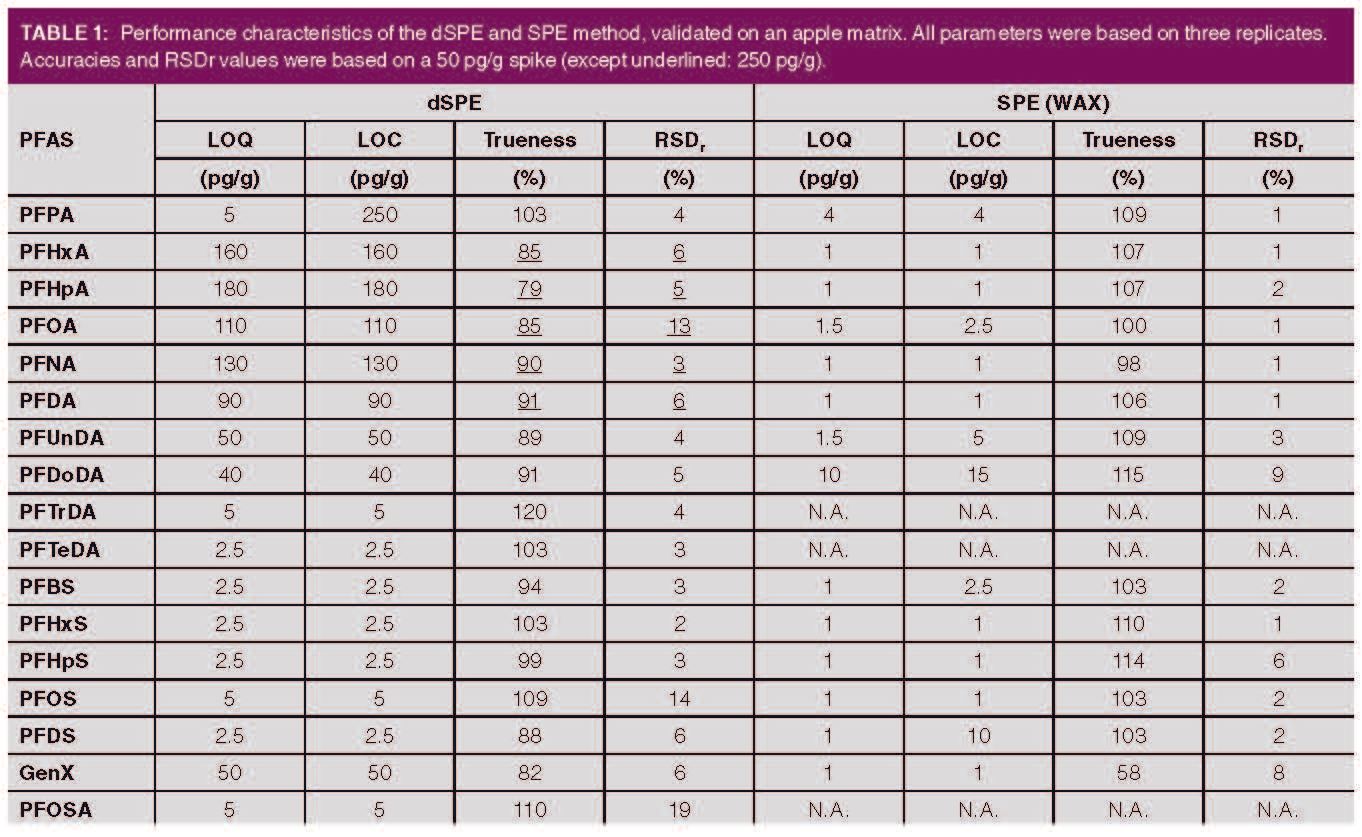
An increasing range of per- and polyfluoroalkyl substances (PFAS) has been found migrating from food contact material into food. This article establishes an integrated analytical approach combining HPLC–MS/MS and GC–MS/MS to detect 36 such PFAS.

High-capacity sorptive extraction combined with thermal desorption–gas chromatography–mass spectrometry (TD–GC–MS) can improve on traditional methods for the analysis of VOCs and other trace analytes that contribute to the aroma, flavor, and safety of food products.

This study demonstrates how the technique can improve on traditional methods in the analysis of VOCs that contribute to the aroma and flavour of a breakfast cereal and in identifying other compounds of interest, such as food additives, contaminants, and potentially toxic compounds at trace levels.

The Column
In Chinese herbal medicine (CHM), traditionally, Hedyotis diffusa and Scutellaria barbata are cooked together and given to patients as tea. It is hypothesized that the interaction of metabolites from both herbs during cooking, improves the medical effect. This hypothesis was tested by preparing two tea variants which were then analyzed using high performance liquid chromatography (HPLC) coupled to ion-mobility mass spectrometry (IM-MS).

The Column
SPME Arrow offers higher adsorption capacity and higher mechanical robustness than traditional solid-phase microextraction (SPME). Traditional SPME also has a small linearity range. In this article, an SPME Arrow fibre and classical SPME fibre were tested for the analysis of flavour profiles for different types of beverages.

The Column
Sulphite is a preservative added to a vast range of foods and beverages to prevent browning or oxidation. Some individuals are sensitive to sulphite additives and may experience a range of allergic reactions. Therefore, both the U.S. Food and Drug Administration (FDA) and European Union (EU) laws require that the presence of sulphites be declared on food labels when the concentration exceeds 10 mg/L. Several analytical methods exist to measure sulphite in food and beverages, however, they suffer from repeatability issues, and can be quite cumbersome to perform. A patent has been filed for an innovative, fast, and accurate ion chromatographic (IC) method based on direct current (DC) mode electrochemical detection. This article explains more.

The Column
Organosulphur compounds are important substances in the food industry because they can contribute to the flavour impression of a product. The human olfactory system’s sensitivity to sulphur leads to low flavour threshold values, making the analysis of these substances a challenging task. Gas chromatography (GC) with sulphur chemiluminescence detection (SCD) is a highly sensitive and selective technique for the analysis of sulphur compounds in various matrices. Using a range of different beers as an example, an approach is presented to reliably qualify and quantify sulphur components in beverages using headspace sampling and GC–SCD.

LCGC North America
Jim Garvey of the Pesticide Control Laboratory in Ireland discusses the development of pesticide analysis methods with high-resolution accurate mass MS.

Special Issues
In food analysis, many different biological matrices are investigated containing numerous compounds that can interfere with liquid chromatographyÐmass spectrometry (LC–MS) analysis. To overcome the challenges that arise with these highly complex matrices, the additional separation of analytes and matrix compounds complementing chromatographic separation is becoming more significant. In this article, the potential of IM-MS to increase selectivity and for additional identity confirmation is investigated. An extensive evaluation of IM-MS instruments was performed on a broad test set of food safety contaminants. The tested IM-MS platforms were DMS, TWIMS, low field DTIMS, and TIMS. CCS data were determined using the different instruments, and the ability to separate isomers and compounds of interest from sample matrix in the IM dimension was explored.

Special Issues
This article describes open access sofware for the modelling and prediction of retention times in gas and liquid chromatography. This software provides useful results for food analysis.