Application Notes: GC-MS


By William Goodman, PerkinElmer, Inc.


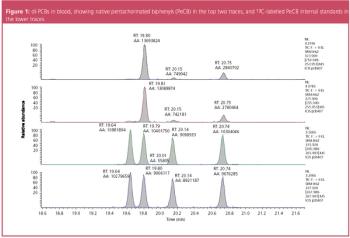
Contamination of public buildings with PCBs used as softeners in the 1970's in sealants and wall and ceiling paints can still be detected. If certain threshold values in indoor air are exceeded the source has to be decontaminated. This requires an effective and fast determination of the PCB concentration in indoor air. Thermodesorption GC–MS is a method especially suitable for this purpose. Polychlorinated Biphenyls (PCBs) are highly toxic and carcinogenic chemical substances. Although first prepared in 1864, they have been industrially manufactured since 1929. The highest production amounts worldwide were recorded in the 1960s and the beginning of the 1970s. In the 1970s their use as additives for building materials was widespread because of their flame inhibiting and noise reduction properties.

Pesticides are widely used by farmers to control pests, weeds and molds that would otherwise decrease crop production. While this has significantly increased worldwide food productions, these same pesticides pose health risks to humans. The restrictions for specific pesticides differ from one country to the next and as world trade increases, the potential threat to other countries' populations increases. For this reason, pesticides and other food related allergens are currently the subjects of increasing scrutiny and regulation.

The flavours of malt whisky result from a complex blend of long chain esters and alcohols, derived from the distillation products and the composition of the wooden barrels in which the finished product is aged. As shown below, the new VF-WAXms column from Varian, Inc. is ideal for analysing whisky, especially when trace analysis is needed. The column's ultra-low bleed increases sensitivity, extends column life and improves accuracy, even at higher temperatures. In addition, VF-WAXms columns are suitable for use with MS detectors, as the ultra low bleed eliminates interferences and permits more sensitive detection.

A Deans switch, employing Agilent's Capillary Flow Technology, was configured on an Agilent 7890A GC equipped with dual ECD detectors. A method was developed for the analysis of fish oil for PCB contamination. The Deans switch was used to heart cut 7 indicator PCBs (IUPAC Numbers 28, 52, 101, 118, 138, 153 and 180) from the primary DB-XLB column on to a DB-200 column for further separation. Fish oil from a supplement capsule was simply diluted 1:10 in isooctane and injected directly. To prevent carryover, contamination and retention time shifts, the Deans switch was used to backflush the primary column at the end of each run.


AC Analytical Controls developed a new chromatographic solution that complies with all ASTM & EN chromatographic test methods listed in biodiesel specifications: the AC all-in-one Biodiesel analyser. Analysis results demonstrate that the AC analyser complies with EN 14103, EN 14105, EN 14106, EN 14110 & ASTM D6584 methods.

Polycyclic aromatic hydrocarbons (PAHs) are commonly found throughout the environment in soil, water and adsorbed to fine particulate matter in air. Of the 16 common PAHs, 7 have been classified as animal carcinogens by the International Agency for Research on Cancer (IARC). Resulting from this classification, PAHs are monitored and regulated in the environment.

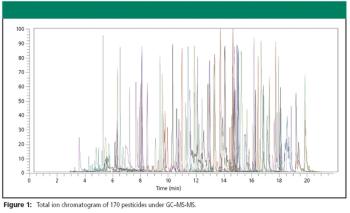
Pesticide contamination of foodstuffs has become a worldwide concern, prompting various levels of regulation and monitoring. Traditionally, pesticides are quantified with gas chromatography (GC) combined with selective detectors (ECD, FID, etc.). Selective GC detectors are great tools to quantify one or two classes at a time. However, screening for a number of different classes of pesticides requires multiple runs utilizing various GC configurations to achieve sufficient chromatographic resolution for unambiguous quantification. Gas chromatography–mass spectrometry (GC–MS) provides positive confirmation of various pesticides in a single analytical run because its superior selectivity allows interference-free quantification even with peak coelution. GC–MS has become a preferred technique for pesticide analysis because of its single-run capability.

The continual increase in sample numbers in busy labs means that it is often difficult for quality control or contract analysis labs to maintain short turnaround times, particularly when instruments are already running at full capacity. To address the need for faster analysis while retaining the quality of separation offered by dedicated amino acid analysers, an improved formulation of sodium citrate based buffers has been developed by Biochrom.

William Goodman and Thomas Meaker, PerkinElmer Life and Analytical Sciences

The analysis of peptides and additives using a new HPLC innovative column technology, Pathfinder, was shown. For the analysis of flavours in lemon juice GC–MS with a new MS library, FFNSC, with linear retention indices was used.

Soft drink formulas often include preservatives, artificial sweeteners, flavours or caffeine in their list of ingredients. Using the Acclaim OA column, as many as eight common additives may be determined in a single run. Many of these additives are hydrophilic organic acids for which this column was designed. Notably, benzoate and sorbate, which do not resolve on C18 columns at low pH, are fully separated.

Column lifetime is a more and more important issue when developing an analytical method for HPLC. Besides sample treatment, column cleaning and storage, operational parameters of the analytical method will have an influence on column lifetime. This question may not always be addressed early enough in the methods development process.

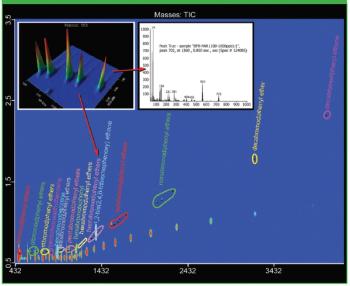
This application note will demonstrate a GC–MS analysis of common polybrominated diphenyl ether (PBDE) congeners. An optimized method will allow the Clarus GC–MS to provide ample separation and high yields of all PBDE congeners. The extended mass range of the Clarus 500 MS and high-mass calibration will produce mass spectra with very high levels of accuracy.

Polybrominated diphenyl ethers (PBDEs) are among the most important and widely used flame retardants. Recent legislation banned certain PBDE congeners.? EU directive 2003/11/EC prohibits the use of Penta-BDE and Octa-BDE for the member states of the European community.? Therefore, analysis of PBDEs have received increased interest as a result of their known toxicity.

Heidi Grecsek, PerkinElmer Life and Analytical Sciences

William Goodman and Heidi Grecsek, PerkinElmer Life and Analytical Sciences

As the global sourcing of foodstuffs becomes more common, the number of pesticide analyses performed continues to increase to test these sources for compliance with various regulations. The sheer number of analyses dictates that utilized methods must be reliable, robust and inexpensive.

Shimadzu app note - May

Protease inhibitors are a class of anti-HIV drugs used in combination therapy to block replication of the HIV virus in a person's blood. It is important to monitor the levels of these drugs in the patient since resistance can develop at low levels and at high levels the drug can exhibit toxic effects.

Mini application notes summaries

Shimadzu Application Note - Feb enewsletter

Maltodextrin is an easily digested carbohydrate made from corn starch...

VENTURE A affinity columns utilize ICEtechTM surface passivation technology...

Mini application note summaries...