Explore the complexities of bispecific antibodies and multispecific biologics, focusing on production, purification, and analytical challenges in biopharmaceuticals.

Explore the complexities of bispecific antibodies and multispecific biologics, focusing on production, purification, and analytical challenges in biopharmaceuticals.

This article reviews literature related to 2D-LC applications in the biopharmaceutical field over the past six years (2018-2024).

In this column, we discuss the label-free and stable isotope labeling proteomics approaches that help in biomarker discovery. We also discuss the different enrichment techniques, such as stable isotope labeling by amino acid in cell culture (SILAC), isobaric tags for relative and absolute quantitation (iTRAQ), and tandem mass tags (TMT, that help in measuring low-abundance protein biomarkers.

We present formulation and delivery of gene therapy products, focusing on adeno-associated virus (AAV) formulations. We also discuss the analytical technologies most used to characterize these products.

When used appropriately in RPLC, ion pairing agents can increase the separation and retention of charged analytes. But should they be explored in other modes of HPLC as well?

Characterizing lipid nanoparticles (LNPs) is a developing delivery modality in biotherapeutic analysis. We address some of the current challenges and opportunities in this field, including an examination of the most common tools used to characterize LNPs.

Some traditional MAM workflows are being substituted with iMAM workflows that rely on analyzing the intact mass of mAbs in their native form, resulting in significant improvements in high-throughput sample analysis.

A drug stability program is a fundamental part of ensuring product quality, safety, and efficacy. Here, we summarize essential guidelines, differences between large- and small-molecule stability, and the analytical methods used.

What is the right number of replicates in biopharmaceutical analysis? Does the answer depend on the type of analysis?

In response to regulatory concerns, host cell protein (HCP) analysis is now often conducted using LC–MS/MS. Unlike ELISA, LC–MS/MS can positively identify and quantify specific HCPs and characterize the total amount of HCPs present.

Recent assessments of four biosimilars illustrate how a combination of orthogonal, high-resolution tools is used to demonstrate analytical and functional biosimilarity.

Charge detection mass spectrometry (CDMS) is a useful tool to characterize larger, more complex biopharmaceuticals like bispecific antibodies and ADCs.

We review different approaches and coupling strategies for analyzing monoclonal antibody aggregates with 2D-LC.

Intact mass analysis is becoming increasingly useful for characterizing biologics. We describe the current application of intact mass analysis, including quantitation, sequencing, and structural characterization.

We present the main analytical techniques for performing functional characterization of biotherapeutic products. Such assessments are particularly critical for biosimilars, where analytical testing must ensure functional comparability with the innovator product.

New analytical workflows are needed to address the advances in biopharmaceutical product composition. A description of the multi-attribute method (MAM) is given, which has been developed to monitor critical quality attributes (CQAs) simultaneously and directly.

IMS is a valuable tool for biopharmaceutical analysis. Two formats in particular have proven useful: cyclic IMS and structures for lossless manipulations (SLIM).

Multidimensional separations, in which two or more separation methods are coupled, are a valuable analytical tool for higher peak capacity and improved selectivity for the analysis of complex samples like biotherapeutics.

Advanced separation and mass spectrometry methods enable comprehensive profiling of the inherent glycan heterogeneities of protein therapeutics. In particular, reversed-phase HPLC–based multiattribute methods (MAMs) provide a wealth of information, and other techniques, such as HILIC and CE-MS, also continue to evolve.

Hydrogen–deuterium exchange–mass spectrometry enables determination of higher order structures of biopharmaceuticals and direct comparisons between a biosimilar and its proprietary analog.

Coupling CE with MS presents some challenges. Here, we discuss the advantages of CE–MS over LC–MS, and the parameters that are important to obtain a stable CE–MS profile.

Determining the higher order structure of a protein pharmaceutical is important. Here, we review the approaches for HOS determination that are currently receiving the most attention in the literature and at scientific meetings.

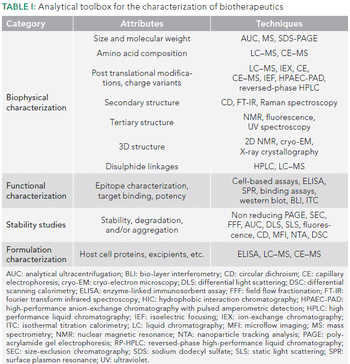
The analytical techniques used for characterizing biotherapeutics have evolved. We review the utility of the traditional tools and discuss the new, orthogonal techniques that are increasingly being used.

To ensure the reliable and accurate characterization of biotherapeutics, an arsenal of orthogonal analytical techniques is needed.

A look at techniques for charge-variant analysis of monoclonal antibodies and the question of whether pH gradients are really better than salt gradients

Several key applications of biolayer interferometry in pharmaceutical development have emerged recently. Here, we evaluate its use for easuring product titer from fermentation, and compare the strengths and weaknesses of the technique to those of HPLC.

Significant recent advances now enable routine usage of HDX-MS for comparing the conformations of biopharmaceutical products.

All agencies have issued varying guidances for the approval of recombinant, biosimilars of biopharmaceuticals. However, their impact or meaning is in our understanding and that all submittals are considered on a case-by-case basis.

In this article, we discuss the use of CE-MS (sheath flow interface) for analysis of intact proteins as well as of protein digests. We discuss the unique aspects that the user needs to be aware of while testing biotherapeutics versus small molecule drugs. We also highlight that the optimization of CE and MS parameters together result in the creation of a more robust and reproducible protein analysis approach. Finally, we list some of the most common errors that are likely to occur during CE-MS analysis and suggest ways to overcome them.

In this column, we introduce the basics of today’s approaches for doing intact protein dissociation with mass spectrometry (MS), or top-down sequencing (that is, rather than the more conventional peptide-based “bottom-up” sequencing where future improvements might occur, advantages and limitations of using top-down sequencing, possible applications, and why it has become such an important and pursued research area for many.