

E-Separation Solutions
Today's workshops cover a variety of topics, including protein analysis, -omics, data analysis, a few specific areas of application, and career development.
E-Separation Solutions
Today's workshops cover a variety of topics, including protein analysis, -omics, data analysis, a few specific areas of application, and career development.
E-Separation Solutions
Today?s plenary is the Biemann Medal Lecture, which will be given by Lingjun Li of the University of Wisconsin-Madison. Li is awarded the 2014 Biemann Medal for the number and depth of her contributions in the field of mass spectrometric study of neuropeptides and functional peptidomics.
E-Separation Solutions
Among the Tuesday afternoon oral sessions taking place on June 17 between 2:30 p.m. and 4:30 p.m. in Room 314-317 is ?Fundamentals of Peptide Fragmentation.? Yu Xia, of Purdue University (West Lafayette, Indiana), will preside.
E-Separation Solutions
This Wednesday afternoon session will be presided over by Demian Ifa of York University and will be held at 2:30–4:30 p.m. in Room 307-308.
E-Separation Solutions
This Wednesday morning session (WOA) will take place in Exhibit Hall AB from 8:30–10:30 a.m. Mark Lowenthall of the National Institute of Standards and Technology (NIST) will preside.
E-Separation Solutions
This Tuesday afternoon session (TOB) will take place from 2:30?4:30 p.m. in room 307-308. The session will be presided over by Bryan Fonslow of Scripps Research Institute.

The CHROMacademy technical team was recently posed with the question of the causes of baseline drift in gradient HPLC.
Chromatography troubleshooting tips from ChromAcademy.
E-Separation Solutions
Click here to view the complete E-Separation Solutions newsletter from June 12, 2014.

E-Separation Solutions
When developing a separation, some fundamental choices need to be made on how we might achieve the separation we require - primarily the mode of chromatography used and the way in which we intend to control and optimise the retention and separation (selectivity) of analyte components.
E-Separation Solutions
This Monday afternoon session, MOC, will be presided over by Gert Von Helden of Fritz-Haber University. The session will run from 2:30?4:30 p.m. in room 309-310.
The Column
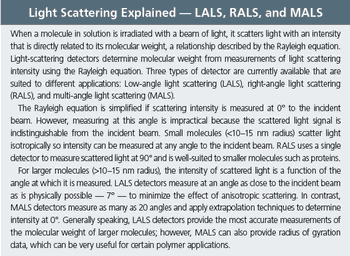
Multi-detection GPC/SEC is described and new data showing how the technique is being used to determine the impact of sterilization on medical grade poly(L-lactide) is presented.
E-Separation Solutions
This Monday morning session will be presided over by Patrick Limbach of the University of Cincinnati and will be held at 8:30?10:30 a.m. in Room 307-308.

The Column
A new study in the journal Heart suggests that high performance liquid chromatography tandem mass spectrometry (HPLC?MS?MS) can be performed as a standard screening tool to identify patients who do not take the anti-hypertensive medications as prescribed by their doctor.1

The Column
GPC/SEC can be performed for samples that range from a few hundred to several million daltons in molar mass. It can often require more skill to analyze high molar mass samples in the molar mass range of several million dalton. This article explains more.

The Column
The use of high temperature adsorption liquid chromatography for the characterization of polyolefins is detailed.

The Column
Red wine could help to protect against oral cavities, according to research published in the Journal of Agricultural and Food Chemistry.1 The team used ultrahigh-pressure liquid chromatography tandem mass spectrometry together with electrospray ionization (UHPLC–ESI–MS–MS) to analyze phenolic compounds found in the sampled red wine.
E-Separation Solutions
Today?s plenary is an award lecture by Richard M. Caprioli of Vanderbilt University. Caprioli is the recipient of the 2014 ASMS Award for a Distinguished Contribution in Mass Spectrometry for the development of matrix-assisted laser desorption ionization (MALDI) imaging mass spectrometry and its application to molecular mapping of tissues in biology and medicine. His award lecture today will be held in Exhibit Hall AB, at 4:45 pm.

The Column
This article provides insight into the basic principles of the MALS technique, and how it can be applied to the detection and characterization of branching in polymers.
E-Separation Solutions
Matthew Crowe, of Dow Chemical (Midland Michigan), will preside over six Monday morning oral sessions on ?Emerging Environmental Contaminants.? The sessions will take place in Exhibit Hall AB between 8:30 a.m. and 10:30 a.m.

The Column
Kate Mosford of The Column spoke to Giorgia Purcaro of the Department of Food Science at the University of Udine, Italy, and Chiara Cordero of the Department of Drug Science and Technology at the University of Turin, Italy, about the sensory evaluation of olive oil and the benefits of a comprehensive approach.
E-Separation Solutions
Click here to view the complete E-Separation Solutions newsletter from June 5, 2014.
E-Separation Solutions
DNA can be analyzed by many techniques, including electrophoretic techniques such as gel, capillary, and microchip electrophoresis, and nanochannel methods in which DNA is labeled and stretched. This interview with Kevin Dorfman, an Associate Professor in the Department of Chemical Engineering and Materials Science at the University of Minnesota in Minneapolis, Minnesota, discusses his research with polymer physics and microfluidic and nanofluidic technologies.
The Column
Click the title above to open The Column June 05, 2014 North American issue, Volume 10, Number 10, in an interactive PDF format.
The Column
Click the title above to open The Column June 05, 2014 Europe & Asia issue, Volume 10, Number 10, in an interactive PDF format.
Advances in mass spectrometry instrumentation have opened up the field of metabolomics, but there are still issues with non-standardized sampling and sample preparation methods. Tuulia Hyötyläinen from the VTT Technical Research Centre of Finland discusses the vast range of sample matrices and gives advice on best practices.

LCGC North America
The chemistry of radicals - which is quite different from that of even-electron species - opens up new analytical capabilities.

LCGC Europe
The pyrolysis–GC–MS method enables direct analysis of solid or liquid polymers without sample pretreatment, as illustrated here for various materials, including a dental filling material and a car wrapping foil.

LCGC Asia Pacific
An analytical method based on liquid chromatography coupled to tandem mass spectrometry (LC–MS–MS) has been developed for the determination of acrylamide in water. To obtain clean extracts and low detection limits, an activated carbon cartridge was investigated for use in solid-phase extraction (SPE), and extraction conditions such as desorption solvent and elution volume were optimized by a series of experiments. High recoveries (99.1–99.8%) were obtained using the activated carbon solid-phase extraction cartridges with methanol as the eluent. This method could be applied to the quantification of acrylamide in environmental water samples.

LCGC Europe
Sample preparation has often been viewed as the bottleneck in analytical procedures. Surveys have shown that time is typically the most frequent problem area for sample preparation procedures. While newly developed extraction techniques address time, modern chromatography advances are also moving towards faster separations. Based on these considerations, what is high-throughput sample preparation? Do modern extraction methods adequately address the issue of time? How can we address the analytical need for speed?