

LCGC Europe
A fast and simple sample preparation method for the simultaneous determination of 11 phytohormones in plants by GC–MS has been developed.
LCGC Europe
A fast and simple sample preparation method for the simultaneous determination of 11 phytohormones in plants by GC–MS has been developed.
LCGC Asia Pacific
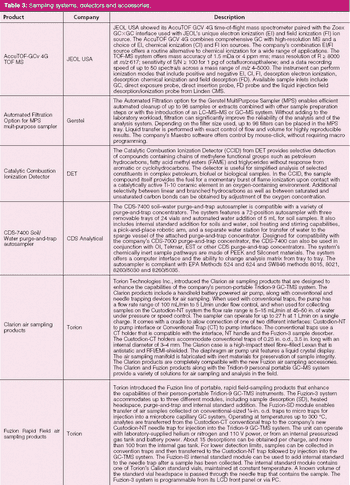
John Hinshaw presents his annual review of new developments in the field of gas chromatography introduced at Pittcon 2013.

LCGC North America
What problems in chromatogram may reveal, and what to do

LCGC North America
Gas chromatography instruments and accessories that were newly on display at Pittcon 2013

LCGC Europe
John Hinshaw presetns his annual review of new developments in the field of gas chromatography introduced at Pittcon 2013.

LCGC Europe
Properly maintaining the GC column can lead to improved chromatography and detector troubleshooting tips allow faster GC problem solving.
LCGC North America
Help with common problems with preparation, installation, and care
LCGC North America
Comparison of gas flow measurement methods for GC laboratories

LCGC North America
A method able to quantitate odorants at levels as low as 100 ppb (v/v)

LCGC Europe
In contrast to isocratic separations, gradient elution can sometimes seem to be counter-intuitive. Yet with the proper perspective, the things we intuitively understand about isocratic methods apply in a similar manner to gradients.

LCGC Europe
Various gas flow measurement methods in the laboratory for GC users are compared.
LCGC North America
The first three important stages in any GC analysis are explained.
LCGC Europe
In part 2 of this series, we complete a list of questions and answers about gases for GC.

E-Separation Solutions
In gas chromatography (GC), the sample vapor passes through the column and separates into its components ? a separation that is governed by the distribution between the mobile and stationary phases.

LCGC Europe
A panel of experts give their opinions about the current trends in gas chromatography (GC) instrumentation and how the technology could develop in the future.

LCGC Europe
This article discusses the details of how the newer techniques of sample preparation are simplified by the use of LC–MS-MS and GC–MS-MS technology.
LCGC North America
A number of frequently asked questions about gases and their delivery to a gas chromatography instrument are addressed.
LCGC Europe
In this month's instament, John Hinshaw addresses a number of frequently asked questions about gases and their delivery to a gas chromatography instrument.
LCGC North America
SPME decouples sampling from matrix effects that would distort the apparent sample composition or disturb the chromatographic separation. It is also easy to use and reduces solvent consumption.
E-Separation Solutions
Following the publication of “Analysis of the State of the Art: GC Instrumentation†in the August 2012 issue of LCGC, a reader notes further factors to consider, including poor user training, unanswered questions in fast GC, and the need for further instrument improvements, particularly better deactivation of the internal surfaces to minimize loss of trace samples.

LCGC North America
Achieving efficient analyte transfer between columns is critical to gaining the benefits of multidimensional GC.

The Column
Comprehensive GCÃ-GC(qMS) provides a maximum chromatographic separation power in gas chromatography (GC). Combining it with the highly selective negative chemical ionization (NCI) mode gives highest sensitivity for electrophilic molecules like trichloroanisole and tribromoanisole.

LCGC Europe
This article describes the GC–MS and LC–MS screening methods developed by the Environment Agency for England and Wales for the analysis of both low-volumn water samples and extracts obtained from various designs of passive samplers.

LCGC North America
In honor of LCGC's celebration of 30 years covering the latest developments in separation science, we asked a panel of experts (listed in the sidebar) to assess the current state of the art of gas chromatography (GC) instrumentation and to try to predict how the technology will develop in the future.

LCGC North America
In honor of LCGC's celebration of 30 years covering the latest developments in separation science, we asked a panel of experts to assess the current state of the art of gas chromatography (GC) column technology, and to try to predict how the technology will develop in the future.