Isabelle Kohler traces her unplanned path from pharmacy to bioanalysis, and why the same career struggles cut across gender lines in her PhD coaching.

Daniela Held studied polymer chemistry in Mainz, Germany, and works for PSS – A part of Agilent as an R&D director in Mainz. She is also responsible for education and customer training.
Isabelle Kohler traces her unplanned path from pharmacy to bioanalysis, and why the same career struggles cut across gender lines in her PhD coaching.

What five LCGC roundtables reveal about barriers, mentorship, and networking for women building careers in chromatography.
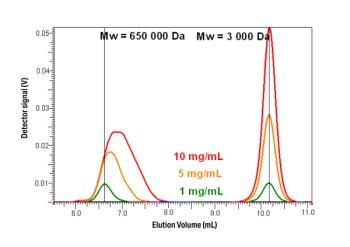
Sample concentration is a parameter that can influence the quality of gel permeation chromatography/size-exclusion chromatography (GPC/SEC) separations and the obtained results. Understanding this influence can help to support the development of reliable GPC/SEC methods.

This installment of Tips & Tricks focuses on the determination of the molar mass using a light scattering detector as an absolute detection method.

This installment of Tips & Tricks deals with pressure monitoring for GPC/SEC systems and gives hints for efficient troubleshooting to solve issues that are identified in the laboratory.

This instalment describes the interplay between column length, pore size distribution, and particle size to optimize GPC/SEC separations.

Hydrolyzed collagens (collagen peptides) are water-soluble products obtained by hydrolysis of natural proteins and used for dietary supplements. A simple GPC/SEC method is described for molar mass determination of collagen peptides, allowing reliable molar mass determination using ultraviolet (UV) detection.

How to create a calibration curve when no chemically-matching reference materials with narrow molar mass distribution are available.

A review of alternative approaches to narrow standard calibration.

Gel permeation chromatography/size-exclusion chromatography (GPC/SEC) columns are filled with porous particles differing in particle and pore sizes. Typical particle sizes in analytical GPC/SEC range from sub-2-µm particles applied in oligomer and protein separations to approximately 20 µm for separations of ultrahigh molar mass macromolecules (1,2). While the effect of combining columns of different pore sizes has previously been discussed in GPC/SEC Tips & Tricks (3,4), the effect of combining columns of different particle sizes has not been addressed before.

The Column
The chemistry of samples analyzed using gel permeation chromatography/size-exclusion chromatography/gel filtration chromatography (GPC/SEC/GFC) is very diverse. Different chemistries of stationary phases are required to allow for true size separation. Several types of materials are available, all of which have their advantages and limitations. While silica‑based stationary phases are most common in high performance liquid chromatography (HPLC), for macromolecules polymer-based phases are popular.

The Column
The “greenest solution” is certainly using no solvent but gel permeation chromatography/size-exclusion chromatography (GPC/SEC) as a liquid chromatography (LC) technique requires the use of a mobile phase. The growing awareness of the need for more sustainable (greener) solutions has focused attention on environmentally- and health-friendly solvents and solutions.

The Column
The accuracy of a measurement describes how close the measured result is to the true value. Accuracy is influenced by systematic errors, which are difficult to detect even for experienced scientists.

The Column
Gel permeation chromatography/size-exclusion chromatography (GPC/SEC) is the standard technique to determine the molar mass distribution of synthetic macromolecules. However, some kinds of polymers (for example, polyolefins) are often only soluble in special solvents and require high temperatures to be used during the analysis to keep the sample completely dissolved. Therefore, for the analysis of these polymers, dedicated high temperature GPC systems are used. This article will discuss the pros and cons of both high temperature GPC/SEC and ambient GPC/SEC.

The Column
One of the major problems with plastics is recycling. Only a few materials can be recycled and the acceptance of recyclates is sometimes low. GPC/SEC can be applied to investigate the quality of materials containing recycled portions.
The Column
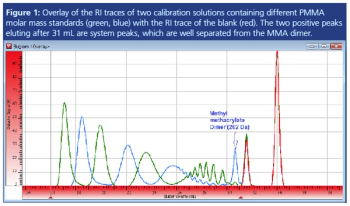
Extraneous peaks, unrelated to the solute to be characterized, are quite common in gel permeation chromatography/size-exclusion chromatography (GPC/SEC), especially when refractive index (RI) detection is used. This instalment of Tips & Tricks explains why system or ghost peaks appear and how to minimize their appearance.

The Column
Although modern GPC/SEC instruments are generally very reliable, scientists sometimes encounter problems. This instalment of GPC/SEC Tips & Tricks offers advice on how to efficiently identify the root cause of problems, such as dealing with a too high pressure, loss of resolution, or drifting baselines.

The Column
Molar mass distributions, molar mass averages, and polydispersity can be determined by gel permeation chromatography (GPC), size-exclusion chromatography (SEC), and gel filtration chromatography (GFC). This makes this technique indispensable for all scientists in quality control (QC) and R&D who have to work with large molecules. However, the technical terms used can be quite confusing for beginners. This instalment of Tips & Tricks explains more.
The Column
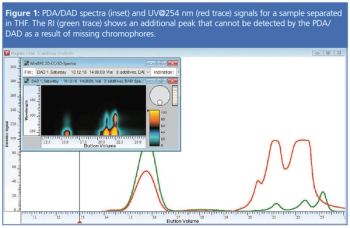
The most commonly applied detector in gel permeation chromatography/size-exclusion chromatography (GPC/SEC) is the differential refractive index detector, RI. How UV–vis detection, if applicable, adds true value to GPC/SEC applications is discussed in this instalment of Tips & Tricks.

The Column
The most commonly applied detector in gel permeation chromatography/size-exclusion chromatography (GPC/SEC) is the differential refractive index detector, RI. How UV–vis detection, if applicable, adds true value to GPC/SEC applications is discussed in this instalment of Tips & Tricks.

The Column
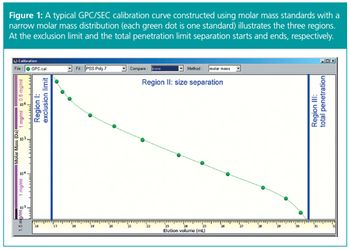
Gel permeation chromatography/size-exclusion chromatography (GPC/SEC) is a relative method and that requires a calibration to obtain molar mass distribution information. The way that the type of calibrants and the quality of the calibration curve influences the results is discussed in this instalment of Tips & Tricks.

The Column
The refractive index (RI) detector is the most common detector in gel permeation chromatography/size-exclusion chromatography (GPC/SEC). The advantage of this universal detector is that it detects everything; the disadvantage is that it detects everything. This instalment of “Tips & Tricks” offers some advice when working with RI detectors.

The Column
Combinations of detectors are often used in gel permeation chromatography/size-exclusion chromatography (GPC/SEC) to measure absolute molar masses or chemical compositions as a function of elution volume. Such multidetector setups require the correction of the delay volume between the detectors for correct data processing. This instalment of Tips & Tricks explains more.

The Column
Molecular mass is one of the central parameters required for product registration. Compared to low molar mass substances, the molar mass determination of macromolecular products is more difficult because the product is a mixture of chains with different lengths and, therefore, molar masses. Gel permeation chromatography/size-exclusion chromatography (GPC/SEC) is the standard technique to separate macromolecules by size and to measure the complete molar mass distribution as well as the molar mass averages. This technique therefore provides crucial information for product registration, including REACH.


The Column
Gel permeation chromatography/size-exclusion chromatography (GPC/SEC) is the standard method to separate samples by molecular size. In protein analysis, size-exclusion chromatography is either applied to detect and quantify aggregation, or to measure the complete molar mass distribution. However, method development is not trivial and the choice of suitable detection options is crucial.
The Column
Gel permeation chromatography/size-exclusion chromatography (GPC/SEC) is used to determine molar mass averages and the complete molar mass distribution with just one injection. This is possible because GPC/SEC is a fractionating technique. The fractionation power allows the higher molar mass fraction to be characterized and more about low molar mass compounds such as oligomers, additives, or residual educts to be learned.

The Column
The vast majority of macromolecules exhibit a molar mass distribution that is often described by the polydispersity index (PDI). This Tips & Tricks instalment offers practical advice to consider when analyzing macromolecules using liquid chromatography (LC).

The Column
Membranes play an important role in living species as well as in technical processes, including in human care (for example, in kidney treatment). This instalment of Tips & Tricks discusses gel permeation chromatography/size-exclusion chromatography (GPC/SEC) for membrane analysis.

The Column
This instalment of Tips & Tricks shows the influence of analytical parameters on gel permeation chromatography/size-exclusion chromatography (GPC/SEC)–light scattering results when artificially wrong parameters reflecting typical experimental errors are used.

April 1st 2021