An overview of different approaches for the qualitative and quantitative analysis of polysorbates.
Pat Sandra is the founder and advisor of the RIC group and emeritus professor at Ghent University (Ghent, Belgium).

An overview of different approaches for the qualitative and quantitative analysis of polysorbates.

In this article, the use of comprehensive two-dimensional liquid chromatography (LC×LC) coupled to mass spectrometry (MS) for characterizing glycosylation of therapeutic enzymes is presented.

In this article, the use of comprehensive two-dimensional liquid chromatography (LC×LC) coupled to mass spectrometry (MS) for characterizing glycosylation of therapeutic enzymes is presented.

An overview of different approaches for the qualitative and quantitative analysis of polysorbates.

This article details a recent experiment that demonstrates how nonspecific interactions can be prevented by using metal-free or low adsorption flow paths.

In this extended special feature to celebrate the 35th anniversary edition of LCGC Europe, key opinion leaders from the separation science community explore contemporary trends in separation science and identify possible future developments.

In this extended special feature to celebrate the 35th anniversary edition of LCGC Europe, key opinion leaders from the separation science community explore contemporary trends in separation science and identify possible future developments.

This article explores potential pitfalls associated with 1D‑LC and how 2D‑LC can overcome these obstacles.

Online 2D-LC is a powerful—and accessible—tool for analyzing pharmaceutical and biopharmaceutical samples, in both R&D and QC. It’s now easier than ever to develop 2D-LC methods, and they can be run in a fully automated manner.

An overview of mRNA-based vaccine production and a discussion on the methods that are currently in use to check the quality of these vaccines.

This article looks at the benefits of combining dynamic headspace sampling (DHS) with capillary GC–TOF-MS as a tool for untargeted analysis of aroma compounds in food and beverages. Applications for the analysis of strawberry yoghurt, chocolate, and red wine are described.

This article investigates host cell protein analysis using micro-pillar array columns combined with mass spectrometry.

Monoclonal antibodies (mAbs) are being developed at an explosive rate and have attracted great interest from both smaller biotech firms and big pharmaceutical companies. Developing mAbs and next-generation antibody–drug conjugates (ADCs) is highly demanding in many ways. From an analytical perspective, handling mAbs and ADCs presents many new challenges. This article describes how size-exclusion chromatography (SEC) combined with high-resolution mass spectrometry (HRMS) can be applied to the detailed characterization of mAbs and ADCs.

Glycosylation is a critical quality attribute (CQA) that can impact on product safety and efficacy of protein biopharmaceuticals. Characterization of N-glycans is therefore of paramount importance for the pharmaceutical industry. Hydrophilic interaction liquid chromatography (HILIC) combined with fluorescence detection (FLD) and 2-aminobenzamide (2-AB) labelling is the golden standard for the analysis of N-glycans enzymatically liberated from biopharmaceuticals. However, for phosphorylated N-glycans, that is, those attached on lysosomal enzymes, irreproducible data and recovery issues are observed on conventional liquid chromatography (LC) instrumentation and columns, which can be attributed to the interaction of the phosphate moieties with stainless steel components in the flow path. This article demonstrates the analysis of phosphorylated glycans with full recovery on a bio-inert LC system and PEEK-lined HILIC column.

The structural complexity of monoclonal antibodies (mAbs) challenges the capabilities of even the most advanced chromatography and mass spectrometry techniques. This study examines the use of micro-pillar array columns in combination with mass spectrometry for peptide mapping of both mAbs and antibody–drug conjugates (ADCs).

Glycosylation is a critical quality attribute (CQA) that can impact on product safety and efficacy of protein biopharmaceuticals. Characterization of N-glycans is therefore of paramount importance for the pharmaceutical industry. Hydrophilic interaction liquid chromatography (HILIC) combined with fluorescence detection (FLD) and 2-aminobenzamide (2-AB) labelling is the golden standard for the analysis of N-glycans enzymatically liberated from biopharmaceuticals. However, for phosphorylated N-glycans, that is, those attached on lysosomal enzymes, irreproducible data and recovery issues are observed on conventional liquid chromatography (LC) instrumentation and columns, which can be attributed to the interaction of the phosphate moieties with stainless steel components in the flow path. This article demonstrates the analysis of phosphorylated glycans with full recovery on a bio-inert LC system and PEEK-lined HILIC column.

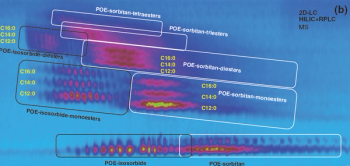
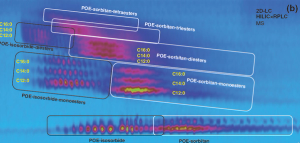
Comprehensive two-dimensional liquid chromatography (2D-LC) was used for detailed profiling of various nonionic ethoxylated surfactants applied in pharmaceutical formulations. Hydrophilic-interaction chromatography (HILIC) and reversed-phase liquid chromatography (LC) were used as the first and second dimensions, respectively. Detection was performed with evaporative light-scattering detection (ELSD) for general profiling and with single-quadrupole mass spectrometry (MS) for structure elucidation of individual peaks and for class-type confirmation of peak-groups.

Comprehensive 2D-LC using HILIC and reversed-phase LC is a robust tool to characterize nonionic ethoxylated surfactants in pharmaceutical formulations.

Monoclonal antibodies are becoming a core aspect of the pharmaceutical industry. Together with a huge therapeutic potential, these molecules come with a structural complexity that drives state-of-the-art chromatography and mass spectrometry (MS) to its limits. This article discusses the use of micro-pillar array columns in combination with mass spectrometry for peptide mapping of monoclonal antibodies (mAbs) and antibodyÐdrug conjugates (ADCs). Micro-pillar array columns are produced by a lithographic etching process creating a perfectly ordered separation bed on a silicon chip. As a result of the order existing in these columns, peak dispersion is minimized and highly efficient peptide maps are generated, providing enormous structural detail. Using examples from the author’s laboratory, the performance of these columns is illustrated.

Chromatographic method development for pharmaceutical analysis can benefit from in silico steered serial coupling of column segments containing different stationary phases of varying length. Contrary to column coupling through trial and error, in stationary-phase optimized selectivity (SOS)-based chromatography the retention of all solutes is predicted for all possible column combinations allowing a rational selection of the optimal column combination. The possibilities of the strategy now surpass the initial usage in isocratic high performance liquid chromatography (HPLC) on dedicated commercial column segments, and allow applications in gradient-, green-, preparative-, and in supercritical fluid chromatography (SFC) on conventional column hardware. Current possibilities, pharmaceutical applications, a downloadable algorithm, and weaknesses of the approach are discussed to allow broader implementation of this methodology in separation science.

In this extended special feature to celebrate the 30th anniversary edition of LCGC Europe, leading figures from the separation science community explore contemporary trends in separation science and identify possible future developments. We asked key opinion leaders in the field to discuss the current state of the art in gas chromatography instruments.

These are exciting times to be involved in monoclonal antibody (mAb) and biopharmaceutical analysis. Advances in instrumentation, column technology, and reagents are providing analysts with a new set of tools to broaden their understanding of the highly complex products they are studying. A good example is hydrophilic interaction chromatography (HILIC). While the technique has been used for more than 20 years to profile enzymatically released and fluorescently labelled N-glycans, the introduction of new columns (sub-2-µm and widepore) has paved the way to explore the technique further. Remarkable separations at all levels of analysis, including protein, peptide, and glycan levels, have been demonstrated. With data from the authors’ laboratories, the versatility of HILIC in mAb analysis will be demonstrated in this month’s “Biopharmaceutical Perspectives”.

In the 21st century, numerous advances have been made in liquid chromatography (LC) column technology. The best known are columns packed with sub-2-µm porous particles or sub-3-µm superficially particles, and monolithic columns. Another very novel and original development is micro-pillar array columns (µPAC). µPACs are produced by a lithographic etching process to create a perfectly ordered separation bed on a silicon chip. Although the performance in terms of efficiency has been illustrated, the applicability for analysis of real complex samples has yet to be fully demonstrated. This article illustrates that state‑of‑the‑art µPAC columns coated with octadecyl are applicable for a challenging application such as lipidomics. The performance is illustrated with the analysis of human blood plasma lipids.

Two-dimensional liquid chromatography (2D-LC) has in recent years seen an enormous evolution, and with the introduction of commercial instrumentation, the technique is no longer considered a specialist tool. One of the fields where 2D-LC is being widely adopted is in the analysis of biopharmaceuticals, including monoclonal antibodies (mAbs) and antibody–drug conjugates (ADCs). These molecules come with a structural complexity that drives state-of-the-art chromatography and mass spectrometry (MS) to its limits. Using practical examples from the authors’ laboratory complemented with background literature, the possibilities of on-line 2D-LC for the characterization of mAbs and ADCs are presented and discussed.

On-line two-dimensional liquid chromatography (2D-LC) embracing mainly comprehensive LC (LC×LC) and multiple heart-cutting LC (mLC–LC) offers new opportunities for in-depth characterization of pharmaceuticals. Reversed-phase LC × reversed-phase LC using different column chemistries and mobile phases provides good orthogonality for a wide range of applications related to small molecule drugs. Moreover, hardware configurations and software are now commercially available to perform LC×LC and mLC–LC measurements in a reproducible manner.

An introduction from the guest editors of this special supplement

This article presents a selection of state-of-the-art analytical tools for mAb characterization and comparability assessment.

The use of off-line 2D-LC–MS for the characterization of HCPs and their monitoring during downstream processing

An introduction from the guest editors of this special supplement from LCGC Europe revealing recent developments in small-molecule drug analysis.

Analysis of additives such as sweeteners, preservatives, and caffeine in various food products, beverages, and consumer toothpaste using the Agilent 1290 Infinity II LC.

Published: January 3rd 2025 | Updated:

Published: October 15th 2024 | Updated:

Published: August 1st 2023 | Updated:

Published: January 6th 2025 | Updated:

Published: September 1st 2022 | Updated:

Published: September 1st 2022 | Updated: