Peter Myers from the University of Liverpool (Liverpool, UK) spoke to David McCalley from the University of the West of England (Bristol, UK) about the past, present, and future of stationary phases, and his working life in academia and industry.

Buffers are commonly used in reversed-phase liquid chromatography (LC) to control the ionization state of analytes. However, the addition of buffers is much more complex than simple pH control. Complex equilibria exist between these mobile-phase additives, the analytes, the silica surface, and even the stationary phase in certain circumstances. The addition of mass spectrometry (MS) as a primary detection technique makes decisions about mobile-phase additives even more crucial. In this column instalment, we use a model set of analytes and selected applications to demonstrate the effects that buffers can have not only on the selectivity of a separation, but also on the sensitivity of a reversed-phase analysis when using MS detection.

Peter Myers from the University of Liverpool (Liverpool, UK) spoke to David McCalley from the University of the West of England (Bristol, UK) about the past, present, and future of stationary phases, and his working life in academia and industry.

This article describes a space-saving, quick, and inexpensive sample preparation technique followed by a high performance liquid chromatography (HPLC) method with a 100% water mobile phase and photodiode array (PDA) detection for quantifying acetamiprid and its N-desmethyl metabolite, IM-2-1, in cow’s milk. The analytes were extracted from the sample and deproteinized using a handheld ultrasonic homogenizer with 5% (w/v) trichloroacetic acid solution, purified using a centrifugal monolithic silica spin minicolumn, and quantified within 20 min per sample. The accuracy and precision are well within the international method acceptance criteria.

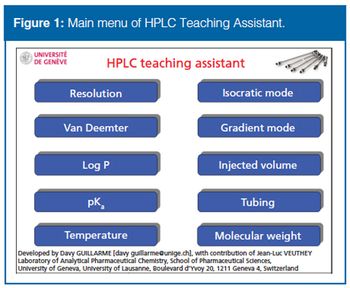
The free spreadsheet-based program HPLC Teaching Assistant was developed for effective and innovative learning and teaching of liquid chromatography. This software allows teachers to illustrate the basic principles of high performance liquid chromatography (HPLC) using virtual chromatograms (simulated chromatograms) obtained under various analytical conditions. In the first instalment of this series, we demonstrate the possibilities offered by this spreadsheet to illustrate the concept of chromatographic resolution, including the impact of retention, selectivity, and efficiency; understand the plate height (van Deemter) equation and kinetic performance in HPLC; recognize the importance of analyte lipophilicity (log P) on retention and selectivity in reversed-phase HPLC mode; and manipulate or adapt reversed-phase HPLC retention, taking into account the acido-basic properties (pKa) of compounds and the mobile-phase pH.

The 45th International Symposium on High Performance Liquid Phase Separations and Related Techniques (HPLC 2017) will be held from 18 to 22 June 2017 at the Prague Congress Centre, Prague, Czech Republic.

The mobile phase pH can be a powerful tool to control retention and selectivity, but it can also get you in trouble if not controlled properly.

Part II of this series describes additional features of the HPLC Teaching Assistant software, including the possibility to simulate the impact of the mobile phase temperature on HPLC separations; understand the chromatographic behavior of a mixture of diverse compounds in both isocratic and gradient elution modes; show the influence of instrumentation (injected volume and tubing geometry) on the kinetic performance and sensitivity in HPLC; and demonstrate the impact of analyte molecular weight on thermodynamic (retention and selectivity) and kinetic (efficiency) performance.

This article describes a workflow for the analysis of phenolic components in wine enabling confident differential analysis using high performance liquid chromatography (HPLC) in combination with low-field drift-tube ion mobility quadrupole time-of-flight mass spectrometry (IMS-QTOF-MS).

This free software allows teachers to illustrate the basic principles of HPLC, such as chromatographic resolution, the van Deemter equation, and how to manipulate or adapt retention in reversed-phase HPLC.

HPLC 2016, chaired by Professor Robert Kennedy, was held June 19–24 in San Francisco, California, at the Marriott San Francisco Marquis. This installment of "Column Watch" covers some of the highlights observed at the symposium including stationary-phase developments, particle technology, and areas of growing application of HPLC. In addition, trends and perspectives on future developments in HPLC noted from the conference are presented.

Detectors based on ultraviolet absorbance are the most common detectors in use for liquid chromatography.

There can be significant benefits by standardizing HPLC columns in a pharmaceutical development laboratory. Here is a story of how one organization attempted to encourage its staff to develop HPLC methods using fewer column brands and dimensions to reduce waste and efforts in method transfers downstream.

A reliable autosampler is one key requirement for unattended operation of a liquid chromatograph.

The HPLC 2016 conference kicks off this afternoon with plenary lectures that focus on human health, spanning from the big picture of wellness to the details of characterizing monoclonal antibodies, with talks by Leroy Hood of the Institute for Systems Biology, Steven Carr of the Broad Institute of MIT and Harvard, and Mary Wirth of Purdue University.

Different techniques of LC mobile phase mixing can give different results… and have different problems.

In recent years industry has been moving to columns with smaller and smaller inner diameters-moving from 4.6 and 3.0 mm i.d. columns to 2.1 mm, 1.0 mm, and even smaller. While small inner diameter columns have some clear advantages, they also bring challenges. Reduction of extracolumn volumes must be given greater consideration by both customers and manufacturers. Additionally, experimental evidence suggests that the very narrow confinement of chromatographic particles can result in packed bed structures that promote increased dispersion and reduced efficiency. This article focuses on the sources of band broadening within high performance liquid chromatography (HPLC) columns with particular emphasis on eddy dispersion. The physical mechanisms of dispersion are discussed and a review of the current literature as it pertains to small inner diameter columns is presented.

A universal generic HPLC or UHPLC method with a primary modern column that works well for most drug analyses in a few minutes would be an attractive idea for many laboratories. With advances in column technologies, this ideal scenario is becoming more realistic, as demonstrated in the proposed 2-min generic method shown here. In addition, rationales for the selection of column and operating conditions are discussed, together with ways to extend this generic method as a starting point for stability-indicating applications by simple adjustments of gradient time and range.

Put yourself in their spot: How would you tackle analyzing a bag of gummy bears that showed up on your lab bench? Here, we offer some insights from the very capable finalists at The Conference on Small Molecule Science (CoSMoS), which was held in August 2015 in San Diego, California.

Understanding how liquid chromatographic pumps operate can help streamline solving pump problems.

HPLC–MS-MS is the go-to technique for high throughput analysis of small molecule therapeutics, metabolites, and biomarkers. Through technological advancements in the last decade, developing quality methods for a novel analyte in the contract research environment has become easier and faster than ever. Increasingly shorter run times, higher sensitivity, and greater separation have all become possible in a standard method. This is, in part, due to column technologies that have enabled the standardization of the method development process. Method efficiency and productivity are also improving because of emerging column technologies such as sub-2 µm particle size coupled with UHPLC–MS-MS, superficially porous particle columns, and microflow HPLC–MS-MS. Increasing efficiency and productivity in high throughput bioanalysis is becoming more important as the applications for HPLC–MS-MS expand to large molecules such as peptides, proteins, and oligonucleotides.


The last decade has seen a series of advances in the field of liquid chromatography that have resulted in improvements for many clinical diagnostic services. These innovations have included the expansion of superficially porous particle columns, new or improved stationary phase options, and “user-friendly” multiple-channel HPLC instrument options that allow sequential analysis-a boon for low and moderate throughput laboratories with limited hardware. As a result, diagnostic services are able to offer faster turn-around-times and measure analytes in patient types and disease states that were previously problematic. This article presents examples of the impact these innovations have had in a number of hospital settings.

This installment describes high performance liquid chromatography (HPLC) instruments and related products introduced at Pittcon 2016 held in Atlanta, Georgia, or in the year prior. We highlight innovative features and benefits of new HPLC systems, modules, software, and product extensions.

Adequate detection of trans-resveratrol in wine is complicated by two factors: relatively low levels and interferences from matrix components. Here, we present two useful approaches to overcoming these issues depending on the instrumentation available. For HPLC–UV analyses, matrix peaks can be removed by microextraction using packed sorbent while simultaneously concentrating the trans-resveratrol peak by a factor of two. For LC–MS, the extracted ion chromatogram for the [M + H]+ analyte ion can be used to obtain specificity without prior extraction procedures.

Particulate matter from the sample or the system can cause havoc in the chromatogram.

Bioanalysis of biologics presents a number of technical challenges. Ligand binding assays (LBA) are the gold standard bioanalytical technique for quantification of biologics in complex matrices such as serum and plasma but selectivity issues and the need for specific capture reagents limit their applicability in the drug discovery and development phase. Liquid chromatography coupled with tandem mass spectrometry (LC-MS-MS) is widely used for highly selective and sensitive bioanalysis of small molecules. However, large molecule bioanalysis presents challenges including the need for extensive and complex sample preparation for LC-MS-MS. This article explores the limitations of LC-MS-MS for bioanalysis of biologics and some of the latest trends for overcoming these in bioanalysis laboratories.

During the course of my scientific career beginning in the 1960s, I have grown up with the birth of modern LC column technology, the refinements of the instrumentation, and the development of widespread application of this most powerful separation and analysis technique. In this installment, I would like to share with you some of my observations and experiences with the beginning, the growth period, and the maturation of HPLC columns, where I have focused nearly 33 years of writing for this magazine. I will explore some of the early column breakthroughs beginning with the development of large superficially porous particles (SPP), the porous irregular and spherical microparticulate particles, inorganic and organic polymeric monoliths and the rebirth of the current generation of SPP. In next month’s installment I will look into my crystal ball and see what the future of HPLC and UHPLC holds.