



LCGC North America
The authors provide a technical overview of the design and operating principles of variable wavelength and photodiode array detectors, and include historical perspectives and common practices in operation and maintenance.

Aogu Furusho from the Graduate School of Pharmaceutical Sciences in Kyushu University, Fukuoka, Japan, spoke to us about his development of a highly selective three-dimensional chiral high performance liquid chromatography (HPLC) system for the determination of extraterrestrial amino acids in carbonaceous chondrites.
LCGC North America
The authors provide a technical overview of the design and operating principles of variable wavelength and photodiode array detectors, and include historical perspectives and common practices in operation and maintenance.

LCGC North America
In this installment, tips, tricks, and suggestions are provided for best practices in reversed-phase separations, in both 1D and 2D LC, with gradient elution for minimum variations in retention time.

Sponsored Content - EU
This note addresses the optimum solution for the true productivity in all nanoLC-MS proteomics workflows.

LCGC North America
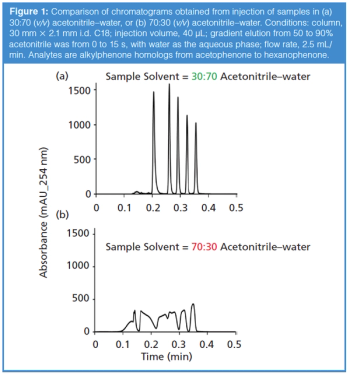
Carefully diluting a sample with weak solvent can mitigate the impact of sample solvent on peak shape in both reversed-phase and HILIC separations, but we need to understand how the choice of sample diluent can affect analyte recovery.
LCGC North America
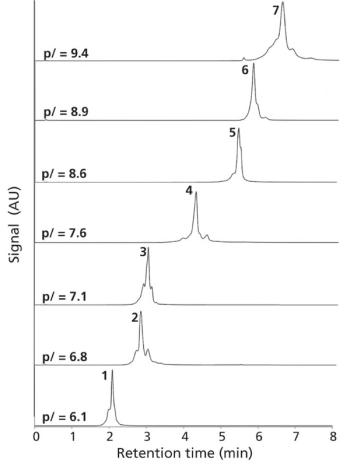
The high levels of non-volatile salts typically used in ion-exchange separations are incompatible with mass spectrometry. But the desire to directly couple these two powerful techniques has prompted researchers find solutions to this problem. Here are three approaches.
LCGC North America
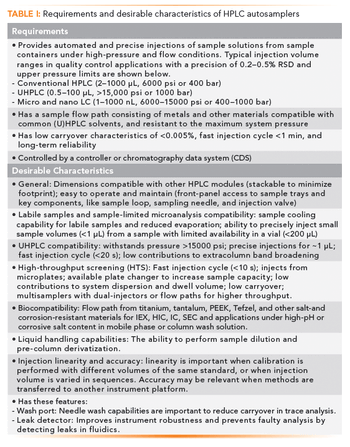
We explain recent trends in HPLC autosampler design, provide recommendations for selecting one, and offer guidelines for operation and troubleshooting.

The Column
In this instalment of the LCGC Blog, Tony Taylor discusses noisy baselines in high performance liquid chromatography (HPLC).
LCGC North America
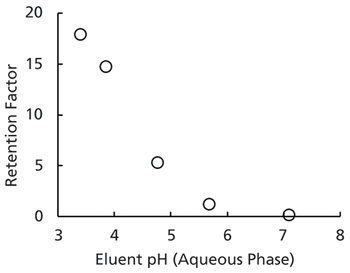
Many analysts have strongly held beliefs about buffer preparation methods, but these positions are not always supported by experimental evidence.

LCGC Europe
The effect of dwell volume on chromatographic selectivity can be successfully modelled using retention prediction software. Hence, the robustness of reversed-phase LC gradient methodologies, with respect to dwell volume, can be conveniently assessed.

Special Issues
Ultrahigh efficiency separations based on the presence of one deuterium in benzene, toluene, and naphthalene were achieved by recycle chromatography using C18 silica columns. The discrimination mechanism of H/D isotopic species is discussed based on the dispersion interactions of a CH/CD group of the solute with the stationary phase as well as the mobile phase.

Special Issues
The impact of ionic strength, buffer capacity, and pH-response on the retention behavior and peak shape of mAb species characterization is evaluated for IEX-MS. The aim of the present study was to understand the impact of ionic strength, buffer capacity, and pH-response on the retention behavior and peak shape of mAb species.

LCGC North America
An in-line mixer between the sample injector and column may resolve problems with peak shape caused during sample dilution.

LCGC North America
Legacy LC methods seem like they come from a different planet. This month, we look at which conditions to keep, and which ones to let go.

Special Issues
Ultrahigh-efficiency separations based on the presence of one deuterium in benzene, toluene, and naphthalene were achieved by recycle chromatography using C18 silica columns. Larger isotopic separation factors, α(H/D), were observed in methanol–water than in acetonitrile–water, when the mobile phases provided similar retention factors (k), or similar methylene selectivity, α(CH2). Isotopic resolutions between nondeuterated and perdeuterated aromatic hydrocarbons at long separation times were estimated by using the plate counts obtainable by recycle operation as a function of a cycle time, along with the retention factors and the separation factors experimentally observed.

Special Issues
This article gives a brief overview of the advantages and limitations of recently introduced mathematical procedures such as the Fourier deconvolution of extracolumn effects, iterative curve fitting, multivariate curve resolution, modified power law, and use of first and second derivatives in enhancing resolution. High-throughput analyses in gas chromatography (GC), LC, and supercritical fluid chromatography (SFC) could benefit from these simple and effective approaches in many challenging separations applications.
Special Issues
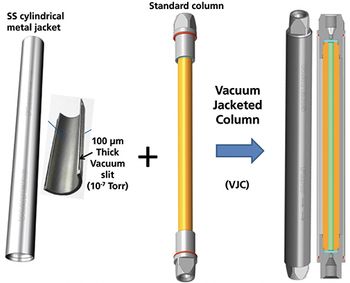
The design of a user-friendly vacuum-jacketed column (VJC) is described for improved LC–MS performance, which does not require a large vacuum chamber with multiple vacuum pumps. Using this configuration, the experimental peak capacities measured for a 2.1 mm × 100 mm column packed with sub-2-μm particles and placed in the VJC-MS probe are doubled with respect to standard LC–MS systems.
LCGC North America
Re-equilibrating a reversed-phase stationary phase following aqueous gradient elution can be achieved much faster than you think.

LCGC Europe
Our annual review of new liquid chromatography (LC) columns and accessories, introduced at Pittcon and other events.
LCGC Europe
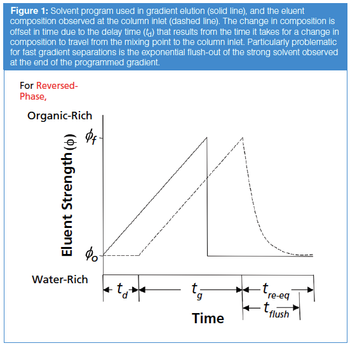
How long does it take to re-equilibrate reversed-phase stationary phases following gradient elution, especially when starting with a highly aqueous eluent?
LCGC Asia Pacific
How long does it take to re-equilibrate reversed-phase stationary phases following gradient elution, especially when starting with a highly aqueous eluent?

LCGC North America
How many new columns truly offer new selectivity?
LCGC North America
In reversed-phase separations, retention generally increases as the fraction of water in the eluent increases. When we encounter situations where retention is too low for an analyte of interest, we tend to use eluents with higher and higher levels of water. But how much water is too much?
LCGC North America
The challenges we face in troubleshooting problems with liquid chromatography (LC) separations are highly diverse. This month we take a closer look at topics that have garnered more attention recently.

LCGC North America
Is an ultraviolet (UV) detector signal good for anything if the analyst is using a mass spectrometer?

The Column
Within the broad scope of analytical techniques required to characterize a protein, chromatographic methods have shifted towards high-flow analyses that can drop development time significantly. However, fast analytical methods for charge heterogeneity have lagged in development because current column technologies are ultrahigh-pressure liquid chromatography (UHPLC)-incompatible. This article will demonstrate the development of a high-flow method for charge variant analysis made possible through a bioinert titanium column flow path.