



Scientists from Tabriz University and the University of Tabriz explored cellulose acetate-UiO-66-COOH as an affordable coating sorbent for thin film extraction of biogenic amines from cheese and alcohol-free beverages using HPLC-MS/MS.
Scientists from Tabriz University and the University of Tabriz explored cellulose acetate-UiO-66-COOH as an affordable coating sorbent for thin film extraction of biogenic amines from cheese and alcohol-free beverages using HPLC-MS/MS.

In this final part of our interview with Females in Mass Spectrometry (FeMS) Empowerment Award Winner Josephine Ouma, we discuss her future research efforts and what Women's History Month means to her.
In this second part of our interview with Females in Mass Spectrometry (FeMS) Empowerment Award Winner Josephine Ouma, we discuss her experience with mass spectrometry and how FeMS has impacted her life.
In this first part of our interview with Females in Mass Spectrometry (FeMS) Empowerment Award Winner Josephine Ouma, we discuss her PhD research and what inspired her to join FeMS.

The researchers explored ways to simplify retention time calculation across LC–MS and various other chromatographic methods.
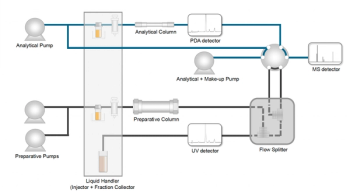
This article introduces a multi-step preparative purification workflow for synthetic peptides using liquid chromatography–mass spectrometry (LC–MS). The process involves optimizing separation conditions, scaling-up, fractionating, and confirming purity and recovery, using a single LC–MS system. High purity and recovery rates for synthetic peptides such as parathormone (PTH) are achieved. The method allows efficient purification and accurate confirmation of peptide synthesis and is suitable for handling complex preparative purification tasks.

A new method has been created for determining N-nitrosamines (NAs) in pharmaceutical preparations using liquid chromatography with tandem mass spectrometry.

A new approach to characterizing human milk oligosaccharides was developed using a combination of liquid chromatography, mass spectrometry, and other techniques.

New types of smart proteolytic samplers were tested for their effectiveness in liquid chromatography-mass spectrometry (LC–MS)-based protein quantification.
Webcasts
Webinar Date/Time: Wed, Apr 16, 2025 11:00 AM EDT

Scientists from the Zhejiang Institute of Quality Scientists used liquid chromatography–tandem mass spectrometry to detect 35 PFAS in paper and plastic products.
Webcasts
Webinar Date/Time: Wed, Apr 9, 2025 10:00 AM EDT
Webcasts
Webinar Date/Time: Wed, May 21, 2025 11:00 AM EDT

Nadia Gadi and Allisson Barros de Souza spoke to LCGC International about their investigation into the application of electrochemical advanced oxidation processes (eAOPs) for the efficient removal of pharmaceutical residues in wastewater.
Webcasts
Webinar Date/Time: Thursday, April 17, 2025 8am PST | 11am EST | 4pm GMT | 5pm CET

During Waters Corporation’s 2025 Investor Day, the company’s top executives highlighted the company’s growth and hints at future points of development.

Here is some of the most popular content posted on LCGC International this week.

Webcasts
Webinar Date/Time: Thurs, March 27, 2025 11:00 AM EST
Here is some of the most popular content posted on LCGC International this week.
Here is some of the most popular content posted on LCGC International this week.


Ardiana Kajtazi discusses her research identifying organic micropollutants in water using liquid chromatography–high-resolution mass spectrometry (LC–HRMS). She highlights the standardized filtration approach her team has developed based on intersection principles, utilizing retention indices from two reversed-phase liquid chromatography (RPLC) columns.

The Harvey W. Wiley Award is presented every year to a scientist, or group of scientists, who have made outstanding contributions to analytical method development in areas of interest to AOAC INTERNATIONAL.

A team of researchers has evaluated approaches in exposome research, highlighting sample preparation, MS-based platforms, and data acquisition strategies.

A QuEChERS sample preparation technique coupled with a UHPLC–MS/MS method was developed to determine 19 veterinary drug residues in foods of animal origin.