
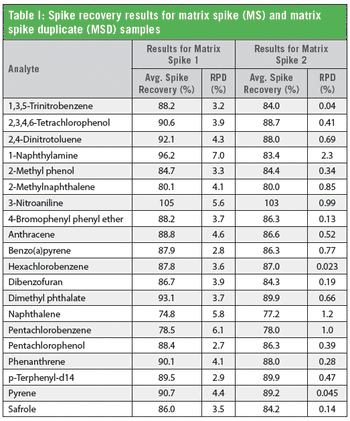
This applicate note presents the use of an automated solid-phase extraction (SPE) system to improve the accuracy and precision of semivolatile extractions, in compliance with EPA Method 8270.
This applicate note presents the use of an automated solid-phase extraction (SPE) system to improve the accuracy and precision of semivolatile extractions, in compliance with EPA Method 8270.

One of the fundamental tenets of chromatography is the interaction between an analyte and stationary phase.

In this study, a reversed-phase HPLC method was developed for separation of five steroid hormones with partition coefficients ranging from 1.47 (cortisone) to 4.5 (pregnenolone) on a Hamilton PRP-C18 HPLC column.

This method showed excellent precision and accuracy for the 12 FDA regulated mycotoxins that were evaluated during a validation study that covered a variety of matrices.

Pickering Laboratories developed an analytical method to comply with all the chromatographic requirements of Commission Regulation (EC) No 152-2009.

For your highly sensitive UHPLC–MS analyses, how can you reduce noise and additional signals to a minimum?
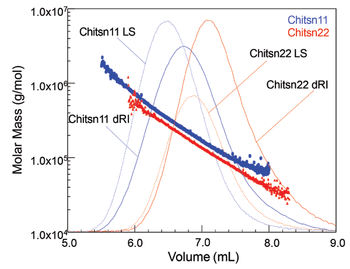
Chitosans are analyzed by SEC-MALS to determine molar mass moments and distributions.

This application note presents calibration plots, RSDs, and MDLs for IEC Method 62321-8 using a CDS Model 6150.

The purpose of this study is to demonstrate the use of mass spectrometry to characterize the elution profile of a typical IgG1 molecule separation on a TSKgel FcR-IIIA-NPR column, and verify the observations that certain glycan structures impart higher activity to the monoclonal antibody, especially as it relates to the presence of terminal galactose sugars.

This application note effectively outlines a simple three-step method for the extraction of loperamide and its main metabolite, N-desmethyl loperamide, from blood.

Here we applied our newly developed UHPLC C18 and C30 columns to oligonucleotide analysis.

In this application, a simple method to simultaneously analyze various water-soluble vitamins was developed.