

The Column
Trajan Scientific and Medical (Melbourne, Australia) has announced the acquisition of LEAP Technologies Inc. (Carrboro, North Carolina, USA).
The Column
Trajan Scientific and Medical (Melbourne, Australia) has announced the acquisition of LEAP Technologies Inc. (Carrboro, North Carolina, USA).

The Column
An Advanced Grant worth 2.5 million Euros has been awarded to Peter Schoenmakers of the University of Amsterdam (UvA) to develop new high-performance separation technology.
The Column
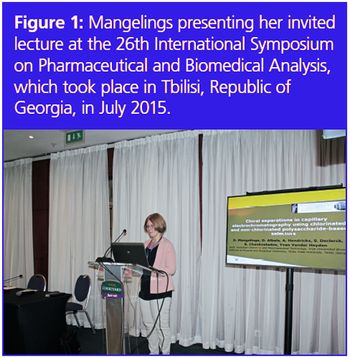
This year, LCGC is pleased to honour Debby Mangelings as the winner of the 2016 Emerging Leader in Chromatography Award. Mangelings received her award on Monday 7 March during an oral symposium at Pittcon 2016 in Atlanta, Georgia, USA.

The Column
Researchers from Heilongjiang University of Chinese Medicine, China, have used ultrahigh-performance liquid chromatography coupled to mass spectrometry and metabolomics to investigate the metabolic networks of Alzheimer’s disease, identifying potential biomarkers and biochemical mechanisms.

The Column
The literature on reversed-phase liquid chromatography (LC) of proteins is reasonably well developed, but not taught in the college classroom much. Kevin Schug therefore wants to focus on a stoichiometric displacement model for reversed-phase LC of proteins and why it is particularly insightful from a practical perspective.

The Column
This is the first of a four-part series of articles exploring current topics in separation science that will be addressed at the HPLC 2016 conference in San Francisco, USA, from 19–24 June.

The Column
The 40th International Symposium in Capillary Chromatography (ISCC) and 13th GC×GC Symposium will be held at the Palazzo dei Congressi, in Riva del Garda, Italy, from 29 May–3 June 2016.
The Column
Click the title above to open The Column April 25, 2016 North American issue, Volume 12, Number 7, in an interactive PDF format.
The Column
Click the title above to open The Column April 24, 2016 Europe & Asia issue, Volume 12, Number 7, in an interactive PDF format.
LCGC Europe eNews
Analytica 2016 Wednesday Afternoon Sessions

LCGC Europe
Magnetic nanoparticles (m-NPs) are becoming important in analytical chemistry as sorbents in dispersive solid-phase extraction (d-SPE) because they simplify the extraction process and save time as a result of their isolation from the sample matrix by an external magnetic field. Many synthetic processes have been developed to fabricate these nanomaterials and an additional coating step is usually included at the end of the synthesis to improve their stability and to avoid the formation of agglomerates. A wide variety of coatings have been used for this purpose to improve selectivity. This manuscript provides an overview of the different synthesis methods, coatings, and applications of m-NPs as sorbents in d-SPE.
LCGC Europe
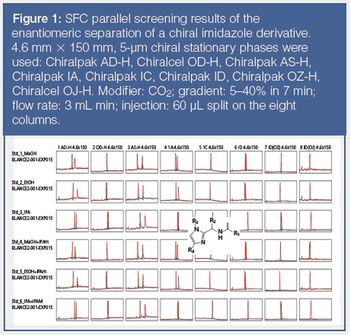
Recent progress in supercritical fluid chromatography (SFC) instrumentation has led to renewed interest in the technique as a powerful tool for chiral and achiral separations of pharmaceutical molecules, for both analytical and preparative purposes. The “green” aspect of the technique and low running costs make SFC technology particularly attractive for preparative chromatography because it considerably reduces the consumption of organic solvents. These factors led to a revised strategy for purification and to a general interest in evaluating possible extensions for the application of packed SFC (pSFC). The results of this extensive evaluation have led to the establishment of SFC platforms for preparative achiral purifications as a standard practice, alongside its use for preparative chiral separations.
LCGC Europe
What should you do if your retention times drop from one injection to the next? A systematic approach to troubleshooting can help to quickly identify the problem source.
LCGC Europe
The 40th International Symposium in Capillary Chromatography (ISCC) and 13th GC×GC Symposium will be held at the Palazzo dei Congressi, in Riva del Garda, Italy, from 29 May–3 June 2016.
LCGC Europe
Our annual review of new liquid chromatography (LC) columns and accessories introduced at Pittcon and throughout the previous year.
LCGC Europe eNews
Analytica 2016 Thursday Afternoon Sessions
E-Separation Solutions
A team of researchers from the State Laboratory of Chemo/Biosensing and Chemometrics in China has developed a novel high performance liquid chromatography-diode array detection (HPLC-DAD) method for the identification of six synthetic colours in five beverages.

The Column
Jean-Luc Veuthey and Alexandre Grand-Guillaume-Perrenoud reveal the latest developments in supercritical fluid chromatography (SFC) that are bringing the technique back to the limelight.

I often get asked about the other important aspects of “screening” in HPLC, which include the mobile phase composition, gradient parameters and flow rate – so that’s the theme of this installment.
The Column
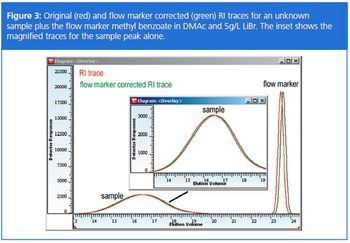
Experienced gel permeation chromatography/size-exclusion chromatography (GPC/SEC) users know that equilibration of the columns takes much longer than the time needed by the pump to produce a constant flow. An analysis in this phase would clearly yield different results from those achieved after complete equilibration of GPC/SEC columns. Furthermore, false but constant flow rates affect the molar masses derived from a GPC/SEC calibration curve. An internal flow marker can help to increase reproducibility and accuracy of GPC/SEC results.

Trajan Scientific (Melbourne, Australia), which develops medical devices as well as analytical systems such as gas and liquid chromatography columns and sample preparation systems, has acquired the business of LEAP Technologies (Carrboro, North Carolina).

The Column
A team of researchers has developed a high‑throughput analysis method for 192 diverse pesticides and 51 environmental contaminants in cattle, swine, and poultry meats. The team used a combination of low-pressure gas chromatography coupled to tandem mass spectrometry (LP)GC–MS–MS and ultrahigh-pressure liquid chromatography coupled to tandem MS in the analysis.

The Column
Researchers from the Joint Research Centre of the European Commission have published a case study detailing the characterization of new psychoactive substances using gas chromatography–mass spectrometry, nuclear magnetic resonance, high‑resolution tandem mass-spectrometry, and Raman spectroscopy.
The Column
Click the title above to open The Column April 11, 2016 North American issue, Volume 12, Number 6, in an interactive PDF format.

The Column
Incognito ponders what it takes to be a “good” analytical chemist. Do you make the grade?