






LCGC North America
In his annual installment, John Hinshaw takes a look at the new gas chromatography instruments and accessories that were on display at Pittcon this year.
LCGC North America
In his annual installment, John Hinshaw takes a look at the new gas chromatography instruments and accessories that were on display at Pittcon this year.

LCGC North America
Guest columnist Walter Jennings reflects on the early days of capillary gas chromatography (GC) and how chromatographers become experts in the technology by constructing their own columns, thereby achieving a more thorough understanding of the chromatographic process.

LCGC Europe
This article looks at current practices in bioanalytical chemistry by examining and critically assessing the various parameters that can be altered to achieve high-speed results with high resolution in LC–MS applications. The decision to opt for gradient or isocratic elution is also discussed.

LCGC Europe
Overall FID sensitivity depends upon the combustion gas flow-rates, the carrier-gas flow-rate, the flame jet exit diameter, the relative positions of jet and collector and, to a lesser degree, the detector temperature.

LCGC North America
This month's installment of "Column Watch" is the conclusion of a two part series in which Ron Majors examines the trends in columns and sample preparation at Pittcon 2006.

LCGC North America
In part I of a two-part series, the author introduces several methods to reduce error in your chromatographic analyses.

E-Separation Solutions
Exciting new uses for gas chromatography and its hyphenated forms show that there is an uncharted territory of applications and that there are limitations that still need to be overcome. The Tuesday afternoon oral session at Pittcon 2006, "GC-MS: Developments and Applications," gave the audience an idea of advances in GC and some new areas for the technique's application. John Chalmers of VS Consulting (Stokesley, United Kingdom) presided over the session.

E-Separation Solutions
At a session entitled "Atomic Emission Detection for Gas Chromatography," several speakers discussed applications of coupling gas chromatography and atomic emission detection (GC-AED).

LCGC North America
This month's installment of "Column Watch" is the first of a two-part series in which Ron Majors examines the trends and highlights in columns and consumables at Pittcon 2006.

LCGC Europe
Capillary gas chromatography (GC) is a well-established separation technique. Rick Parmely reviews some of the capillary column basics by investigating a standard test mixture and observing some of the chromatographic effects that can affect peak response, peak shape and column bleed. He provides guidelines for obtaining the best performance from a capillary column. He discusses peak tailing, column overload, ghost peaks and column bleed and speculates on "when to give up." He concludes with a set of fundamental steps to be used in achieving better GC analyses.

LCGC North America
In this month's edition, John Hinshaw takes a look at how choosing a suitable syringe for a specific application can be difficult, especially if the inlet system has special requirements; choosing the wrong syringe ca cause significant problems.

LCGC Europe
Part 2 of the column explores using the right balance for the right job in the right way.

LCGC Europe
It would help to have a restricted set of chromatographic systems (CS) that together serve as potential starting points in method development.
LCGC North America
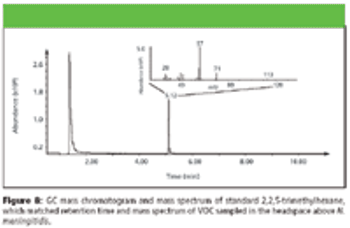
A method for the identification of key volatile organic compound (VOC) markers associated with infection by Neisseria meningitidis bacteria by gas chromatography–mass spectrometry (GC–MS) was developed. Headspace samples of bacterial VOCs were trapped on triple-sorbent bed tubes and then thermally desorbed into a laboratory GC–MS system for separation. Identification was carried out by comparison of GC retention time and electron ionization mass spectra to the National Institute of Standards and Technology (NIST) database. Further confirmation was obtained by GC–MS of known standard chemicals. A total of 75 VOCs were detected, five of which can be considered key VOC markers for Neisseria meningitidis. These peaks were identified as 1,2-dimethylcyclopropane, 2-methylpropanal, methacrolein, N-2-dimethyl-1-propanamine, and 3-methylbutanal by the NIST database.
LCGC Europe
There are three basic types of silica glass that have been used for capillary columns: sodium, borosilicate and fused silica.

LCGC Europe
Direct coupling of SFE with GC has advantages over the off-line alternative.

LCGC North America
Flame ionization detection (FID) is the most commonly used gas chromatography (GC) detection method. Flame ionization detectors respond to a wide assortment of hydrocarbons, have a large dynamic range, are...

LCGC North America
guest Columnist Rick Parmely takes a look at some capillary column basics of a well-established separation technique. He discusses peak tailing, column overload, ghost peaks, and column bleed, and speculates on "when to give up."

LCGC Europe
In January 2004, LCGC Europe published an article on methods for selecting pure gases for analytical applications. 1 Here, the authors expand on this topic by addressing questions regarding gas mixtures - defined simply as more than one gas in a cylinder.

LCGC Europe
Analytical chemists are concerned with the quality of their methods and results. An important question in this context is whether the precision of a newly developed and validated method is up to standard. In other words: is the precision of the newly developed method comparable to what could be expected? This article looks at how the Horwitz equation can answer this. It also describes the results of an extensive study involving 10000 laboratories which indicates that the relative reproducibility approximately doubles for every 100-fold decrease in concentration and that, surprisingly, it does not depend on the type of material or method.

LCGC North America
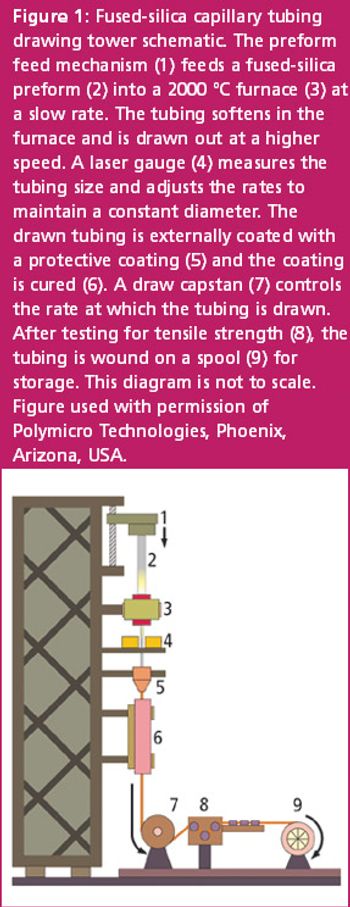
In this installment of "GC Connections," the author reviews some of the developments infused-silica solumn technology and then takes a brief tour through the process of column manufacturing.

LCGC Europe
The implementation and validation of a new site-wide chromatography data system for a major active pharmaceutical ingredient custom manufacturer provided the opportunity to map and optimize the GMP and ISO business processes to use electronic signatures effectively. This article describes the process optimization and how it integrates with the validation activities of the system. This overall approach provides substantial business benefits from the use of electronic signatures as evidenced by the savings resulting from process improvement and by the fact that the non-GMP laboratories implemented a similar process to analyse and approve results electronically.
LCGC North America
There is a great deal of confusion floating about when it comes to selecting gas mixtures for analytical applications. Questions such as "How is the gas certified?," "What standard should I use?," and "What level of uncertainty is acceptable?" are common concerns heard among those tasked with specifying and using mixtures. In addition, the uncertainty regarding terminology, measurement, safety, and storage can make specifying mixtures a true source of headaches and hassles for any lab manager. The following article provides answers to questions about gas mixtures.

LCGC Europe
The trend towards dedicated analytical solutions continues to gain momentum while what might have been considered high performance instrumentation a few years ago are increasingly being viewed as routine techniques.

LCGC Europe
The instrument is "a splendid example of automatic analysis."