Gas Chromatography (GC)

Latest News


The Victoria Advocate (Victoria, TX) published an article about the random testing of high school student-athletes in the Texas public school system. The article is entitled "No Steroid Test is Foolproof" and focuses on the process of drug testing using gas chromatography-mass spectroscopy (GC-MS).

i4-457022-1408662758582.jpg

In addition to the universal detectors used in gas chromatography (GC), selective detectors have also played an important role in the rapid spreading of the utilization of the technique. Probably the most important selective GC detector is the electron-capture detector, with a very high sensitivity to organic compounds containing chlorine and fluorine atoms in their molecules. The electron-capture detector had a vital role in environmental protection and control - its use helped to prove the ubiquitous presence of chlorinated pesticides in nature and halocarbons in our atmosphere, and made us aware of the global extent of pollution. It was the electron-capture detector that made concentration ranges of parts-per-billion (ppb: 1:109) or even parts-per-trillion (ppt: 1:1012) detectable. Today, these terms are used routinely without realising how formidable such a sensitivity really is: 1 ppb means that a spaceship (or a UFO, depending upon one's inclination) could pick up a particular family of six from..

i4-457019-1408662773642.jpg

Size-exclusion chromatography (SEC) and pyrolysis-gas chromatography (Py-GC) are commonly used to characterize copolymers. SEC is a powerful method to determine the molecular-weight distribution of polymers whereas Py-GC provides valuable information on their chemical composition. The combination of these two techniques could yield combined size and composition information for copolymers or polymer mixtures. A fully automated system was constructed to perform these two-dimensional (2D) characterizations. Several examples of the use of this new technique to comprehensively characterize polymers are described.

i3_t-454548-1408665164967.jpg

This month's installment of "GC Connections" discusses factors that can help determine which type of liquid injection technique is appropriate for specific samples, including having to use existing inlet systems that are on-hand in the laboratory with samples for which they might not be ideally suited.

john_hinshaw_390x190_flash-491838-1408677169585.jpg

This month's installment of "GC Connections" discusses factors that can help determine which type of liquid injection technique is appropriate for specific samples, including having to use existing inlet systems that are on-hand in the laboratory with samples for which they might not be ideally suited.

Brazilian scientists have teamed to use gas chromatography (GC) and electron-capture detection (ECD) for the testing of wastewater.

As part of a new method developed by researchers from The Nisshin OilliO Group, Ltd., analysis of trans-fatty acids was completed in 20 minutes for non-hydrogenated oils and just 40 minutes for hydrogenated oils.

In an article recently published in Rapid Communications in Mass Spectrometry, researchers developed an application to show that an N, C, and S measurement system allows a three-dimensional view of element dynamics in estuarine systems that are undergoing pollution inputs from upstream watersheds.

In an article recently published in the British Journal of Nutrition, researchers used gas chromatography to determine the fatty acid concentrations of plasma phosphatidylcholine, triacylglycerol, NEFA and cholesteryl esters to test the hypothesis that gender-related differences in n-3 PUFA metabolism are reflected in the concentrations of n-3 PUFA in plasma lipids.

i8_t-447627-1416913670225.jpg

Triclosan is an ubiquitous antibacterial, antimicrobial chemical found in numerous consumer health care products today. This article demonstrates that triclosan can be quantitatively determined in commercial hand soaps using reversed-phase solid-phase disk extraction coupled to quantification using capillary gas chromatography-atomic emission detection while avoiding emulsions.

Phenomenex, Inc., a global leader in the separation sciences business, has been notified by R&D Magazine that it has won the coveted R&D 100 Award for the second year in a row.

i1-439746-1408654825228.jpg

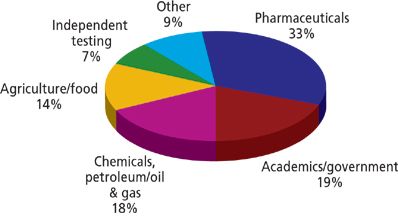
The volatile extraction market consists of three techniques: purge and trap, headspace, and thermal desorption equipment. These systems are often employed as a sampling method for gas chromatography (GC) instrumentation but are also used with IR detectors, electrochemical sensors of electronic noses, and mass spectrometers.

The laboratory life science and analytical instrument industry is comprised of a large, diverse group of organizations that manufacture and distribute their products worldwide. However, overall industry sales are concentrated among a small set of companies. Approximately 950 firms are included in the industry, but only about 100 companies have sales above $50 million.