

The Column
GC–MS Analysis of Aroma Compounds in Edible Oils by Direct Thermal Desorption
The Column
GC–MS Analysis of Aroma Compounds in Edible Oils by Direct Thermal Desorption

Special Issues
To translate the enormous potential of MS into meaningful, actionable, and safe test results in the specific setting of a clinical laboratory is a very substantial challenge. It is essential to realize that reliability is not inherent to this technology but must be addressed carefully and questioned systematically.

LCGC North America
We have developed a miniaturized, multifunctional device, called the "Single-Probe," that is capable of probing small targets and of sampling and ionizing molecular species.
Special Issues
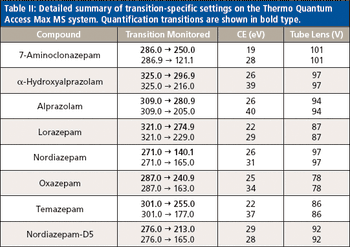
A new method was developed and validated using automated on-line solid-phase extraction (SPE) with tandem mass spectrometry (MS). Urine samples were enzyme-hydrolyzed and diluted before detection. The validated method was applied to positive authentic urine samples to evaluate concordance with high performance liquid chromatography (HPLC)–MS-MS results.

Special Issues
An important attribute of a novel ionization process for use in mass spectrometry (MS) is its simplicity and flexibility to be hyphenated to conventional liquid-based separation methods.

Special Issues
The main objective of this study was to evaluate the capabilities of gas chromatography (GC) with time-of-flight mass spectrometry (MS) for screening pesticides in fruits and vegetables using a purpose-built accurate-mass database.

Special Issues
Digital waveform technology is emerging as a powerful tool in mass spectrometry (MS). Digital quadrupoles rely on precise control of frequency rather than voltage, which allows these devices to access a greatly extended mass range

Special Issues
Bryan Vining from SGS Environmental Service in Wilmington, North Carolina, reveals some of the cutting-edge research his team has performed involving dioxin analysis, and proposes some future possibilities for the direction of this field.

Special Issues
Marijuana, the common or slang term for cannabis in its herbal form, is one of the most widely used illicit drugs in the world.

LCGC Europe
The use of a mass spectrometer in quantitative analysis exploits its exquisite selectivity and sensitivity as a detector, allowing a signal to be ascribed to a particular chemical entity with high certainty, even when present in a sample at a low concentration. There are, however, some special considerations that are necessary when a mass spectrometer is used as a quantitative tool.
Special Issues
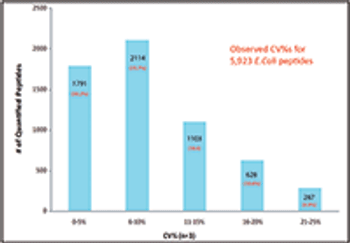
This article describes the development of a new data-independent acquisition (DIA) workflow for protein quantification that uses a mass spectrometer that combines three types of mass analyzers to achieve lower limits of detection (LOD), higher sensitivity, more accurate quantitative results, wider dynamic range, and better reproducibility than existing high-resolution accurate-mass (HRAM) tandem mass spectrometry (MS-MS) DIA workflows.
Special Issues
Worldwide trends in illicit drug use and production have shifted toward an increase in synthetic analogues and the emergence of new variations in their manufacture.

Special Issues
A multiresidue method has been developed and validated for the analysis of methylxanthines (caffeine and its metabolites) and cotinine in human plasma.

Special Issues
In most countries, herbal medicinal products (HMPs) are introduced into the market without proper scientific evaluation or enforced safety and toxicological studies.

Special Issues
Direct sample analysis coupled to high-resolution time-of-flight mass spectrometry (TOF-MS) may be effective at analyzing synthetic cathinones, especially for qualitative analysis, because it does not require potentially tedious sample preparation.

Special Issues
Military jet fuel (JP-8) is very similar to commercial jet fuel (Jet A) except for the presence of three additives, fuel system icing inhibitor, corrosion inhibitor–lubricity improver (CI-LI), and antistatic additive, which are added to improve characteristics of JP-8.
Special Issues
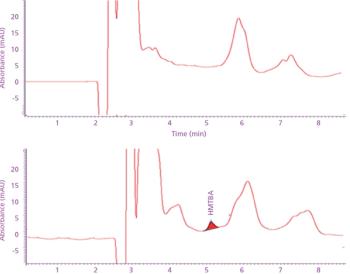
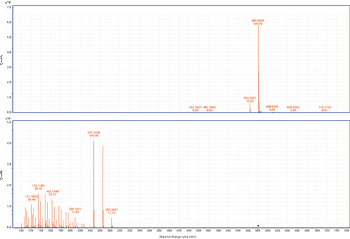
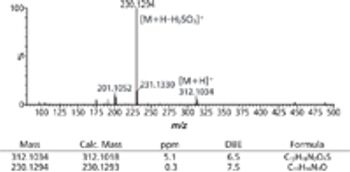
Simple, sensitive, rapid, selective, and precise reversed-phase liquid chromatography (LC), electrospray ionization mass spectrometry (ESI-MS), and tandem MS (ESI-MS-MS) methods were developed and validated for the determination of 2-hydroxy-4-(methylthio)-butanoic acid (HMTBA) in bovine serum and sea water matrix. HMTBA is the ?-hydroxy analog of the sulfur-containing amino acid methionine and is extensively used as a methionine supplement in poultry and bovine feed.
Special Issues
Canola largely contains unsaturated fatty acids, thus rendering it clear in most cases after extraction and refining.

Special Issues
In this article, we examine how tandem and tandem hybrid mass spectrometry has opened up new frontiers already. We go further and examine how lesser-known experiments are breaking new ground, with alternative fragmentation techniques, as well as the addition of extra levels of orthogonality by parallel separations techniques.

Special Issues
Native mass spectrometry, the method by which noncovalent protein complexes are retained in the gas phase for intact mass analysis, is gaining interest as a method for intact protein characterization. The development of a modified orbital ion trap platform for high-resolution analyses has expanded the role of native mass spectrometry to address the challenges of intact protein characterization.

Special Issues
The identification of nontargeted species in environmental and commercial samples by mass spectrometry can be very difficult. In this article, authors from Eastman Chemical Company describe their systematic approach for the identification of nontargeted species using nominal and accurate mass data, searching both mass spectral and "spectra-less" databases.

Special Issues
Ionization of small, large, volatile, and nonvolatile compounds with charge states nearly identical to electrospray ionization are produced from a solid matrix or solution with high sensitivity utilizing the vacuum inherent with any mass spectrometer. With the proper matrix, analytes can be analyzed from ambient conditions or by direct introduction into vacuum.
Special Issues
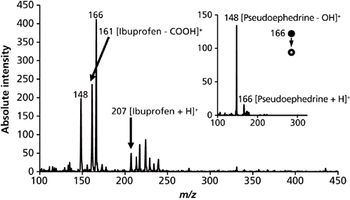
The production and sale of counterfeit drugs has risen sharply in recent years. The World Health Organization (WHO) estimates that counterfeit medicines account for approximately 1% of sales in developed countries and well over 10% in developing countries.
Special Issues
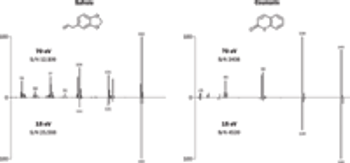
Despite the advantages of soft ionization ion-source technologies for improving confidence in the identification of a range of challenging analytes, soft ionization remains a niche technique for gas chromatography–mass spectrometry (GC–MS).

Special Issues
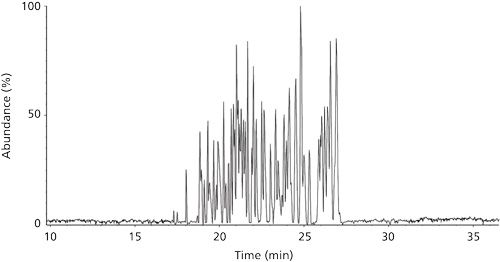
Here, a method to characterize edible oils and edible oil mixtures through fingerprinting and the isolation of individual analyte differences is reported. Aroma and flavor analytes in extra virgin olive, olive, peanut, grapeseed, and vegetable oils were sampled with headspace solid-phase microextraction (HS-SPME).