


Special Issues
This article describes how a food testing laboratory can transition routine high performance liquid chromatography (HPLC) methods to microflow LC for improved sensitivity, throughput, and robustness of analysis.
Special Issues
This article describes how a food testing laboratory can transition routine high performance liquid chromatography (HPLC) methods to microflow LC for improved sensitivity, throughput, and robustness of analysis.

Special Issues
A study of pharmaceuticals and personal care products in river water samples is presented from northeastern United States using ultrahigh-pressure liquid chromatography (UHPLC) coupled with TOF-MS for both targeted and nontargeted analytes

Special Issues
This article examines the various effects of phospholipids in liquid chromatography tandem mass spectrometry (LC–MS-MS) analysis and demonstrates a new phospholipid-removal approach.

LCGC Europe
This instalment provides a brief overview of some multidimensional approaches targeted at intact protein analysis for life science applications, particularly for biopharmaceutical analysis.
Special Issues
This article reports on the isolation, purification, and characterization of phorbol esters in Jatropha curcas seeds.

Special Issues
Here, the process to build an accurate mass database is thoroughly described and applications are commented on.
Special Issues
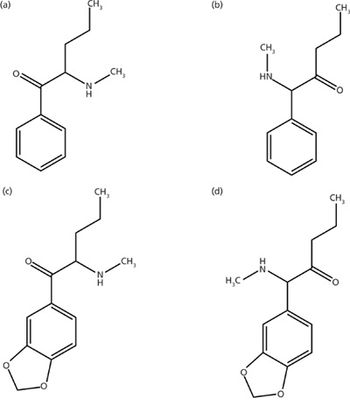
Gas chromatography–mass spectrometry (GC–MS) and liquid chromatography–mass spectrometry (LC–MS) techniques offer advantages in separating and confirming the identity of constituents in novel psychoactive substances.
Special Issues
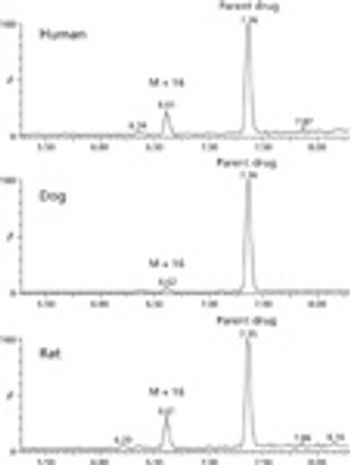
Accurate-mass approaches offer a significant advance over nominal-mass approaches in the arena of qualitative analysis, and some of the analytical approaches can now be conducted in a relatively routine manner.

Special Issues
A study of colony collapse disorder in honey bees illustrates how mass spectrometry–based proteomics techniques can be used to to identify pathogens without any prior knowledge of what is contained in the sample.
Special Issues
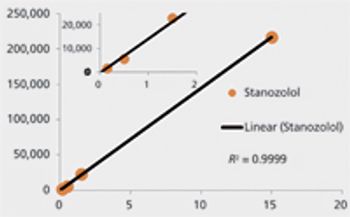
A proof-of-concept application for detecting abused steroids in urine samples collected from an antidoping surveillance program
Special Issues
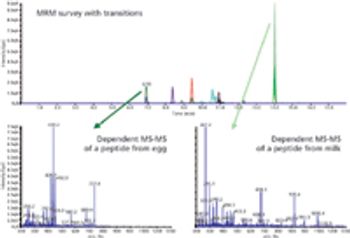
An update on the sample preparation and LC–MS-MS tools available for allergen detection, as well advantages of those techniques.
![Huck_Fig 2-[41825010]-{584590}_t-746305-1408610899253.gif](https://cdn.sanity.io/images/0vv8moc6/chroma/f6261c79607ac53f41c790ed011e5b2e0d4f0626-200x140.gif?w=350&fit=crop&auto=format)
Special Issues
A summary of the most recent advances in sample preparation, instrumentation, and data-processing techniques for MALDI-IMS
![Roy figure 5-[41827930]-{585410}-746304-1416911904998.gif](https://cdn.sanity.io/images/0vv8moc6/chroma/5e8a7a8b42be4c1287e42a9e19c61a898804cfe5-700x592.gif?w=350&fit=crop&auto=format)
Special Issues
A discussion of active pharmaceutical ingredient (API) selection, drug product development, and mass spectrometry instrumentation
![Schug_Fig 3-[41827280]-{641210}_t-746310-1408610889870.jpg](https://cdn.sanity.io/images/0vv8moc6/chroma/6da0479f1e71c57976064cc832407ebe8e770158-200x104.jpg?w=350&fit=crop&auto=format)
Special Issues
A review highlighting the combination, or potential combination, of various separation methods with ambient ionization mass spectrometry
![Heinle Figure 1-[41825860]-{582380}_t-746308-1408610893731.gif](https://cdn.sanity.io/images/0vv8moc6/chroma/309898def0ba4426d4cd28df126a523915eb3959-200x103.gif?w=350&fit=crop&auto=format)
Special Issues
How to create a liquid chromatography–tandem mass spectrometry (LC–MS-MS) system using mass spectrometers, a high performance liquid chromatography (HPLC) binary pump system, and an autosampler

Special Issues
A breakthrough using a microfluidic interface to conduct sensitive time-of-flight secondary ion mass spectrometry (TOF-SIMS) analysis and study liquid surfaces in situ under vacuum conditions is described here.

Special Issues
A critical look into the future of imaging mass spectrometry is made by addressing some of the fundamental and technical challenges that still need to be overcome.

Special Issues
A method is illustrated for the simultaneous analysis of ethyl glucuronide and ethyl sulfate in human urine samples.
Special Issues
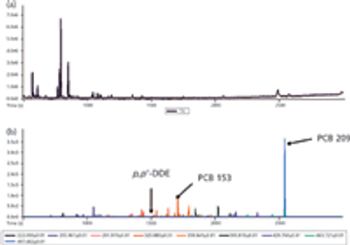
The combination of GC with time-of-flight (TOF)-MS proves to be a successful approach for the challenging analysis of persistent organic pollutants in complex matrices such as sediment and fish samples.

Special Issues
This study illustrates the versatility of a laser-induced acoustic desorption (LIAD) approach for volatilization of analytes in modern mass spectrometry.
Special Issues
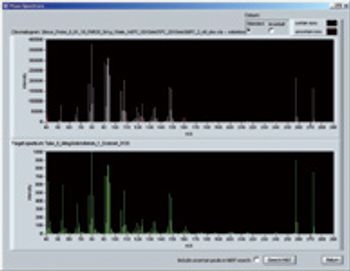
High-definition screening by gas chromatography–mass spectrometry (GC–MS) is shown to be a viable option for the reliable identification of odorous compounds in pork.
Special Issues
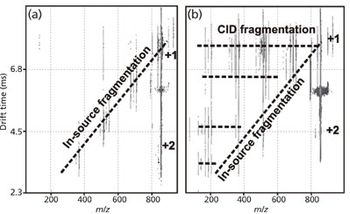
Ion mobility–mass spectrometry (IM-MS) is outlined as a separations method, several examples of the utility of IM-MS for complex biological measurements are illustrated, and the implications of this approach for systems biology research are discussed.

LCGC North America
Identifying unknown compounds continues to challenge analysts.

LCGC North America
On the 50th anniversary of the invention of the laser, Michael Balogh examines its importance in MS practice.
LCGC North America
In mass spectrometry, the electrospray ionization technique quickly earned its place among the primary analytical tools. Yet it is not always the best tool for the job.