Mass Spectrometry

Latest News


Betowski-figures-1_web-New-1494360249808.jpg

With computational chemistry, chemists can now study chemical phenomena by performing computationally intense calculations on computers rather than examining reactions and compounds experimentally. This is especially attractive when the laboratory experiments are time consuming, costly, dangerous, or difficult. Modern computational chemistry tools are capable of determining molecular structures, molecular spectra, and energetics, and of elucidating reaction pathways and chemical reaction products.

Figure-1_WEB-New-1494360817891.jpg

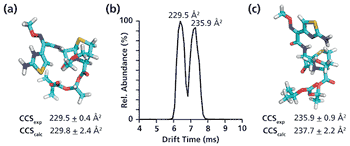
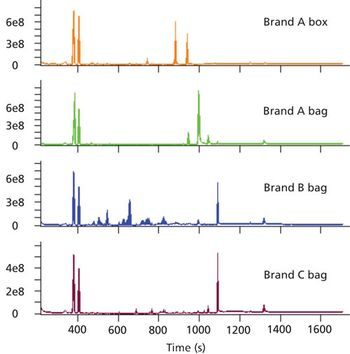
The analysis of oil samples containing many thousands of constituents best illustrates the benefits of ion mobility MS for complex samples. Here, we test the limits of ion mobility MS to discern differences between batches of Copaxone, a highly complex drug containing billions of peptides, and various purported generic versions of the drug.

Figure-1_web-3-New-1494359973240.jpg

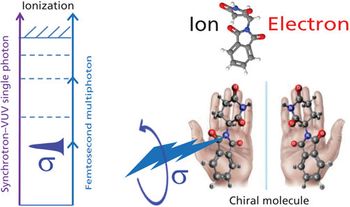
Simultaneous, enantiomer-specific identification of chiral molecules in multicomponent mixtures is extremely challenging. With mass-selected photoelectron circular dichroism (MS-PECD) using an electron–ion coincidence imaging spectrometer, a compound can be identified as chiral without the need for any prior enantiomeric separation or enantiomer-selective complexation.

Marzilli-fig05_web-New-1490041921662.jpg

A new peptide mapping method was developed specifically for mAb characterization that employs optimal enzyme pH for robustness, but with short digestion times and time-course elements to minimize and monitor deamidation–isomerization, respectively, enabling a more accurate assessment of potential CDR sequence liabilities.

Figure-3_web-1-New-1490208518785.jpg

With this method, a single injection was sufficient to characterize the amino acid sequence with complete sequence coverage. In addition, glycosylation and drug-loaded peptides could be identified from MS/MS spectra. A drug-loaded peptide fragmentation mass spectra study yielded drug-specific fragments, which reinforced the confidence about the identifications. The results reveal the ability of the sheathless CZE–MS/MS method to characterize an ADC’s primary structure in a single experiment.

The isotopic profile of a material refers to the ratios of the stable isotopes of elements contained within, such as 2H/1H, 13C/12C, and 18O/16O. Biological, chemical, and physical processes cause variations in the ratios of stable isotopes; analysis of a material for its distinctive isotopic signature can thus be used to reveal information about its history. Isotope ratio mass spectrometry (IRMS) is a technique used to measure the relative abundance of isotopes in materials. Forensic investigators have used IRMS to measure a variety of materials, such as drugs, explosives, food, and human remains. In a recent web seminar, Lesley Chesson, the president of IsoForensics, Inc., explained how IRMS works and discussed the use of IRMS in forensic science, illustrating her discussion with several case examples.

West-Part-4-Figure-1_web.jpg

Part IV of this series takes a closer look at clustering. Clustering can be very useful at observing your data when the sample dimensionality is large. This is a barbarian term meaning that diversity among your samples may be wide. In that case, the space reduction provided by principal component analysis (PCA) is not always convincing, because the simplification provided by a single two-dimensional plot erases too much information. Clustering allows you to preserve more information.

Aldeek-figures-1_web.jpg

In recent years, Huanglongbing (HLB), or citrus greening disease, has devastated citrus crops throughout the world. Penicillin G has been used to treat HLB infected trees with promising results. However, the metabolites produced from the degradation of penicillin G are known to cause potentially life-threatening allergic reactions; therefore, the concentration and presence of the metabolites must be carefully monitored. We have built and revised an analytical method based on Ultra High Performance Liquid Chromatography in combination with Tandem Mass Spectrometry (UHPLC-MS/MS) in order to identify and quantitate penicillin G and its major metabolites, penillic acid and penilloic acid, in citrus fruit and juice. Here, we discuss the chromatographic conditions and revisions that improved the precision and accuracy of our measurements.

Hattan-fig05-web-New-1477414388389.jpg

This MS-based method represents a simple, fast, and attractive alternative to current immunoassay-based methods for the quantitation of albumin and creatinine in urine. This protocol enables the direct detection and measurement of the intact analytes from the same sample preparation, requiring only a 10-fold dilution of a urine sample into a MALDI-TOF matrix solution.

LECO-fig04-web-large-New-1477414765133.jpg

A gas chromatography–time-of-flight mass spectrometry method was developed to screen for and quantify regulated allergens in approximately 5 min. This method used a short and narrow chromatographic column along with mathematical deconvolution of the TOF-MS data to separate the target allergens from each other in the standards and from matrix interference in samples.

Table I continued small-New-1477415053632.jpg

This study demonstrates that GC–TOF-MS can be a useful approach to generate comprehensive fragrance profiles of essential oils. Peak deconvolution enables discrimination between closely eluted compounds, and soft electron ionization, assisted by comparison of ion ratios, makes it possible to discriminate between isomeric monoterpenes with very similar mass spectra at conventional 70-eV ionization energies.

Prenni-Figure-3-web-New-1477415405277.jpg

The power of nontargeted metabolite profiling is illustrated in a study focused on the determination of molecular markers in malting barley that are predictive of desirable malting quality for brewing applications. The metabolite extraction, detection, and analysis methods are high throughput and reproducible, and therefore, this approach represents a practical addition to the plant breeder’s molecular toolbox.

In this article, we discuss the use of CE-MS (sheath flow interface) for analysis of intact proteins as well as of protein digests. We discuss the unique aspects that the user needs to be aware of while testing biotherapeutics versus small molecule drugs. We also highlight that the optimization of CE and MS parameters together result in the creation of a more robust and reproducible protein analysis approach. Finally, we list some of the most common errors that are likely to occur during CE-MS analysis and suggest ways to overcome them.

figure 1 L.jpg

In clinical and forensic/toxicology laboratories, urine is a preferred matrix from which to quantify drug concentrations because it yields accurate results and allows for noninvasive collection methods. Prior to excretion, drug metabolites in the body undergo a glucuronidation reaction, resulting in a glucuronide bond that must be cleaved before mass spectrometry (MS) analysis by a β-glucuronidase enzyme hydrolysis. Many laboratories employ a “dilute-and-shoot” method after hydrolysis to decrease residual protein or enzyme concentration, but this method negatively affects column lifetime and reduces the sensitivity of analyte detection. By using a β-glucuronidase removal approach, analysts are able to see an increase in sensitivity and a reduction in MS instrument maintenance.

While immunoassay (EIA) is a prevalent screening technique it is also prone to issues such as high false positive rates because of lack of analyte specificity. Mass spectrometry was therefore investigated as an alternative screening technique for the ability to improve analyte specificity on a comparable time scale. In this study, a rapid online sample preparation and injection method was developed using a commercially available guard cartridge on a conventional LC–MS-MS system. Using a two-point calibration curve to provide semi-quantitation, a robust method was developed and validated that improved upon the high false positive rate observed in immunoassay screening.

Table3-web-2-New-1468852395103.jpg

A look at the use of field-portable GC–MS with solid-phase microextraction, purge-and-trap, thermal desorption, and heated headspace sampling techniques to provide a fast response for in-field analysis of SVOCs in a wide variety of environmental-type samples including potable waters, tea, plants, and road gravel.

Trimpin-figure08-web-New-1463427909110.jpg