


A reluctance to make any changes to a validated or compendial method is common, and often well founded.

A reluctance to make any changes to a validated or compendial method is common, and often well founded.

Excess variability is not acceptable in a pharmaceutical method.

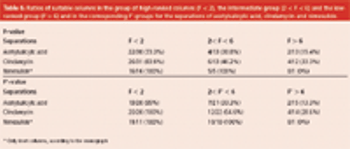
This article gives an overview of the performance of a previously developed system for the ranking of C18 reversed-phase columns applied to different pharmaceutical analyses. The separation of eight different drug substances from their respective impurities was studied. The chromatographic procedure for acetylsalicylic acid, clindamycin hydrochloride, buflomedil hydrochloride, chloramphenicol sodium succinate, phenoxymethylpenicillin and nimesulide was performed according to the corresponding European Pharmacopoeia monograph. The separations of dihydrostreptomycin sulphate and vancomycin were performed according to literature. It was found that that the column ranking system is a helpful tool in the selection of suitable columns in these analyses.


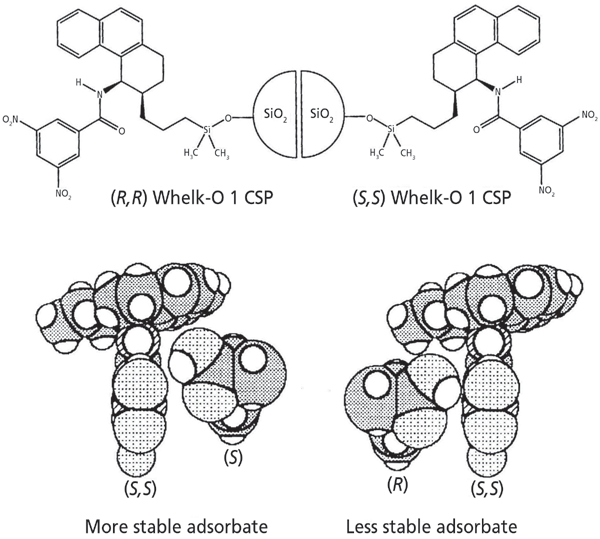
Measurement of chiral purity is a necessary means of quality control for drug substances that exhibit chiral centers. This article describes a simple and practical approach to setting up system suitability and validation for chiral purity assays.

Dissolution testing is a mandatory test for the physical evaluation of solid dosage forms such as capsules, tablets, ointments, and creams. The most basic form of testing measures the rate of dissolution or solubility of a drug tablet. Dissolution testing also can be used in ADME and bioavailability studies, release rates of a drug substance under different conditions, as well as provide information as to the efficacy of in-vivo performance.

September 2006. Top-down and bottom-up are alternative strategies for protein identification and characterization by mass spectrometry. How do they fit into the world of proteomics? What are their implications for separation technology? These questions are addressed in this installment of "Directions in Discovery."

The market for high performance liquid chromatography (HPLC) continues to be one of the most dynamic markets of the analytical instruments industry. A few years ago, the HPLC market began showing signs of maturity with little product innovation and slower growth rates. Although innovations in mass spectrometry (MS) helped to fuel growth, HPLC was an afterthought and considered to be a mere inlet to MS. However, the recent development of fast liquid chromatography (LC) systems is energizing the HPLC market.

The authors work to develop a universal high performance liquid chromatography method that is capable of simultaneously retaining and separating both cations and anions within a single chromatographic analysis for the purpose of quantification in pharmaceutical products.

Implementation of the EU Directive proves to be challenging as regulatory variations among member states continue and questions remain unanswered.

In the clinical trials arena, integrated software solutions help life science companies meet ever more stringent compliance challenges.

Two experts in the GCP field answer common questions about clinical trials and regulatory compliance.

At the same time the pharmaceutical industry faces new and complex issues with the drug development process and clinical trial environment, regulatory policies are increasing and adding to the burden of cost and time to market.

Safety and ethical concerns generate additional reporting and disclosure policies despite efforts to streamline research requirements.

Globally, 2005 sales of pharmaceuticals have been estimated at approximately $550 billion. A significant fraction of this amount was due to the top pharmaceutical companies in the world. The top five companies alone were responsible for total revenues of $168 billion, or 30% of the entire market.

This is the second installment of a two-part series on the practical aspects of configuring and operating a nano liquid chromatography-mass spectrometry (LC-MS) system.

The first of a two-part series addresses HPLC pumps, sample introduction systems, and columns for nanoLC-MS.

A more practical parameter for system suitability would be to use the peak width for a reference peak...


The authors explain why sample diluent is more than just a solubilizing agent and describe a systematic process for diluent selection when developing an HPLC assay of an active pharmaceeutical ingredient.

Almost 40 years have passed since the concept of capillary electrophoresis (CE) was described by Hjertén (1) in 1967. It emerged as a viable analytical technique after the pioneering work of Jorgenson (2) in the early 1980s, and commercial instruments were first introduced at the end of that decade. It is appropriate at this time to survey the history of CE and to judge its success in the world of analytical instrumentation.

process is interesting and involved, and in this month's installment of "MS - The Practical Art," Michael Balogh continues the Profiles in Practice series by exploring this topic with featured scientists Michele Kelly and Mark Kershaw.

LC-MS monitoring of the drug clozapine is detailed along with a description of the overall system architecture, workflow, and maintenance routines that spport a large-scale drug monitoring program.

Hyaluronic acid (HA) is a naturally occurring, unbranched polysaccharide that consists of alternately repeating D-glucuronic acid and N-acetylglucosamine units. This biopolymer is present throughout all mammalian systems but occurs primarily in synovial (joint) fluid, vitreous humor, and various loose connective tissues (such as rooster comb) (1). HA is of enormous commercial interest for ophthalmic, medical, pharmacological, and cosmetic applications.