
A method using HR-MS systems to characterize the structures of metabolites is presented. The result is a general workflow for metabolism studies in drug discovery and development.

A method using HR-MS systems to characterize the structures of metabolites is presented. The result is a general workflow for metabolism studies in drug discovery and development.

Click here to view the complete E-Separation Solutions newsletter from August 22, 2013.

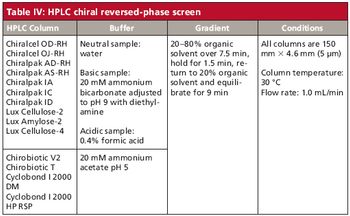
A set of extended chiral separation screens using HPLC and SFC has been tailored to meet the specific and changing needs of customers in a pharmaceutical development setting.

HPLC method development can be accelerated by using three distinct method templates of increasing complexity.

Pharmaceutical Analysis Technology Forum

Click here to view the complete E-Separation Solutions newsletter from May 23, 2013.

This article highlights some selected examples of the power of liquid chromatography combined with mass spectrometry (LC–MS) in the development of protein biopharmaceuticals.

The determination of genotoxic impurities (GIs) in drug substances and pharmaceutical products is an emerging topic in pharmaceutical quality control. GIs are intermediates or reactants in the synthetic pathway of a drug substance and should be monitored at ppm (?g/g drug substance) or even ppb (ng/g) levels. This is several orders of magnitude lower than in classical impurity analysis (0.05% or 500 ppm level) or in residual solvent analysis. Analytical methods for the determination of GIs include gas chromatography (GC) and liquid chromatography (LC), both often combined with mass spectrometry (MS) detection. Some typical examples of GIs trace analysis using GC and LC are presented. The potential of on-line reaction monitoring is also discussed.

This article provides an overview of the most recent advances in the field of chiral and achiral separations in SFC. This involves research focused on the most critical parameters in SFC separations, but also on practical issues such as the serial coupling of columns.

Hydrophilic interaction liquid chromatography (HILIC) has recently become more important, particularly for the analysis of polar drugs, metabolites and biologically relevant compounds in glycomics, proteomics, metabolomics and clinical analysis. HILIC makes it possible to increase the retention of polar compounds, achieve orthogonal selectivity and increase mass spectrometry (MS) sensitivity, compared with reversed-phase liquid chromatography. This article discusses the advantages and limitations of HILIC in a variety of practical applications in the pharmaceutical industry.

A new type of method development that uses modeling to find the "best" separation for high performance liquid chromatography (HPLC) was investigated and principles of Quality by Design (QbD) were followed when planning the investigation. The process delivered precise results and the method was able be transferred to a routine quality control (QC) laboratory.

In biopharmaceutical development the stability of biological molecules in drug formulations is important. This article describes three different approaches to the measurement and quantification of aggregates in protein solutions, and highlights the range of information that each technique can provide about the sample.

How to use these tools to develop an efficient and robust process

By achieving selectivity in other portions of the analytical cycle, we can lower the burden on sample preparation.

Detailed examples of light-scattering techniques are presented as well as how their performance compares to MS and other methods.

An overview of the important and versatile role that capillary electrophoresis coupled to mass spectrometry plays in the biopharmaceutical analysis.

A look at what influences the use of CE in the pharma industry.

Light-scattering detection: the theory and the advantages

Multidimensional LC can automate sample preparation and provide a convenient way to analyze a sample with complementary columns.

An overview of applications of various types of MS systems in drug discovery efforts, including in vitro and in vivo screening assays.

This article discusses GPC and gives examples of the use of the technique in excipient analysis.

Metrohm Application Note

Waters Application Note

Waters Application Note

Agilent Application Note