

Sponsored Content - NA
The optimized dual solid phase extraction (SPE) method was developed to significantly reduce the surfactant background from formulated drug products.
Sponsored Content - NA
The optimized dual solid phase extraction (SPE) method was developed to significantly reduce the surfactant background from formulated drug products.
Sponsored Content - NA
A HILIC solid phase extraction (SPE) and LC method that results in sensitive, effective, and a time savings for the clean-up of N-Glycans.
Sponsored Content - EU
The development of a selective and rugged LC–MS/MS method for the quantitation of Amlodipine enantiomers in human plasma.
Sponsored Content - EU
GenX, along with 24 other PFASs, are analyzed simultaneously to achieve sub-ppt reporting limits.
Sponsored Content - EU
A reliable and efficient method was developed to determine the concentration sterols in olive oil by GC-FID.
Sponsored Content - NA
The development of a selective and rugged LC–MS/MS method for the quantitation of Amlodipine enantiomers in human plasma.
Sponsored Content - EU
SPE is used in combination with LC–MS/MS to analyze a panel of opiates from a urine sample.
Sponsored Content - EU
Mycotoxin in grain are extracted using SPE to removes interferences followed by a rapid LC–MS/MS method.
Sponsored Content - NA
Mycotoxin in grain are extracted using SPE to removes interferences followed by a rapid LC–MS/MS method.
Sponsored Content - NA
GenX, along with 24 other PFASs, are analyzed simultaneously to achieve sub-ppt reporting limits.
Sponsored Content - NA
A fast analytical method including both sample preparation and LC–ƒMS/MS analysis of ibuprofen in human plasma.
Sponsored Content - NA
SPE is used in combination with LC–MS/MS to analyze a panel of opiates from a urine sample.
Sponsored Content - EU
Optimize the LC–MS/MS workflow by using a SPE solution that provides in-well urine hydrolysis to save time.
Sponsored Content - NA
Optimize the LC–MS/MS workflow by using a SPE solution that provides in-well urine hydrolysis to save time.
Sponsored Content - NA
A reliable and efficient method was developed to determine the concentration sterols in olive oil by GC-FID.
The Application Notebook
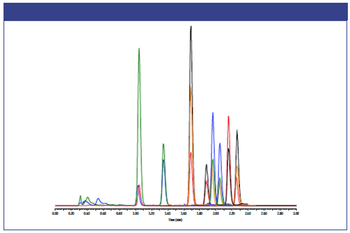
Abuse of synthetic opioid prescription painkillers such as fentanyl, along with a rapidly growing list of illicit analogues, is a significant public health problem. In this study, we developed a simple dilute-and-shoot method that provides a fast 3.5-min analysis of fentanyl and related compounds (norfentanyl, acetyl fentanyl, alfentanil, butyryl fentanyl, carfentanil, remifentanil, and sufentanil) in human urine by LC–MS/MS using a Raptor Biphenyl column.

The Application Notebook
Phospholipids (PLs) are the major components of cellular membranes. They are important for the functionality of membrane proteins or serve as precursors for second messengers. Several studies reveal the role of PL alterations in various diseases such as cancer (1). Therefore, it is crucial to identify and quantify PLs in complex biological samples for lipidomic studies and clinical research.

The Application Notebook
Abuse of synthetic opioid prescription painkillers such as fentanyl, along with a rapidly growing list of illicit analogues, is a significant public health problem. In this study, we developed a simple dilute-and-shoot method that provides a fast 3.5-min analysis of fentanyl and related compounds (norfentanyl, acetyl fentanyl, alfentanil, butyryl fentanyl, carfentanil, remifentanil, and sufentanil) in human urine by LC–MS/MS using a Raptor Biphenyl column.

The Application Notebook
This study describes the monitoring of potentially harmful volatile organic compounds (VOCs) emitted from respiratory medical devices, by pumped sampling and thermal desorption–gas chromatography–mass spectrometry (TD–GC–MS) analysis in accordance with ISO 18562 part 3. Emissions from two sets of face-mask supply tubing and three nasal cannulas were compared, and all were found to emit VOCs at levels that may give cause for concern.

The Application Notebook
Methods for monitoring alcohol consumption biomarkers EtG and EtS are generally limited by poor retention and coelution with matrix interferences, as well as by long analysis times and short column lifetimes. The dilute-and-shoot EtG/EtS LC–MS/MS analysis developed here using the novel Raptor EtG/EtS column easily resolves EtG and EtS from matrix interferences, providing consistent, accurate results for high-throughput labs testing human urine samples for alcohol consumption.

Special Issues
This article describes a workflow using nontargeted liquid chromatography–tandem mass spectrometry (LC–MS/MS) for reliable compound identification.

The Application Notebook

The Application Notebook

The Application Notebook

The Application Notebook
The Application Notebook

The Application Notebook


Special Issues
High resolution mass spectrometry with nano-LC is used for protein identification and quantification in both top-down and bottom-up proteome analysis. Reliable instrumentation in combination with ultrapure mobile phases is essential for data integrity. Premixed 80% acetonitrile with 0.1% formic acid (LS122-500) and water with 0.1% formic acid (LS118-500) were designed to produce a consistent chromatographic performance using this instrument system. In this study, these mobile phases were used extensively to evaluate several factors which can affect separation of protein digests such as peak retention, peak repeatability, and sample carryover. Our results demonstrated excellent chromatographic performance using Thermo Scientific EASY-nLC 1200 LC system and Thermo Scientific LTQLX ™ ion trap mass spectrometer with the specialized premixed mobile phases.

The Application Notebook