

The Application Notebook
This article describes the use of combined ion chromatography-mass spectrometry (IC–MS) and ion chromatography-inductively coupled plasma mass spectrometry (IC-ICP–MS) to analyze potentially harmful compounds.
The Application Notebook
This article describes the use of combined ion chromatography-mass spectrometry (IC–MS) and ion chromatography-inductively coupled plasma mass spectrometry (IC-ICP–MS) to analyze potentially harmful compounds.

The Application Notebook
Morphine is an effective pain-relieving drug that is primarily metabolized into morphine-3-glucuronide (M3G) and morphine-6-glucuronide (M6G). The highly potent M6G may have adverse effects, such as respiratory depression and renal failure, if accumulated in the body. As morphine abuse continues to affect modern society, an effective method must be established to analyse morphine and its structurally related compounds in biological fluid samples. In this work, a UPLC–MS-MS method was developed to separate six morphine-related compounds on a 2.1 Ã- 100 mm, 1.8 μm ACQUITY UPLC HSS T3 column in a single run using an ACQUITY UPLC system connected to a fast-scanning triple-quadrupole MS detector (TQD). The method achieved adequate retention of these very polar compounds by reversed-phase (RP) chromatography in an 8-min total run time.

The Application Notebook
Since September 2008, 294 000 infants and young children suffered urinary problems as a result of the contamination of melamine in infant milk powder and were hospitalized. This hospitalization was required to treat the symptoms caused by the ingestion of melamine contaminated infant formula and related dairy products. Previously in 2007, pet food, animal feed wheat gluten and other protein-based foods were found to contain residues of melamine and its degradation product cyanuric acid.

The Application Notebook
Forensic laboratories face a daunting task to identify trace amounts of controlled substances in small samples of seized evidence. Unambiguous identification is required to meet the stiff challenge that is sure to be raised in the courtroom. Positive proof is especially difficult to establish if the controlled substance is hidden in a complex food matrix with a high content of sugars, fats, fatty acids, proteins and alkaloids.

The Application Notebook
Penicillins are regulated substances in food for human consumption. The minimum residue limits range from 1 ng/g to as high as 50 ng/g depending on the compound. Because of the complexity of food matrices measuring the level of contaminants requires a total solution composed of sample extraction, sample clean-up, chromatographic separation and detection. In this paper, a solid-phase extraction method with a high performance liquid chromatography tandem mass spectrometry method (HPLC–MS–MS) is shown for the simultaneous determination of six antibiotic residues.
The Application Notebook
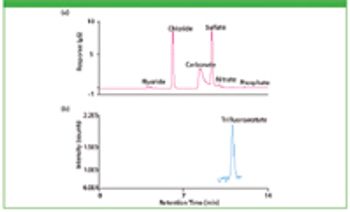
Perflourinated organic acids are ubiquitous and found at relatively low concentrations in the environment (1). Trifluoroacetic acid (TFA) is the persistent atmospheric degradation product of hydrofluorocarbons (HFCs) that are increasingly used as an alternative to banned, ozone-damaging chlorofluorocarbons (CFCs). However, debate surrounds the use of HFCs because of their potential to contribute to global warming and demonstrated toxicity to the environment (2). TFA is also widely used in pharmaceutical and biotechnology purification processes. It is crucial to monitor for TFA in environmental risk assessment and in products intended for human use. TFA can be measured by gas chromatography (GC) after sample preparation and chemical derivatization (3), ion chromatography (IC) (4), and capillary electrophoresis (5). This paper describes an IC-MS method to separate TFA from common anions based on Reagent-Freeâ„¢ IC (RFICâ„¢) technology with sensitive and selective mass spectrometric detection.

The Application Notebook
Gel Permeation Chromatography (GPC) is widely used for sample clean up in mycotoxin analysis. The most commonly described methods use GPC columns packed with SX-3 BioBeads suitable for cleaning Zearalenone, Aflatoxins, and Trichothesenes from edible oils and fatty matrices. Separation of Fumonisins from the oil fraction are inadequate with this column.

The Application Notebook
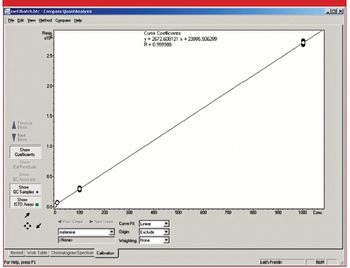
Melamine is an organic base and a trimer of cyanamide, with a 1,3,5-triazine skeleton. Melamine can react with formaldehyde to produce melamine resin, a very durable thermosetting plastic, and melamine foam, a polymeric cleaning product. Some end products made from melamine include countertops, dry erase boards, fabrics, glues, housewares, and flame retardants. Melamine is also one of the major components in Pigment Yellow 150, a colorant in inks and plastics.

The Application Notebook
Forensic laboratories face a daunting task to identify trace amounts of controlled substances in small samples of seized evidence. Unambiguous identification is required to meet the stiff challenge that is sure to be raised in the courtroom. Positive proof is especially difficult to establish if the controlled substance is hidden in a complex food matrix with a high content of sugars, fats, fatty acids, proteins, and alkaloids.

The Application Notebook
LC–MS-MS instruments operating in Multiple Reaction Monitoring (MRM) are widely used for targeted quantitation on triple quadrupole and hybrid triple quadrupole linear ion trap (QTRAP® ) systems because of their well known selectivity and sensitivity. In MRM mode, the first quadrupole (Q1) filters a specific precursor ion; the collision cell (Q2) generates fragments (product ions) which are filtered in the third quadrupole (Q3). Although this double mass filtering greatly reduces noise there is always a chance that elevated background levels or matrix signals interfere with the targeted analyte.
The Application Notebook
Since September 2008, 294,000 infants and young children suffered urinary problems due to the contamination of melamine in infant milk powder and were hospitalized. This hospitalization was required to treat the symptoms caused by the ingestion of melamine contaminated infant formula and related dairy products. Previously in 2007, pet food, animal feed, wheat gluten, and other protein-based foods were found to contain residues of melamine and its degradation product cyanuric acid (2).

The Application Notebook
The analysis of chemical residues in food requires techniques sensitive enough to detect and quantify contaminants at or below the maximum residue limit (MRL) of the compound in a given sample matrix. Because of increased food safety regulations and the growing numbers of samples to be analyzed, it is critical that the analytical techniques provide high sample throughput.
The Application Notebook
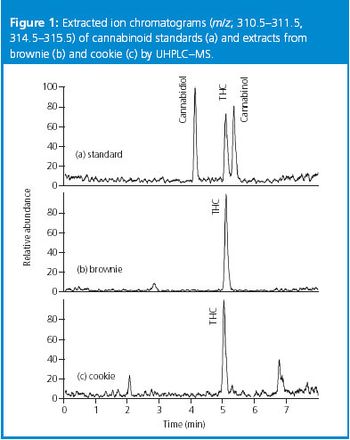
Goal: Positively identify trace amounts of cannabinoids in a complex food matrix quickly, with minimal sample preparation and no chemical derivatization.

The Application Notebook
A highly sensitive analytical method for the analysis of tamsulosin in human plasma has been developed for use in bioanalytical studies. The solid-phase extraction (SPE) and UPLC–MS–MS methodologies are described, as well as performance against validation parameters.
The Application Notebook
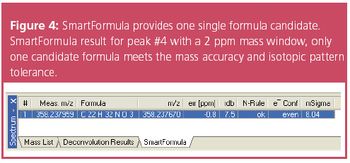
An ultrafast gradient LC separation method was developed to separate a 5-component drug mixture in 30 seconds, with peak widths of 1 second. maXis mass accuracy at sub-ppm levels and true isotopic pattern of the spectra from the peaks lead to a confident elemental formula assignment for each drug compound with the SmartFormula algorithm.
The Application Notebook
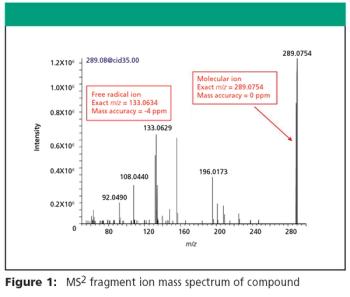
Studies of odd-electron CID behaviors reveal that free radical fragmentation is structure-dependent and is directly correlated with the functional groups that stabilize the newly-formed free radicals.

The Application Notebook
In March 2007, several North American manufacturers of pet food voluntarily issued nationwide recall notices for some of their products that were reportedly associated with renal failure in pets. The raw material wheat gluten, used to manufacture the pet food, was imported from China and was identified as the source of contamination.

The Application Notebook
The analysis of anions and cations is critical during drug development and related QC. Measure both the API and the counterion in a single run.

The Application Notebook
Organic acids are present in many matrices and play crucial roles. Extensive research involving low molecular mass organic acids (LMMOA) has been performed in food chemistry since these acids contribute to the organoleptic properties of food and beverages, including flavor, color, aroma, taste, shelf-life, and health effects. Developing a profiling method to monitor LMMOA levels in raw materials and final products is very desirable. Many reported methods focus on limited numbers of LMMOAs and are incapable of providing a complete LMMOA profile.
The Application Notebook
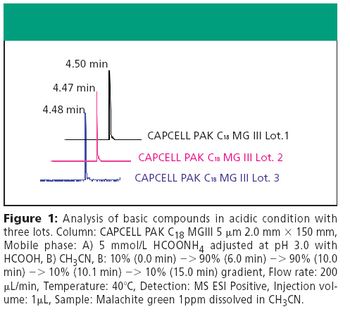
The SHISEIDO CAPCELL PAK C18 MGIII is an HPLC column packed with a silicone polymer-coated phase, providing excellent peak profiles for basic compounds under acidic conditions, and generating ultimately minimized column bleeding in LC–MS.

The Application Notebook
The analysis of polar compounds in support of clinical and preclinical pharmacokinetic studies requires an analytical methodology capable of achieving ultra-low detection and quantification limits. The high sensitivity afforded by coupling HPLC with tandem mass spectrometry (MS–MS) has made it the technique of choice in this environment, but it is subject to the following limitations when reversed-phase liquid chromatography (RPLC) is used

The Application Notebook
An effective UHPLC–MS method for high throughput separation, identification and quantification of pseudoephedrine was developed on a Hypersil GOLD PFP 1.9 µm, 2.1 Ã- 100 mm column.

The Application Notebook
Several common birth control formulations contain both drospirenone and ethinyl estradiol. A highly selective and sensitive analytical method for the analysis of drospirenone in human plasma has been developed for use in bioequivalence studies. The solid-phase extraction (SPE) and UPLC–MS–MS methodologies are described as well as performance against validation parameters.
The Application Notebook
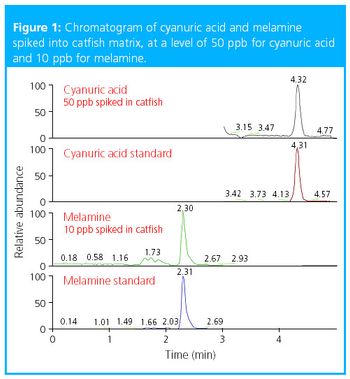
In March 2007, several North American manufacturers of pet food voluntarily issued nationwide recall notices for some of their products that were reportedly associated with renal failure in pets. The raw material wheat gluten, used to manufacture the pet food, was imported from China and was identified as the source of contamination.

The Application Notebook
This application note describes a fast and sensitive LC–MS method using a Hypersil GOLD column on a Thermo Scientific LC–MS system for the quantitative analysis of two widespread PFCs, perfluorooctanoic acid (PFOA) and perfluorooctansulphonate (PFOS).

The Application Notebook
Mercury pollution mainly originates from industrial activities such as chlorine production, garbage incineration and above all coal-fueled power generation. The US Environmental Protection Agency (US EPA) considers mercury as highly toxic with a pronounced accumulative and persistent character.
The Application Notebook
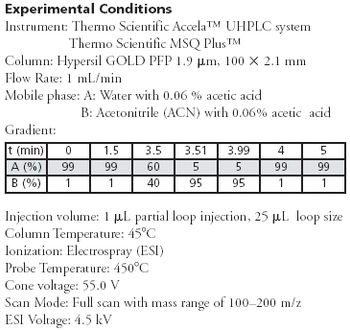
An effective UHPLC-MS method for high throughput separation, identification and quantitation of pseudoephedrine was developed on a Hypersil GOLD™ PFP 1.9 µm, 2.1 x 100 mm column.

The Application Notebook
Two of the most commonly occurring unpleasant odor-causing compounds in drinking water are geosmin and 2-methylisoborneol (MIB) (Figure 1). Geosmin is produced primarily by blue-green algae (cyanobacteria) and actinomycete bacteria, and MIB is produced by certain species of cyanobacteria, primarily Oscillatoria. Many environmental laboratories are required to detect these compounds as low as 1–3 ppt concentration and measure quantitatively at 5 ppt.

The Application Notebook
The United States Geological Survey (USGS) has found pharmaceuticals and personal-care products (PPCPs) containing known or suspected endocrine-disruptors in U.S. rivers. As such, it is important to use adequate techniques to help identify these compounds and possible metabolites.

The Application Notebook
Mycotoxins, toxic secondary metabolites of several fungal species, represent food safety issues of high concern. Deoxynivalenol, the most abundant trichothecene mycotoxin, can be found worldwide as a contaminant of wheat, barley, maize and other cereals (1,2). The transmission of deoxynivalenol from barley into beer has been reported in several studies (3,4). Therefore, its levels should be controlled.