Application Notes: LC-MS


The analysis of polar compounds in support of clinical and pre-clinical pharmacokinetic studies requires an analytical methodology capable of achieving ultra-low detection and quantification limits. The high sensitivity afforded by coupling HPLC with tandem mass spectrometry (MS–MS) has made it the technique of choice in this environment, but it is subject to the following limitations when reversed phase liquid chromatography (RPLC) is used


Multidimensional liquid chromatography (MDLC) techniques are essential for the separation of highly complex proteomic samples. Advantages of off-line MDLC techniques over on-line approaches include high flexibility in choice of column dimensions and mobile-phase compositions, and the ability to reanalyse sample fractions. Here we present a fully automated off-line two-dimensional chromatographic approach for the analysis of proteomic samples using an UltiMate 3000 system optimized for proteomics MDLC.

This article describes a fully automated online solid-phase extraction–liquid chromatography–tandem mass spectrometry (SPE–LC–MS-MS) setup using a mass spectrometer and an electrospray ionization probe for analyzing different groups of polar contaminants in natural waters. The goal was to develop an online SPE method for the quantification of sulfonamide antibiotics, including their acetyl metabolites, as well as for frequently used pesticides (triketones, phenylureas, chloracetanilides, phenoxyacetic acids, amides, and triazines) in ambient waters. The analytical methods were applied successfully for a field study in an agricultural region within the catchment area of Lake Greifensee near Zurich, Switzerland.

Drug discovery scientists are continually striving to improve productivity and efficiency in their workflows. From early discovery to clinical development, existing workflow bottlenecks represent an opportunity to develop solutions to speed the process and improve productivity. The key requirements for quantitative analysis are precision, accuracy, and linear dynamic range. With any quantitative instrument, the hope is that it will be applicable to a vast range of coumpounds, ruggest, and fast. New mass spectrometry (MS) technologies are being developed that meet these criteria and permit high throughput while enabling its application to areas in which speed limitations previously curtailed its practicality. In particular, in the area of ADME profiling, new MS platforms are becoming available that increase the throughput by at least 25-fold, by combining the speed of matrix-assisted laser desorption ionization (MALDI) with the specificity of triple-quadrupole MS. This is bound to greatly accelerate the ADME..

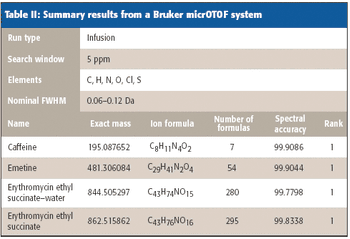
Mass spectrometry has become a fundamental tool for compound identification or confirmation by virtue of its ability to obtain elemental composition determination (formula identification) by accurate mass measurements. The speed, sensitivity, and ease of interfacing the technique with gas chromatography and liquid chromatography make it the technique of choice for many applications. However, accurate mass measurements must be made with care, and sometimes they can require careful calibration procedures and validation methods. In addition to accurate mass measurements, the isotope abundance distribution also provides information unique to a given chemical formula. However, the mass spectral accuracy required for accurate isotope modeling has not been easy to obtain previously. More recent approaches (1–3) that calibrate the spectral line-shape show promise in obtaining the necessary level of spectral accuracy but still require careful calibration methods with the use of known standards. This article..

This application note describes an LC–MS–MS method for on-line sample preparation and concentration of drinking water samples prior to analysis using a triple quadrupole with full scan Q3 confirmation.

One problem frequently encountered in LC–MS is the appearance of mass peaks, which appear totally unrelated to the samples run - "ghost" mass peaks. It is impossible to differentiate whether these signals come from an unknown component in the sample co-eluting with a known peak, or from an impurity in the mobile phase or from some residual contamination "bleeding" from the column.

Preliminary studies of biodiesel samples by a high speed LC–MS system using electrospray ionization and a patented cone-wash feature demonstrate that LC–MS reduces the analysis time to 20 minutes and reveals information about higher molecular weight compounds in biodiesel while still detecting many low molecular weight chemicals, including FAMEs, at high sensitivity.

The use of 30 mm UPLC columns coupled with Oasis SPE in µElution format was investigated to increase the speed of quantitative bioanalytical methods while maintaining sensitivity and resolution of closely related analytes.

AC Analytical Controls developed a new chromatographic solution that complies with all ASTM & EN chromatographic test methods listed in biodiesel specifications: the AC all-in-one Biodiesel analyser. Analysis results demonstrate that the AC analyser complies with EN 14103, EN 14105, EN 14106, EN 14110 & ASTM D6584 methods.

TN012 Sulfanilamides from Honey using strata-X-C phenomenex

LC–MS–MS methods for the unambiguous identification and quantification of pesticides in complex matrix samples are well known and widely used. Triple quadrupole systems have proven useful for this task because of their high specificity in MS–MS mode and their low detection limits. However, working in targetted MS–MS mode prevents the detection of other compounds.

The continual increase in sample numbers in busy labs means that it is often difficult for quality control or contract analysis labs to maintain short turnaround times, particularly when instruments are already running at full capacity. To address the need for faster analysis while retaining the quality of separation offered by dedicated amino acid analysers, an improved formulation of sodium citrate based buffers has been developed by Biochrom.

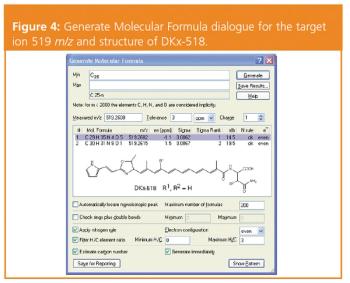
The exploration of myxobacterial metabolite profiles by LC–MS screening for the presence of new natural products is described. Extracts from fermentations of Myxococcus strains are analysed by UPLC-coupled ESI-TOF mass spectrometry and the obtained data are processed using principal component analysis (PCA). The generation of molecular formulae from accurate mass measurements facilitates rapid compound identification.

Soft drink formulas often include preservatives, artificial sweeteners, flavours or caffeine in their list of ingredients. Using the Acclaim OA column, as many as eight common additives may be determined in a single run. Many of these additives are hydrophilic organic acids for which this column was designed. Notably, benzoate and sorbate, which do not resolve on C18 columns at low pH, are fully separated.

Accurate mass measurements are a key element of chemical characterization. However, the accepted mass accuracy tolerance of 3–5 ppm can still leave significant ambiguity in the proposed chemical formula. Consequently a further input from other analytical techniques such as NMR or MS/MS, along with some judgment based on the synthetic history is often required to arrive at a confident formula assignment.

Glyphosate [N-(phosphonomethyl) glycine] is a broad spectrum, non-selective herbicide, which acts by inhibiting the shikimic acid pathway in plants. Recent studies have raised global health and environmental concerns about glyphosate's use.1 Glyphosate readily breaks down into aminomethyl phosphonic acid (AMPA) in the environment; requiring accurate measurement. Both highly polar compounds present an analytical challenge to the chromatographer (Figure 1). Typical silica based reversed-phase C18 columns experience difficulty with the retention of such polar compounds, and may generate non-resolved co-eluting peaks, often with polar analytes eluting in the void volume. Traditional analytical methods require complex eluents and time consuming derivatization steps to achieve retention on a reversed-phase support.

Column lifetime is a more and more important issue when developing an analytical method for HPLC. Besides sample treatment, column cleaning and storage, operational parameters of the analytical method will have an influence on column lifetime. This question may not always be addressed early enough in the methods development process.

(3R, 3’R)-zeaxanthin is one of several dietary carotenoids found in human ocular tissue. Research has shown that concentrations of zeaxanthin, as well as other carotenoids, are significantly lower than normal in the macula of persons diagnosed with neovascular age-related macular degeneration (AMD)...

Protease inhibitors are a class of anti-HIV drugs used in combination therapy to block replication of the HIV virus in a person's blood. It is important to monitor the levels of these drugs in the patient since resistance can develop at low levels and at high levels the drug can exhibit toxic effects.

Mini application notes summaries

Maltodextrin is an easily digested carbohydrate made from corn starch...

VENTURE A affinity columns utilize ICEtechTM surface passivation technology...

Mini application note summaries...

Polymeric monolithic stationary phases offer an alternative to the classical microparticulate sorbents...

State-of-the art two-dimensional (2-D) nano LC coupled to mass spectrometry (MS) provides a powerful analytical tool...

As new directives and legislation intended to regulate both the herbal medicine and nutraceutical industry are imminent...