

Sponsored Content - NA
Zebron gas management filter selection chart by the GC instrument and the fitting size
Sponsored Content - NA
Zebron gas management filter selection chart by the GC instrument and the fitting size
Sponsored Content - EU
Zebron gas management filter selection chart by the GC instrument and the fitting size
Sponsored Content - NA
Dual GC poster that includes gas management selection chart and GC column selection chart
Sponsored Content - EU
Zebron gas management filters and click-on GC traps remove contaminants from mobile-phase gases, reduce column bleed, increase column life, protect GC detectors.
Sponsored Content - EU
Zebron click-on trap step-by-step installation instruction
Sponsored Content - EU
Zebron gas filter step-by-step installation instruction
Sponsored Content - NA
Zebron electronic indicator technical information and installation steps
Sponsored Content - EU
Zebron LC–MS gas filter step-by-step installation instruction
Sponsored Content - EU
Zebron electronic indicator technical information and installation steps
Sponsored Content - NA
Zebron click-on trap step-by-step installation instruction
Sponsored Content - EU
Zebron Electronic Indicator technical information and installation steps
Sponsored Content - EU
Zebron electronic indicator technical information and installation steps
Sponsored Content - NA
Zebron gas filter step-by-step installation instruction
Sponsored Content - NA
Zebron electronic indicator technical information and installation steps
Sponsored Content - NA
Zebron Electronic Indicator technical information and installation steps
Sponsored Content - NA
Zebron LC–MS gas filter step-by-step installation instruction
Sponsored Content - EU
Solvent-reduced determination of 100 contaminants from low double-digit to low triple-digit pg/L in 100 mL surface water samples, meeting the requirements of the EU-WFD based on SBSE-TD-GC-MS/MS
Sponsored Content - EU
Quantifies affinity, stoichiometry of biomolecular assemblies, helping understand the mechanism of interaction and develop therapeutics that target and modulate them.
Sponsored Content - NA
Quantifies affinity, stoichiometry of biomolecular assemblies, helping understand the mechanism of interaction and develop therapeutics that target and modulate them.

Special Issues
A rapid, accurate, and reproducible method was developed for high-throughput testing of nicotine, cotinine, trans-3’-hydroxycotinine, nornicotine, norcotinine, and anabasine in urine. Data show that a fast and highly efficient analysis of these basic compounds can be achieved with the Raptor Biphenyl column using standard reversed-phase LC–MS mobile phases that are compatible with a variety of LC–MS instrumentation.

The Application Notebook
The term ionic liquid refers to organic salts with relatively low melting points (below 100 °C) that usually consist of an organic cation or anion and a counterion, in either organic or inorganic form. Ionic liquids exhibit unique characteristics such as extremely low vapour pressure, excellent thermal stability, electrical conductivity, a high degree of polarity and miscibility with various types of solvents. Ionic liquids have been used as catalysts and solvents in organic chemistry and electrochemistry and as mobile phase modifiers or functionalized stationary phases in separation science.1–3

The Application Notebook
Catecholamines are important markers for the diagnosis and management of tumour diseases of the sympathoadrenal system. The major catecholamines are dopamine, norepinephrine and epinephrine. Urine tests have shown to be applicable to measure the level of catecholamines in the human body. Various separation methods have been used for the clean-up of catecholamines in biological fluids: solvent extraction, adsorption on alumina, ion-exchange and solid-phase extraction of a diphenylboronic acid-catecholamine complex. From the point of simplicity, reproducibility and automation the last method is the most suitable and can be realized by on-line SPE–LC. Diphenylborate forms a negatively charged complex with the diol groups of catecholamines. These complexes which are strongly retained on a polystyrene-divinylbenzene cartridge in alkaline medium (pH 8.5) can be eluted in a second step from the SPE unit directly onto the HPLC column. The separation of catecholamines is performed in isocratic mode by..
The Application Notebook
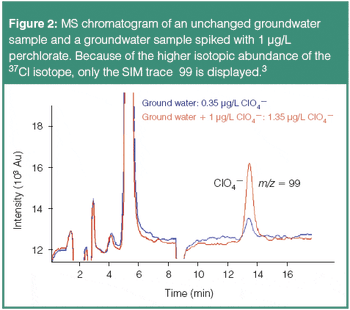
This article describes the use of combined ion chromatography-mass spectrometry (IC–MS) and ion chromatography-inductively coupled plasma mass spectrometry (IC-ICP–MS) to analyse potentially harmful compounds.

The Application Notebook
Zhe Yin, Kenneth J. Fountain, Erin E. Chambers and Diane M. Diehl, Waters Corporation, Milford, Massachusetts, USA.

The Application Notebook
Based on the QuEChERS AOAC Official Method 2007.01, 16 pesticides were used for evaluating the performance of the Agilent's AOAC buffered extraction and SampliQ QuEChERS dispersive SPE kits for general fruits and vegetables.

The Application Notebook
Tobacco specific nitrosamines (TSNA) are a group of carcinogens found only in tobacco products and are formed from nicotine and related alkaloids during the production and processing of tobacco and tobacco products.

The Application Notebook
The screening of pesticides, mycotoxins, and veterinary drugs is of great importance in regulated environments such as food or feed analysis. Due to some of the limitations of traditional triple quadrupole approaches (for example, targeted analyte detection, limited number of compounds, and unidentified unknown compounds), there is currently a trend towards use of full-scan MS data for the analysis of residue samples. Current screening approaches mainly rely on the use of ToF instruments coupled to U-HPLC delivering mass accuracy (~5 ppm) at a maximum resolution of <15,000. This can produce inaccurate mass measurements due the presence of unresolved background matrix interferences. In this work we show a full-scan MS screening approach with the Thermo Scientific Exactive mass spectrometer, a novel single-stage Orbitrapâ„¢ MS capable of providing precise mass accuracies at resolutions of up to 100,000 without the need for internal mass calibration.

The Application Notebook
Melamine is an organic base and a trimer of cyanamide, with a 1,3,5-triazine skeleton. Melamine can react with formaldehyde to produce melamine resin, a very durable thermosetting plastic, and melamine foam, a polymeric cleaning product. Some end products made from melamine include countertops, dry erase boards, fabrics, glues, housewares, and flame retardants. Melamine is also one of the major components in Pigment Yellow 150, a colorant in inks and plastics.
The Application Notebook
Based on the QuEChERS AOAC Official Method 2007.01, sixteen pesticides were used for evaluating the performance of the Agilent's AOAC Buffered Extraction and SampliQ QuEChERS Dispersive SPE kits for General Fruits and Vegetables. Apple was selected as the fruit matrix. The pesticides are from the "representative pesticides" list (1). A method working well for these representative pesticides should work equally well for the other pesticides that are routinely monitored in multi-class, multi-residue methods. The compounds are from nine different pesticide classes: including acidic, basic, neutral, base-sensitive, and acid-labile pesticides. The selected pesticides are suitable for LC–MS-MS analysis. The MRLs of these pesticides have been set at 10 ng/g or higher (2–4).

The Application Notebook
Tobacco Specific Nitrosamines (TSNA) are a group of carcinogens found only in tobacco products and are formed from nicotine and related alkaloids during the production and processing of tobacco and tobacco products (1). Due to their carcinogenic properties, efforts have been made to reduce TSNA levels in tobacco products. The project goal was to demonstrate a high throughput and sensitive method to monitor TSNA levels.